


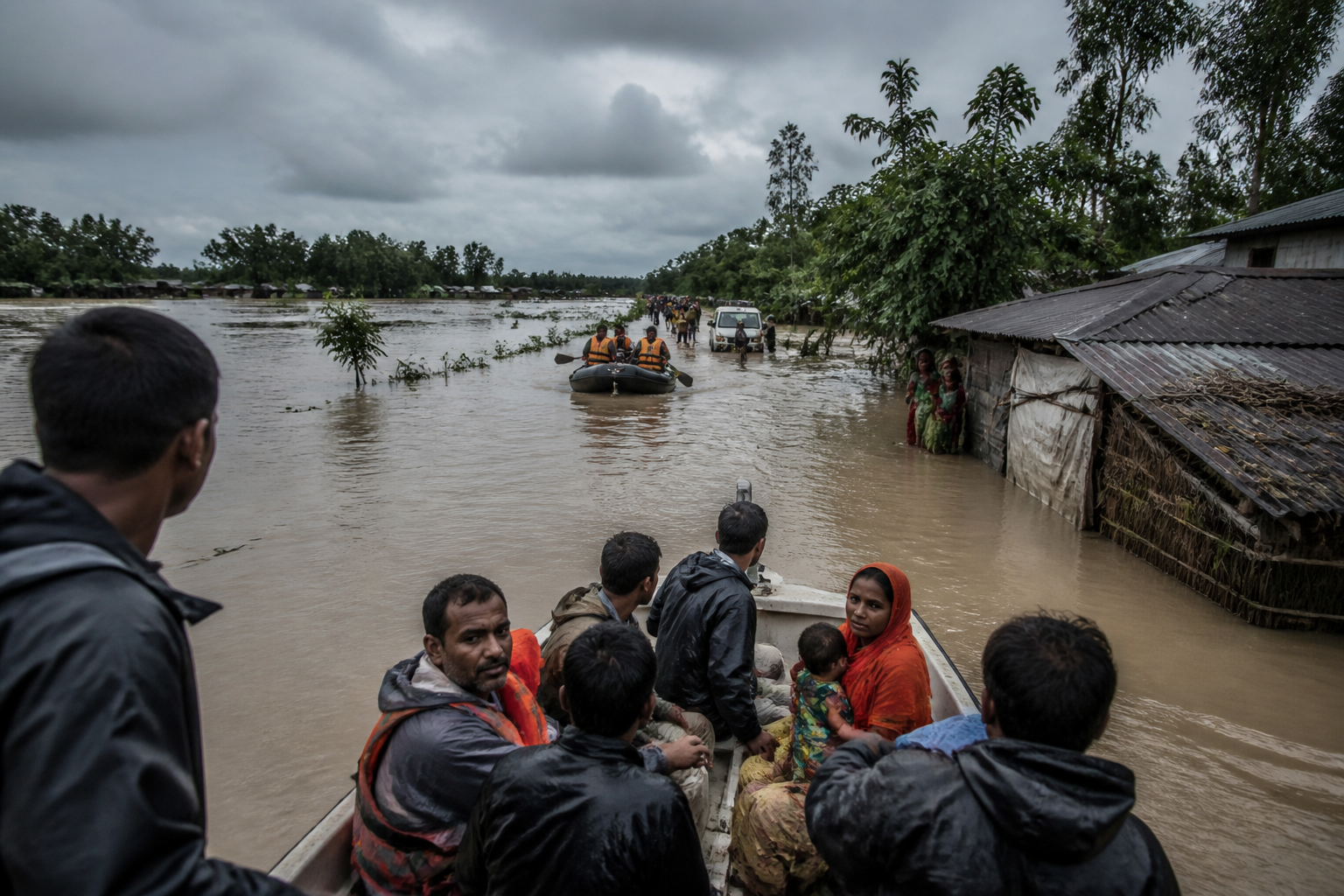
Malda’s river erosion crisis has intensified as the Ganga and Fulahar rivers are reported to be only about 500 metres apart, while paramilitary personnel have joined rescue operations in the flood-affected Bhutni Char area of Manikchak block. District authorities are running warning announcements, distributing relief and keeping a boat ambulance ready as water remains in the area.
Bhutni Char is described as the worst-affected part of Malda in the current Ganga flooding. The water has not fully receded and there has been no significant improvement in conditions, according to a report by Sangbad Pratidin. People still living in their homes are receiving dry food, while cooked meals are being distributed daily at relief camps. Medical services are also being provided.
Residents have faced difficulties travelling because government boats have not been available in sufficient numbers, the report said. Some people are using tin boats, while others are paying from their own pockets to travel. The district administration has deployed paramilitary forces for rescue work and visited the bridge area on Thursday to assess the situation, with the district magistrate and other officials taking part in the inspection.
The proximity of the rivers has raised wider concerns over the safety of settlements in Malda. Khagen Murmu, the Member of Parliament from Malda North, said that the Mahanandatola and Bilaimari gram panchayats were at risk of being swallowed by the river. The area also contains a branch of the Kosi river. According to Murmu, if the Ganga, Fulahar and the branch channel were to merge, large parts of the Kahala and Debipur gram panchayats in Ratua-I block could be lost to the river.
Water levels in the Ganga and Fulahar had fallen considerably on Thursday, but the report said the scale of erosion this year was being viewed by the state as more severe than in the previous two years. Several political claims about earlier flood-control spending and responsibility for the current situation were also reported, but those allegations were not independently established in the source material.
Minister of State for Irrigation Juel Murmu said that a budget allocation of Rs 3,600 crore had been made this year for erosion-control work, with most of the funds expected to be spent in Malda. He said funding alone would not be sufficient and that Bihar and Jharkhand would need to be involved in discussions on the Ganga’s flow. A meeting of the chief ministers of the three states was described as necessary for a broader resolution.
The minister also referred to a proposal to construct a canal at Sakrigali in Bihar to divide the flow of the Ganga into two channels. The report said the state was awaiting a specialist team from IIT Kanpur, which is expected to examine the situation and prepare an estimate before dredging work is undertaken in the Ganga.
For residents of Bhutni and vulnerable settlements in Ratua-I, the immediate priorities remain rescue access, relief supplies, medical support and safe movement. The next formal steps identified in the report are the IIT Kanpur assessment, preparation of an estimate and subsequent decisions on dredging and inter-state river-management measures.
