


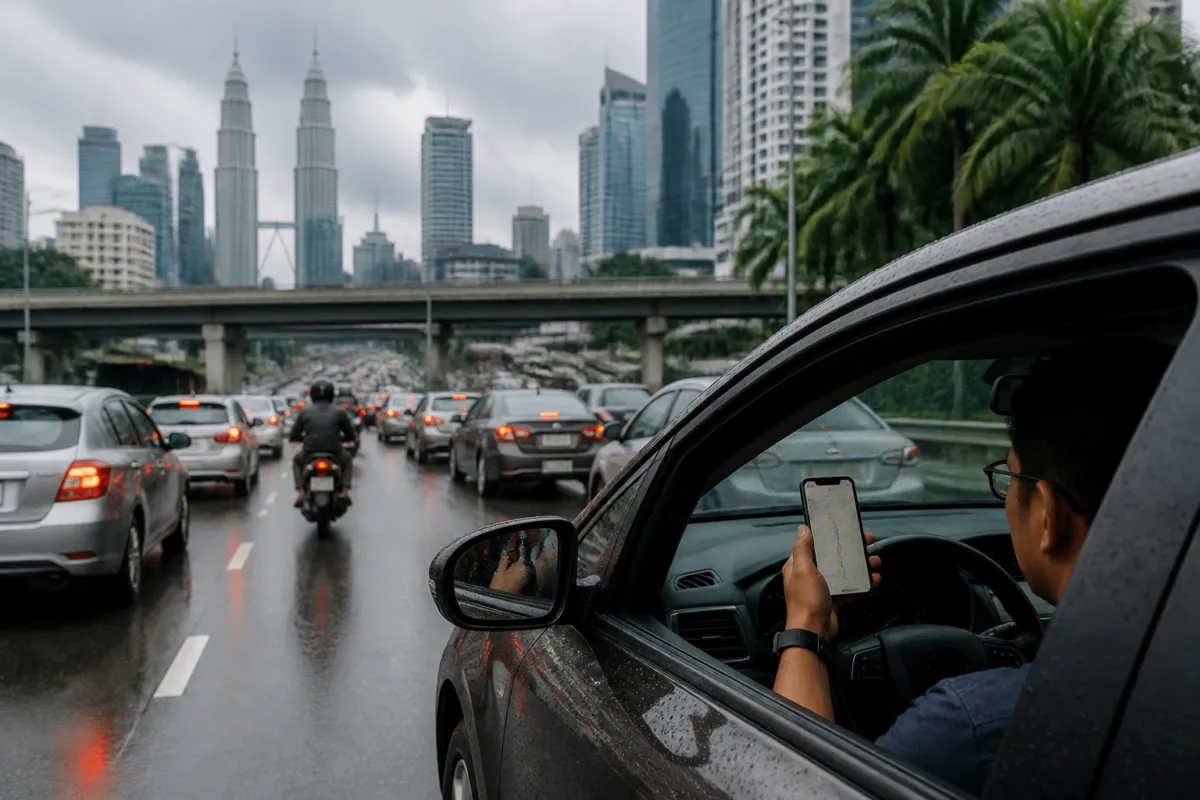
Malaysia has barred civil servants from using Waze for official duties and may impose wider restrictions on the navigation app, Prime Minister Anwar Ibrahim said, putting a widely used digital mobility tool at the centre of a national security and data-governance dispute.
Anwar said the government could consider a complete ban once viable alternatives are available. He said the restrictions were intended to protect government information and citizens’ personal data from possible misuse by the Israeli government, citing Waze’s origins in Israel.
“I apologise if the decision to ban this navigation application, which belongs to the Israeli regime, causes inconvenience to the public,” Anwar said in Facebook posts on Friday. “However, the security of the nation and its people cannot be compromised, as we must uphold national sovereignty and protect the personal information of our citizens.”
The partial ban currently applies to civil servants using Waze for official duties. Anwar’s comments indicate that the government has not ruled out extending the restrictions, although he linked any complete ban to the availability of reliable alternatives for drivers.
Waze rejected the claims about its handling of sensitive information. According to Agence France-Presse, which cited a company spokesperson, the suggestion that Waze collects sensitive government information or allows any entity to exploit personal user data is “completely false”. The company said it operates under strict privacy policies and global data-protection standards.
Founded and based in Israel, Waze was acquired by Google in 2013. The app is widely used by Malaysian drivers for real-time, crowdsourced information on traffic congestion, accidents, speed traps and alternative routes. Its dependence on user-generated updates means that a sudden shift away from the platform could affect how quickly motorists receive information about changing road conditions.
Anwar has encouraged Malaysians to use TuJu, a locally developed navigation app operated by the Malaysian Highway Authority. However, users have criticised TuJu over unreliable directions, limited real-time traffic information and technical glitches. The authority apologised for disruptions after a sudden increase in users and said it expected to restore stable navigation services within two weeks.
The episode highlights the operational challenge of replacing a mature navigation platform with a local service at short notice. For drivers, the immediate issue is not only which app is permitted, but whether the replacement can provide dependable routing and live traffic information across the road network.
Anwar said the controversy among users was mainly about the reliability of alternatives to Waze rather than opposition to the government’s decision itself. The Malaysian Highway Authority’s planned restoration of stable TuJu services is the next stated milestone as authorities assess whether a broader restriction on Waze is feasible.

