


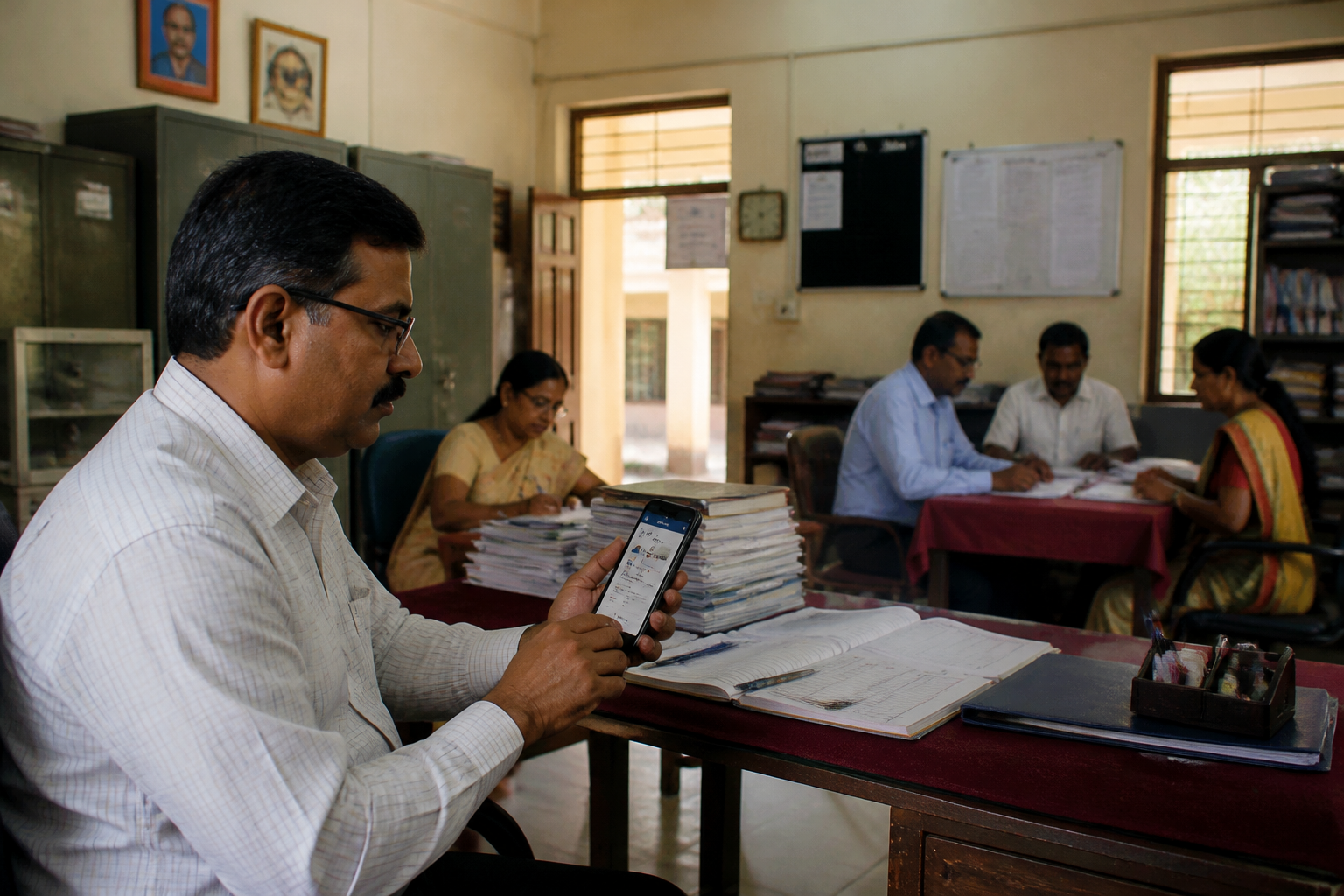
Maharashtra will make online attendance mandatory for teachers in all schools from Classes 1 to 12 starting October 15, with headmasters responsible for recording daily attendance through the state’s Smart Attendance system. The directive applies to schools across all mediums and management categories, according to instructions issued by Education Commissioner Sachindra Pratap Singh.
The system is being introduced through the state’s Vidya Samiksha Kendra, which is responsible for monitoring attendance, assessment, accreditation, administration, adaptive learning and artificial intelligence-related activities under a framework developed by the National Vidya Samiksha Kendra. Online attendance for students has already begun, and the current academic year will see teacher attendance added to the digital monitoring process.
Headmasters will be required to record the attendance of teachers from Classes 1 to 12. In their absence, the responsibility will pass to the acting headmaster. For schools registered on the Shalarth portal, headmasters must use the school’s U-DISE code, their own Shalarth ID and the mobile number registered on the portal while entering attendance through the Swift Chat application.
If a headmaster’s mobile number has changed, it must first be updated on the Shalarth portal. Schools that are not registered on Shalarth will have to use the 10-digit National Teacher Code recorded on the U-DISE+ portal and the mobile number registered there. The instructions cover schools operated by all managements and across all mediums.
Headmasters and acting headmasters who cannot see the teacher list in the attendance application have been asked to update their status on the Shalarth or U-DISE+ portals. The teacher list is expected to become visible within the following days after the portal information is updated.
The department has also specified attendance windows according to school schedules. Schools operating in two shifts must record attendance between 7 am and noon. Other schools must complete the process between 10 am and 5 pm, while night schools will be permitted to record attendance until 9 pm.
The system places the immediate administrative responsibility on school heads, but monitoring will take place at multiple levels. Deputy education officers for primary education, officers working under Samagra Shiksha and equivalent officials at the municipal corporation level will act as district nodal officers for the Vidya Samiksha Kendra. Programmers working under Samagra Shiksha will assist them with the process.
Divisional deputy directors of education, primary and secondary education officers, and district nodal officers will review whether teacher attendance is being recorded regularly. The directive therefore links daily school-level data entry with a wider departmental review structure, making digital attendance both an administrative task and a monitoring mechanism for the education system.

