


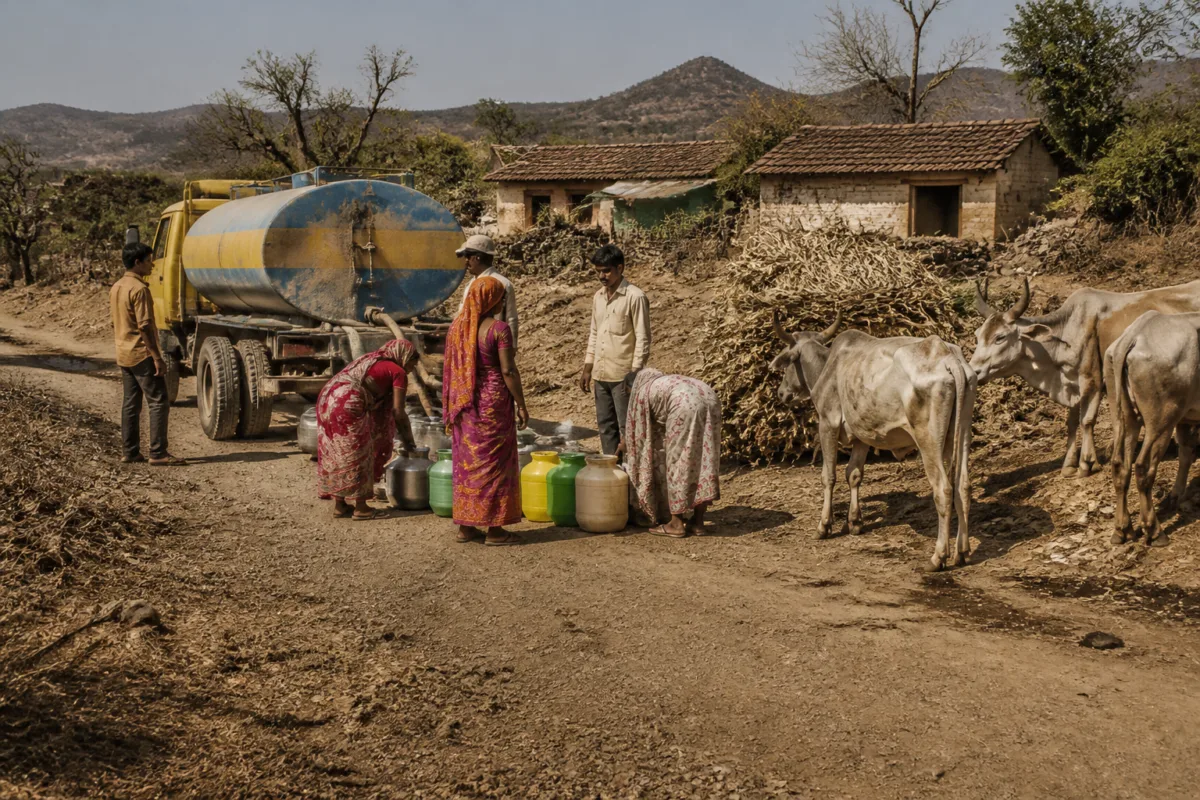
Maharashtra has empowered district collectors to procure and cultivate fodder, restore stalled rural drinking-water schemes and coordinate drought relief as conditions worsen across 304 talukas in the state. The measures were approved at a meeting of the state cabinet subcommittee on drought mitigation chaired by Revenue Minister Chandrashekhar Bawankule on Tuesday.
The state government said the decisions are intended to address drinking-water shortages, protect livestock and reduce financial distress among farmers. Under a new standard operating procedure, dry fodder will be supplied at ₹12 per kg and green fodder at ₹8 per kg. A five-member committee headed by each district collector will oversee procurement, local cultivation and the movement of fodder from districts with surplus supplies.
Fodder cultivation will be supported on available land belonging to the forest, revenue and water resources departments, using funds from district planning committees, or DPCs. Surplus fodder from Sindhudurg and Ratnagiri will be diverted to drought-hit districts, according to the measures announced after the meeting.
The government has also authorised DPC funding to restart rural drinking-water schemes where water is available but supply has stopped because of unpaid electricity bills or the absence of a new power connection. The administration expects restoring these schemes to reduce dependence on water tankers and improve access to potable water in villages.
The decision places district collectors at the centre of the response, combining procurement, land coordination, water-scheme restoration and local monitoring within the district administration. The announcement does not specify the total funds being released through DPCs or the number of schemes that will be revived under the measure.
The subcommittee also clarified the eligibility rules for a ₹5,000 assistance payment to farmers scheduled before Diwali. Income taxpayers, government officers and employees, and elected representatives will be excluded. The state said the eligibility conditions would be applied along the lines used for farm loan waivers.
Additional measures focus on water storage and agricultural productivity. The government will provide a subsidy of ₹31 per cubic metre for removing silt from lakes and dams, and ₹35 per cubic metre for transporting and spreading the material on farmland. Royalty will be waived on soil, murum and gravel taken from lakes for road construction.
The meeting also addressed reports of aggressive recovery practices by microfinance and private finance companies during the drought. Following an incident in Nanded, Chief Minister Devendra Fadnavis directed that police cases be registered directly against company officials and recovery agents accused of subjecting farmers to mental harassment.
The list of drought-affected areas may expand. Haveli, Maval and Mulshi talukas in Pune district, Hatkanangale in Kolhapur district and parts of Konkan have sought drought classification. The subcommittee is expected to decide on their inclusion at its next meeting on Tuesday after receiving field reports from district collectors.

