


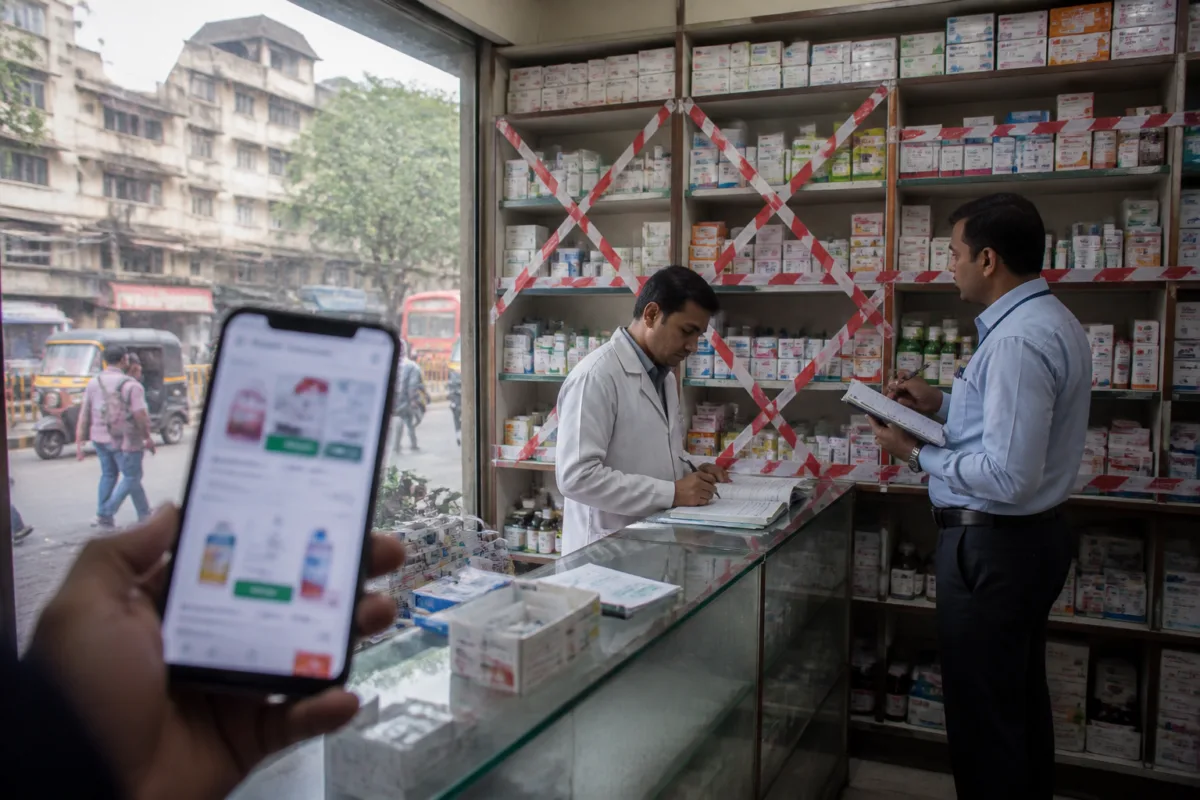
Maharashtra’s intensified Food and Drug Administration crackdown has sharply increased inspections, licence suspensions and arrests, but it has also exposed a regulatory question that traditional pharmacists say remains unresolved: whether the same standards are being applied to physical chemists and online pharmacies. The issue goes beyond a dispute between retailers and a regulator. It concerns how medicine safety is enforced when drug distribution moves between a shop that can be inspected in person and a digital platform whose transactions, prescriptions and fulfilment networks are less visible to citizens.
According to a report by Navbharat Times, pharmacists led by chemist associations have objected to the action taken under FDA Commissioner Tukaram Mundhe. Their allegation is not that physical pharmacies should be exempt from the rules. Instead, they argue that traditional retailers face immediate and severe action for violations while online medicine sellers are not being subjected to comparable scrutiny. The report does not include a response from the FDA addressing these specific allegations.
The dispute has emerged alongside an enforcement campaign that the report describes as unusually extensive. Mundhe assumed charge as Maharashtra FDA commissioner on 25 May 2026. During the department’s first 100 days under his leadership, public complaints reportedly rose by 557 per cent and formal inspections increased by 378 per cent compared with the quarterly average of the previous financial year. The figures indicate a substantial expansion in enforcement activity, although the report does not establish whether the rise in complaints reflects more violations, improved reporting, greater public awareness or a combination of these factors.
The FDA’s stated enforcement focus, as described in the report, covers both food safety and drug regulation. In the food sector, the department carried out 12,083 inspections, conducted 904 raids, made 457 arrests and sealed 322 establishments. It also suspended 603 food licences and seized or destroyed adulterated, synthetic or counterfeit products worth Rs 34.7 crore. A separate operation resulted in the seizure of banned gutka and pan masala valued at Rs 19.62 crore. The establishments affected included quick-commerce dark stores and major restaurant chains, suggesting that the regulatory campaign is not limited to small neighbourhood businesses.
The pharmaceutical side of the campaign provides the more direct context for the pharmacists’ complaint. Between June and September 2026, the FDA conducted 4,256 drug-related inspections involving pharmacies and manufacturing units. The report says the monthly average of these inspections increased 4.6 times. The department suspended 856 licences, cancelled 288 licences, registered 33 first information reports and made 14 arrests. It also seized illegal, incorrectly labelled or substandard medicines and cosmetic products valued at Rs 19.11 crore.
The reported violations included dispensing medicines in the absence of a registered pharmacist, inadequate inventory maintenance and the sale of medicines without a valid doctor’s prescription. For physical pharmacies, the presence of a qualified pharmacist is a basic operational requirement under the enforcement approach described in the report. If an inspection finds that the pharmacist is absent, the shop can face suspension or cancellation of its licence. Retailers can also face action for cutting medicine strips and selling partial quantities, supplying restricted or controlled medicines without the required prescription, or registering the same pharmacist at multiple locations.
These requirements create a clear chain of accountability in a conventional shop. The premises are identifiable, the licence is linked to a physical address, stock can be inspected and the pharmacist is expected to be present at the point of sale. The concerns raised by chemist associations are about whether an equivalent chain exists in online transactions. They allege that some e-pharmacies distribute medicines without a verified or valid prescription and that restricted or potentially addictive medicines, along with medical-abortion pills, can be obtained without adequate controls. These are allegations made by pharmacists and are not independently established in the supplied report.
The regulatory challenge is therefore not simply about choosing between offline and online retail. It is about whether enforcement follows the medicine through the entire transaction: from prescription verification and order placement to storage, dispensing, delivery and record-keeping. A physical inspection can identify a missing pharmacist or poorly maintained inventory at a shop. An online transaction may involve a platform, a seller, a warehouse, a delivery partner and a digital prescription process. The report does not provide details of how Maharashtra FDA currently monitors each of these stages.
That absence of detail is important because the reported enforcement numbers show a highly visible expansion of action against identifiable premises. A rise to 4,256 drug-related inspections, 856 licence suspensions and 288 cancellations demonstrates regulatory intensity. It does not, by itself, show whether the enforcement system is achieving parity across different channels of distribution. Nor does it reveal how many inspections involved online sellers, how many digital platforms were examined, or what penalties were imposed for violations originating in online orders.
This distinction also matters for interpreting the increase in complaints and inspections. The 557 per cent rise in public complaints and 378 per cent rise in formal investigations point to a department receiving or generating far more enforcement activity than before. But aggregate activity cannot answer whether consumers are safer unless the data is separated by product category, violation, location, type of seller and outcome. Without that breakdown, the public can see the scale of the campaign but not its distribution across the market.
The report presents the pharmacists’ complaint as a question of regulatory consistency. Traditional chemists argue that they are being held to strict standards while larger digital companies are escaping equivalent scrutiny. Their concern is also linked to commercial pressure: a physical pharmacy must maintain licensed premises, employ or retain a registered pharmacist and comply with inspection requirements, while customers increasingly encounter medicine sellers through digital interfaces. The supplied material does not quantify the economic effect on chemists or establish the relative market share of online pharmacies in Maharashtra.
For the FDA, the institutional problem is one of jurisdiction and visibility as much as enforcement capacity. The department’s reported campaign covers pharmacies and manufacturing units, but the source does not specify how responsibility is divided when an online platform lists medicines supplied by another licensed entity. It also does not explain whether inspections are directed at the platform, the seller, the warehouse or all three. Those unanswered questions are central to the allegation of double standards because comparable rules can produce unequal outcomes if the regulator cannot identify the responsible party at each stage.
The figures released in the report show a department using conventional enforcement tools at scale: inspections, raids, licence suspensions, cancellations, FIRs, arrests and seizures. Those tools are consequential because they can remove products and businesses from the market. However, the online medicine question requires enforcement information that is not included in the report, such as the number of digital sellers reviewed, prescription-related violations detected online, blocked listings, platform notices and action against repeat offenders. Without these figures, it is not possible to determine whether the alleged gap is real, how large it is or whether the FDA has already begun addressing it.
The wider urban issue is the governance of essential services as they become platform-based. Medicines are not merely consumer goods. Their safe distribution depends on professional oversight, traceability and a reliable prescription system. When access is organised through neighbourhood shops, responsibility is relatively visible to the customer and the regulator. When the same access is mediated through apps, warehouses and delivery networks, the system becomes more convenient but potentially more fragmented. The report’s central question is whether regulation has adapted at the same pace as distribution.
What the available evidence confirms is that Maharashtra FDA enforcement intensified significantly after Mundhe took charge, with large numbers of inspections, suspensions, cancellations, arrests and seizures reported across food and pharmaceutical regulation. It also confirms that chemist associations have alleged unequal treatment between physical pharmacies and e-pharmacies. What remains unestablished is the FDA’s response to those allegations, the extent of online enforcement and whether digital sellers have faced comparable action for prescription, licensing or distribution violations. Those are the next facts required to assess whether Maharashtra’s crackdown is creating a uniform medicine-safety regime or reinforcing a divide between the visible street-level pharmacy and the less visible digital marketplace.

