


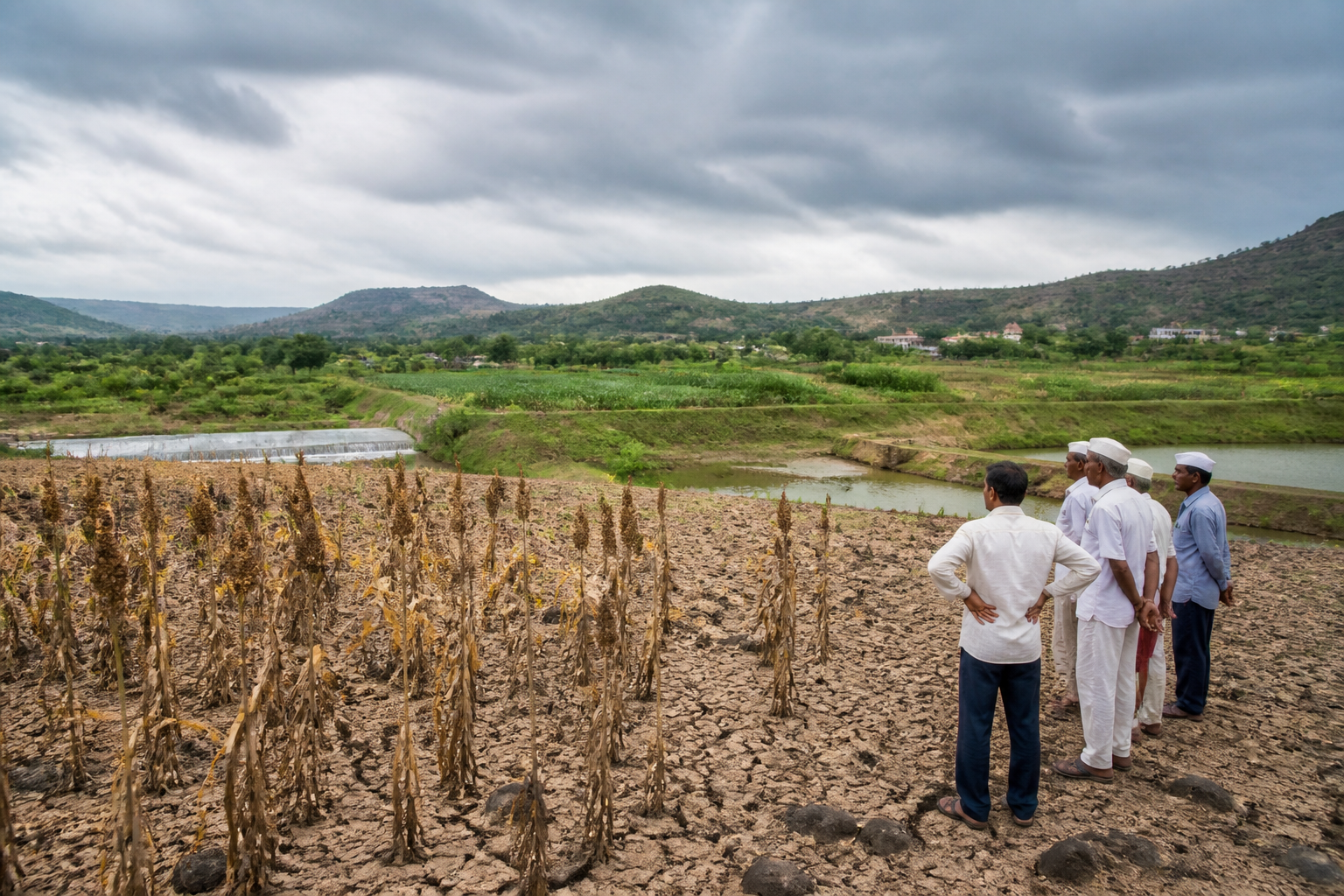
Maharashtra’s drought has destroyed crops, emptied wells and deepened farmers’ debt across Ahilyanagar district, but Ralegan Siddhi in Parner taluka presents a sharply different picture. The village has also received very little rain this monsoon, yet its check dams, nala bunds, farm ponds and percolation tanks have helped retain water and recharge groundwater. The contrast shows that drought severity is shaped not only by rainfall, but also by what villages do with the water they receive.
The difference is visible within a few kilometres of one another. In Punawadi, farmer Macchindra Borude lost a bajra crop on which he had invested Rs 15,000. In Parner village, Balasaheb Awati said his 18 acres of soyabean, onion, tur, maize and bajra had been destroyed after wells 70 to 80 feet deep ran dry. He had borrowed Rs 10 lakh and now faces repayment with little or no income from the season’s harvest. Another farmer, Vilas Borude, used a rotavator to destroy standing bajra because the crop had stopped growing after receiving only about half an hour of rain over two months.
These are not isolated farm failures. Parner is one of 14 talukas declared drought-hit in Ahilyanagar district, where all 131 villages have been affected by a prolonged dry spell and rainfall deficit. The Maharashtra government has declared drought in 265 of the state’s 358 tehsils after the state recorded an 18 per cent rainfall deficit this year. In Ahilyanagar, officials cited a 30 to 35 per cent deficit and an extended dry spell of nearly 51 days. They said the Kharif crop had been damaged on a large scale and that even surviving crops had little chance of producing a good yield.
The rainfall pattern helps explain why sowing and harvesting diverged so sharply. The district recorded a rainfall deficit of nearly 39 per cent in June, but some areas received good rainfall in July. That encouraged farmers to sow cotton, soyabean, bajra, maize, black gram, green gram, pigeon pea, paddy and finger millet. August then brought a 73 per cent deficit. September, normally the district’s wettest month with average rainfall of 147 mm, produced only 32.7 mm, according to officials cited by The Indian Express.
This sequence is important because agricultural damage does not begin only when the government declares drought. A good spell at the start of the season can create the confidence and financial commitment to sow. When later rainfall fails, farmers are left with input costs, standing crops that cannot mature and debt that cannot be serviced. In Parner, that cycle has been compounded by uncertainty over compensation. Farmers told The Indian Express that the government had made similar assurances after last year’s wet drought, but payments had not yet reached them.
Ralegan Siddhi’s experience offers a practical explanation for why the same rainfall deficit does not produce the same immediate outcome everywhere. The watershed conservation model associated with social activist Anna Hazare has been developed since the 1970s. Its infrastructure includes check dams, nala bunds, farm ponds and percolation tanks designed to slow runoff, store rainwater and allow water to percolate into the ground. The objective is not to create rainfall, but to extend the usefulness of the rainfall that arrives.
The village’s current water position is therefore the result of accumulated local infrastructure rather than a favourable monsoon. Farmers told The Indian Express that fields remained green, standing crops survived and percolation tanks were filled. Ashok Awati, a 40-year-old farmer, said farm ponds and percolation tanks had adequate water and that borewells were still supplying water. He also cautioned that the position was not secure: the village had received rain for only three days this monsoon, and the duration for which borewell water would last remained uncertain.
That caution prevents Ralegan Siddhi from being treated as a simple drought success story. Its water reserves have created a buffer, not immunity. Sarpanch Jaysing Mapari said the check dams and nala bunds had helped save rainwater and recharge the groundwater table, while Hazare warned that conditions could worsen in the coming months. The village’s advantage is that it entered the dry period with stored water and a more replenished groundwater system. The wider question is whether that buffer can be maintained through a longer dry spell.
The comparison with the rest of Ahilyanagar also reveals the administrative timing problem in drought management. By the time crops fail, wells dry and governments announce relief, the most important opportunity for reducing damage may already have passed. Hazare argued that measures should begin in anticipation of drought, with catchment areas identified, check dams built and groundwater recharge treated as a continuing task. His emphasis was on an integrated approach rather than a response limited to compensation after crop loss.
This places water conservation between two different kinds of public action. Compensation addresses the immediate financial consequences of crop failure. Watershed infrastructure addresses the physical conditions that determine how much water remains available after rainfall stops. Farmers in Parner need the first because they have already lost crops and face debt. Ralegan Siddhi demonstrates the value of the second because stored and recharged water has preserved some agricultural capacity despite the same broad regional weather pattern.
The institutional challenge is that these functions do not necessarily sit within one decision. Drought declaration, crop assessment, compensation and agricultural support involve government departments and administrative tiers, while the construction and maintenance of local water structures depend on village-level planning, land conditions and collective participation. The evidence supplied in the report does not establish how these systems are coordinated across Maharashtra. It does, however, show the cost of a gap between rainfall failure, groundwater depletion and the delivery of relief.
The numbers from Ahilyanagar make the water-management problem concrete. A 30 to 35 per cent district rainfall deficit, a 51-day dry spell, a 73 per cent deficit in August and only 32.7 mm of rain in September have translated into destroyed crops and depleted wells. The state-level figure of 265 drought-hit tehsils indicates that the problem extends far beyond one taluka. Yet the experience of Ralegan Siddhi shows that the impact of those numbers is mediated by storage, recharge and local preparedness.
The village’s history reinforces that point. Baban Awati, now 73, recalled leaving Ralegan Siddhi during the 1972 drought to work in Gujarat. Other villagers also migrated to sustain their families. The present difference between Ralegan Siddhi and surrounding villages is therefore not a permanent geographic advantage. It reflects a long period in which local water infrastructure changed the village’s capacity to withstand dry conditions.
For Maharashtra’s drought policy, the central lesson is not that one village can be copied without modification. It is that rainfall data alone cannot describe drought resilience. Two villages may receive similarly poor rain but experience different levels of crop loss depending on catchment treatment, groundwater recharge, storage capacity and the timing of local action. The supplied evidence does not show whether Ralegan Siddhi’s model can be reproduced across all 265 drought-hit tehsils, but it establishes why such questions matter.
What is confirmed is a sharp regional crisis: farmers in Parner have lost Kharif crops, wells have run dry, debt burdens are rising and compensation remains uncertain. What is also visible is a contrasting local system in Ralegan Siddhi, where decades of watershed work have provided water reserves despite a weak monsoon. The developments to watch are the release of promised compensation, the condition of surviving crops, the persistence of the dry spell and whether drought management moves from post-failure relief towards sustained catchment and groundwater planning.
