


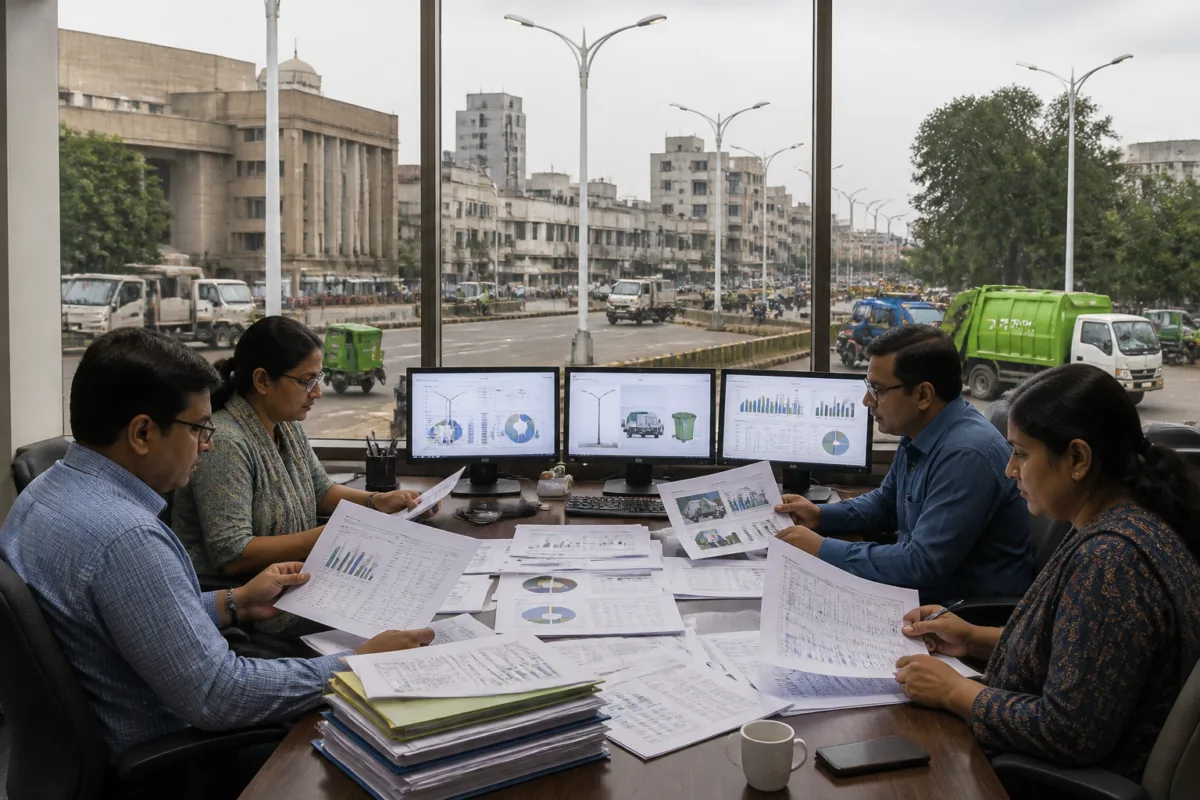
The Madhya Pradesh Lokayukta’s decision to examine alleged irregularities in urban local-body purchases worth nearly Rs 1,134 crore has turned a government procurement presentation into a wider test of how municipalities spend public money. The immediate trigger was a leaked video showing extreme price variations for identical or comparable goods, but the underlying issue is larger: whether the state’s 374 urban local bodies have the systems needed to plan, compare, monitor and justify procurement.
The presentation, made at an April meeting by Urban Administration and Development Department additional chief secretary Sanjay Dubey, analysed purchases made over three years. It covered goods ranging from garbage vehicles and streetlights to octagonal poles and disinfectants. The analysis was intended to make municipal officials more vigilant, according to an IAS officer cited in the report. Its public circulation has now been followed by a Lokayukta probe, with Special Police Establishment director general Yogesh Deshmukh saying the concerned department would be contacted for reports.
That sequence matters because municipal procurement is not a peripheral administrative activity. It determines the equipment available for waste collection, the quality and coverage of street lighting, the cost of sanitation and the pace at which local bodies can execute basic services. When the same item is purchased at sharply different prices, the financial effect is not limited to an accounting discrepancy. It can reduce the number of vehicles, lights or sanitation supplies that a municipality can afford within its available budget.
The presentation cited a particularly wide gap in disinfectant prices. One civic body recorded a purchase at Rs 5 a litre, while another recorded Rs 33,500 for the same product. The report does not establish the reasons for each difference, such as specifications, packaging, quantities, delivery conditions or contract terms. But the scale of the variation was sufficient for the state analysis to flag it for scrutiny.
Similar questions were raised over garbage vehicles. One urban local body bought a vehicle for Rs 2 lakh, while another paid Rs 6 lakh for the same vehicle with four additional dustbins. Dubey alleged that some officials had effectively added dustbins while pocketing the difference. That allegation remains part of the material being examined and should not be treated as a finding until the investigation establishes the facts.
The presentation also questioned purchases of garbage vehicles costing Rs 1.5 crore each by municipalities that allegedly did not have enough wards to justify their deployment. This points to a second procurement problem beyond price: whether a purchase responds to a documented service requirement. A low price for an unnecessary asset can still represent waste, while a higher price for a properly specified and fully used asset may require a different assessment. Procurement oversight therefore has to examine both value and need.
Government e-Marketplace data provided another indication of the potential scale. A 60-watt LED light was purchased by one civic body for Rs 306, while an order in Bhopal recorded a price of Rs 11,800 per light in a transaction worth Rs 3.78 lakh. The presentation said the median price was around Rs 4,000 and described the Bhopal rate as an extreme outlier. According to the analysis, the state could have saved Rs 250 crore on GeM purchases alone by buying closer to average market prices rather than the lowest available rates.
The purchases examined included Rs 65 crore in garbage tipper dumpers, Rs 49 crore in streetlights, Rs 27 crore in octagonal poles and Rs 18 crore in disinfectants. About 1,200 vendors were involved. These figures show that the concern is not tied to one product or one transaction. It spans equipment categories with different technical specifications, levels of municipal demand and operational uses.
The geographical pattern also raises questions about the relationship between municipal size and purchasing capacity. Jabalpur was identified as the largest purchasing urban local body, with procurement worth Rs 66 crore, while the Jabalpur division accounted for Rs 202 crore. Barodiya Kala, which made purchases worth Rs 29.29 crore, was flagged for buying octagonal poles worth Rs 97 lakh. An official questioned whether the municipality had enough physical space to install the number of poles it purchased.
The issue is not only that smaller municipalities may lack procurement expertise. Fragmented buying can also weaken the ability of the state to compare prices and detect unusual transactions. If several municipalities purchase similar products separately, suppliers may face different specifications, quantities and delivery requirements. But those differences should be visible in the records. A system that brings the data together can identify outliers for review before payment or deployment, rather than after a presentation exposes them.
The presentation’s reference to a supplier operating under two entity names illustrates the importance of matching vendors across records. A supplier identified as Labor Industry was associated with purchases worth Rs 38 crore under one name and Rs 12 crore under another. The two entities executed 201 contracts across 21 municipalities, while Barodiya Kala reportedly issued orders worth Rs 11 crore under one name and Rs 8 crore to Rs 9 crore under the other. Khurai in Sagar district and Mandsaur were also cited.
The supplied report does not establish whether the two names represented the same legal entity, related businesses, legitimate changes in registration or an attempt to divide procurement. That is precisely the type of question that requires documentary examination of ownership, tax identifiers, registrations, bank details, tender documents and contract performance. The central governance challenge is to ensure that procurement databases can connect those records even when supplier names vary slightly.
Officials said an artificial intelligence-based system could identify identical products entered under different names or spellings, including disinfectants and phenyl. The same approach could be extended to e-tenders and newspaper quotations. Used properly, such a system would not replace an investigation or determine wrongdoing by itself. It would function as an early-warning layer, directing human officials towards unusual prices, repeated suppliers, clustered contracts and purchases that do not match a municipality’s size or stated needs.
That distinction is important for public administration. A price anomaly is a signal, not proof of corruption. It may reflect a different specification, an emergency purchase, transport costs, installation, warranty obligations or a data-entry error. However, without a common data structure and a defined review process, officials may not know which anomalies require immediate action. The Lokayukta probe now places the focus on whether the state can move from identifying irregular patterns to establishing responsibility through records and procedure.
The procurement findings were accompanied by a separate cyber-security warning. UADD commissioner Sanket Bhondwe told officials that around 2,500 email IDs and passwords belonging to ULB users had been found on the dark web and that malware was active on affected computers. He attributed the infections to practices including the use of torrents on official systems and warned that the Digital Personal Data Protection Act could impose penalties of up to Rs 250 crore, including on government bodies.
The cyber warning broadens the institutional concern. Municipal procurement increasingly depends on digital accounts, tender platforms, email communications and electronic records. If passwords are exposed or computers are compromised, the risk is not limited to personal data. It can affect tender confidentiality, payment records, vendor communication and the integrity of the audit trail. Procurement transparency therefore depends on both financial controls and basic digital security.
The case also reveals how responsibility is distributed. Urban local bodies make purchases, departments oversee them, GeM provides a procurement platform, vendors supply the goods and investigative agencies examine suspected irregularities. Each layer can possess only part of the information. The state-level presentation attempted to consolidate those fragments across 374 ULBs, creating a view that individual municipalities may not have had on their own.
The evidence currently confirms that the state identified large price variations, unusual purchasing patterns and cyber-security vulnerabilities, and that the Lokayukta has begun seeking departmental reports. It does not yet establish the legality of every flagged contract, the reasons for individual price differences or whether the supplier names represent one entity or two. Those questions will depend on tender files, specifications, invoices, delivery records, vendor documents and municipal requirements.
The next stage will therefore determine whether the presentation becomes a one-time warning or the foundation for a permanent procurement-monitoring system. The material already shows the value of comparing municipal purchases across the state. The probe will show whether Madhya Pradesh can convert those comparisons into verified findings, recoverable savings and stronger safeguards for the public services that urban residents depend on.

