


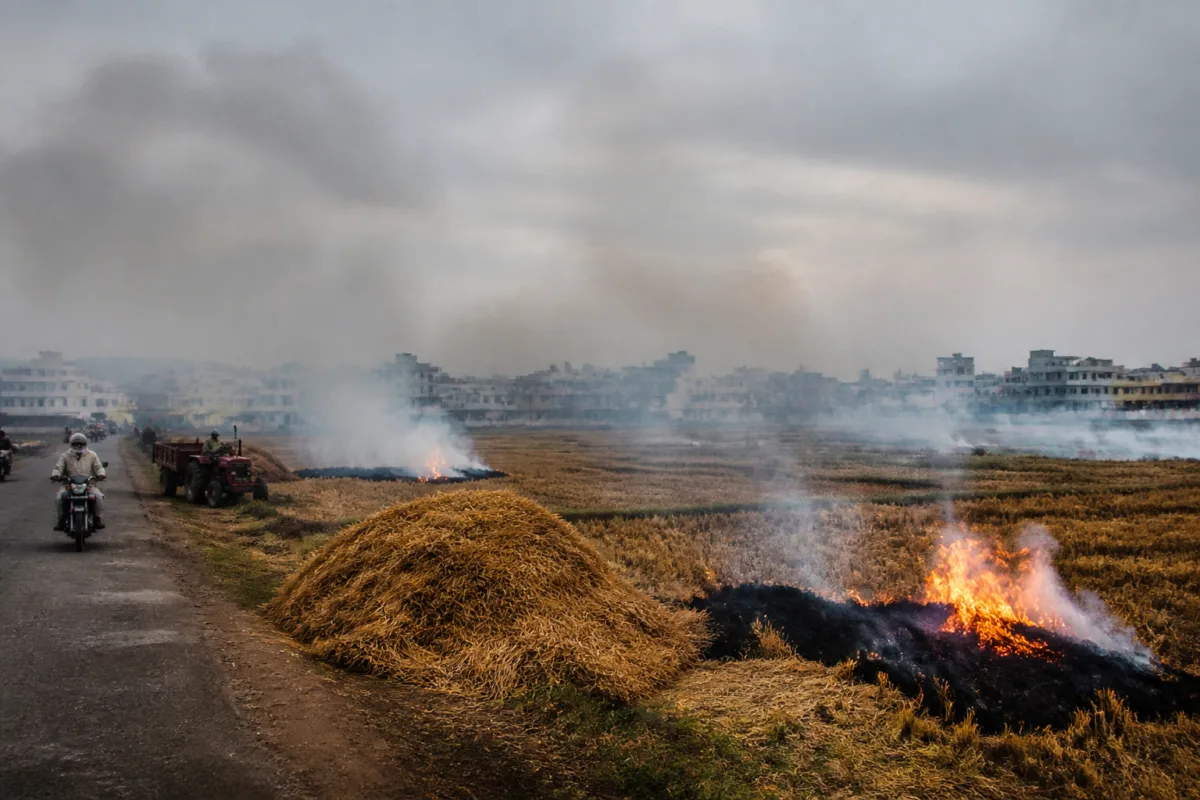
Madhya Pradesh’s stubble-burning season is again exposing the distance between detecting a farm fire and stopping it. Satellite data cited in a Times of India report recorded 708 crop-burning incidents in the state between September 15 and November 3, 2026, including 94 on November 3 alone. The figures place Madhya Pradesh third among seven states monitored in the latest count, behind Punjab and Rajasthan, even though the state has a ban on crop-residue burning and penalties intended to deter violations.
The immediate image is familiar: harvested paddy fields, residue left behind after threshing and farmers setting fire to the piles. The deeper administrative problem is less visible. Madhya Pradesh has a system that can identify many fires through satellite heat sensors, but the evidence supplied in the report indicates that detection is not the same as enforcement. Information moves from satellites to a pollution-control emergency centre and then to district collectors. What happens after that depends on local administrative action.
That gap matters because crop-residue burning is not confined to the field where it begins. The report describes smoke spreading across homes and corridors and contributing to hazardous air. In Bhopal’s outskirts, the fires were observed around fields near 11 Mile Road. Similar incidents were reported across the state. The urban consequence is therefore shaped by a rural practice, but it is experienced through the city’s air, neighbourhoods and transport corridors.
The current episode also shows why headline counts alone do not adequately describe the enforcement challenge. Madhya Pradesh’s 708 incidents since September 15 were marginally lower than the previous count cited in the report, when the state had recorded the highest number among the monitored states. That reduction does not establish that the state’s enforcement system is working effectively. It only indicates that the number of detected incidents had fallen from an earlier level while fires continued despite the legal prohibition.
The figures come from the Indian Agricultural Research Institute’s latest report, based on live satellite feeds tracking farm fires. On November 3, Madhya Pradesh recorded 94 incidents, compared with 584 in Punjab and 100 in Rajasthan. Across the period beginning September 15, Punjab recorded 2,196 incidents and Rajasthan 838, while Madhya Pradesh recorded 708. These comparisons place the state below the two leading contributors in the latest data, but they also show that the practice remains widespread enough to be a recurring air-quality concern.
The numbers have a second significance. Satellite monitoring provides a common layer of visibility across large and difficult-to-supervise areas. A fire can be detected without an officer being present at the field. That makes remote sensing valuable for identifying patterns and directing field administration. But the data does not, by itself, establish who set the fire, whether the residue was burned intentionally, whether a penalty was imposed, or whether an alternative disposal method was available to the farmer.
The enforcement chain described by the report begins with the Emergency Response Centre of the Madhya Pradesh Pollution Control Board. Pracheer Dixit, who works with the centre, said its primary responsibility is to collate data from NASA and ISRO satellites that detect stubble fires through heat sensors. The centre then sends the information to district collectors. According to Dixit, the collectors are responsible for taking cognisance of the data and initiating necessary steps.
This division of responsibility is central to understanding the problem. The pollution-control authority can assemble and transmit evidence, but it is not presented as the agency directly enforcing the ban in the fields. District administration becomes the operational link between a satellite alert and a possible inspection, identification of a violator, penalty or other action. If any part of that chain is slow, unclear or weakly documented, the existence of high-quality detection data may have little practical effect.
The report does not provide a state-wide account of how many alerts led to field inspections, how many farmers were identified, how many penalties were imposed, or whether benefits were withdrawn. Without those measures, it is not possible to assess the enforcement rate or determine whether the penalties are changing behaviour. The absence of such figures is itself important for public accountability: incident counts show the scale of the problem, but enforcement records would show the performance of the response system.
The state law, as described in the report, seeks to raise the cost of residue burning through severe financial penalties, strict oversight and the withdrawal of benefits. Such provisions make the legal framework appear stronger than a simple advisory. Yet a prohibition is effective only when residents believe that violations will be detected, investigated and acted upon. The continued fires reported from fields around Bhopal and elsewhere suggest that the existence of a ban has not removed the implementation challenge.
That challenge is partly institutional. Satellite information is centralised, while crop residue is burned across dispersed fields under district-level administration. The agency that detects an incident is not necessarily the agency that can identify the farmer or impose the penalty. Agriculture, revenue, local administration and pollution-control bodies may therefore need to work from the same alert and record the same outcome, although the supplied report does not establish how this coordination is organised in practice.
It is also a question of timing. Crop residue is burned after harvesting and threshing, creating a narrow period in which field-level action must occur. A response that arrives after the residue has been burned can document the incident but cannot prevent that particular smoke episode. The report’s description of farmers moving a thresher from one field to another and then burning the resulting piles illustrates how quickly the process can unfold. Monitoring must therefore be linked to timely local intervention, not only retrospective compilation.
The evidence also cautions against treating the issue as a competition between states. Punjab’s 2,196 incidents and Rajasthan’s 838 are higher than Madhya Pradesh’s 708 in the period cited, but a lower ranking does not make the state’s problem immaterial. The public-health and governance question is whether a state with a declared ban is able to reduce repeated violations and limit exposure in affected settlements. A state can record fewer fires than another and still have a serious compliance failure within its own districts.
For cities, the most important institutional fact is that the source of pollution may sit outside municipal boundaries. Bhopal’s municipal administration may be responsible for urban services and local conditions, but the fires described in the report occur on the city’s outskirts and across agricultural land. The response therefore cannot be understood only through municipal action. Air-quality consequences can cross administrative boundaries, while enforcement powers remain distributed among state and district authorities.
The report records that the Madhya Pradesh Pollution Control Board was working on the ground to curb crop fires and mitigate their effects, according to Dixit. It also records that Agriculture Minister Aidal Singh Kansana did not respond to repeated calls and messages seeking comment. The supplied material does not establish the details, scale or results of the government’s field work. Nor does it provide a response from district collectors. Those missing answers leave the implementation record incomplete.
What the available evidence does establish is narrower but significant. Madhya Pradesh has a legal ban, satellite-based detection, a mechanism for transmitting alerts and continuing crop-burning incidents. The system can see the fires. The unresolved question is whether it can consistently convert that visibility into prevention, enforcement and transparent reporting of results.
That distinction should shape how the issue is measured. The next useful set of figures would not be limited to the number of fires detected. It would include the number of alerts forwarded to each district, inspections conducted, violations confirmed, penalties imposed, benefits withdrawn and repeat incidents recorded. It would also show how quickly alerts moved from detection to field action. Without those indicators, the public can see the smoke and the satellite count but not the administrative response between them.
Madhya Pradesh’s stubble-burning problem is therefore both an environmental episode and a test of governance. The latest satellite count shows that the state’s prohibition has not ended the practice. The testimony from the pollution-control emergency centre shows where responsibility is passed onward. What remains unclear is whether district-level enforcement is matching the scale and speed of the alerts. Until that chain is documented, the state’s policy will continue to be judged by the fires it detects rather than by the fires it prevents.

