


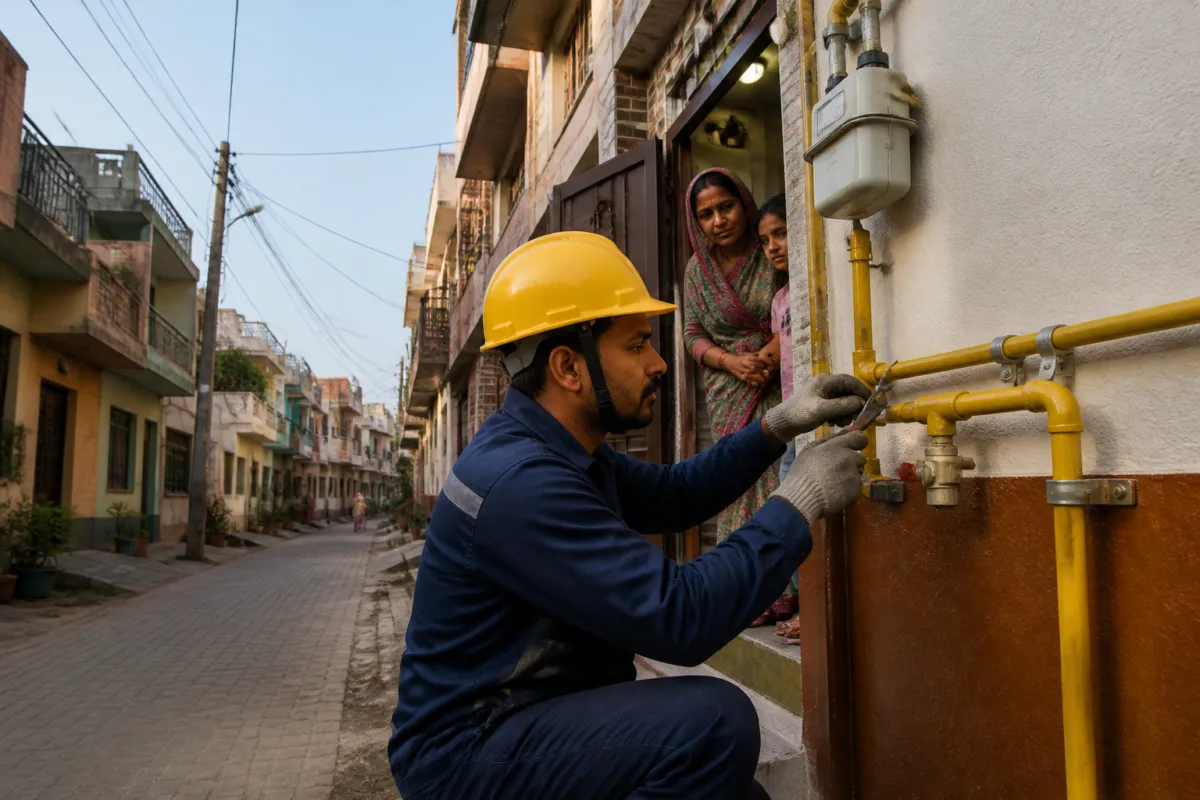
Madhya Pradesh’s piped natural gas rollout is expanding faster at the connection stage than at the supply stage. Gas distribution companies are now adding about 6,000 domestic PNG connections a month, three times the earlier pace, but 1.24 lakh of the 3.74 lakh households that have received connections are still not getting gas. The gap exposes a central weakness in urban utility expansion: a pipeline connection is not the same as a functioning household service.
Of the domestic PNG connections provided across Madhya Pradesh, around 2.5 lakh are currently receiving supply, according to the report. The remaining connections have been linked to the network but have not yet become operational. The reasons identified by officials include a shortage of skilled technicians, delays at the consumer end and reluctance among some households to shift from LPG cylinders.
This distinction matters because utility programmes are often measured through the infrastructure installed rather than the service actually delivered. A household may have a pipeline connection outside or inside its premises, but the public benefit is realised only when the installation is completed, the consumer is ready to switch, safety and commissioning procedures are finished, and gas begins flowing regularly. Madhya Pradesh’s figures show how these stages can move at different speeds.
The state ranked eighth nationally in domestic PNG connections, with around 3.37 lakh connections recorded in Petroleum and Natural Gas Regulatory Board data for May 2026. The higher figure of 3.74 lakh connections cited in the current rollout indicates continued expansion after that data point, but the supply gap remains substantial. Roughly one-third of the connections provided so far are not yet receiving gas, based on the figures reported.
The infrastructure already built is particularly significant in Bhopal. PNG services began in the city in 2021, and about Rs 900 crore has been invested in developing its network, according to an official involved in distribution who spoke to the Times of India on condition of anonymity. Companies are now concentrating on connecting households to this existing pipeline system and activating connections that have already been installed.
The official said the focus was on making maximum use of the infrastructure and strengthening last-mile connectivity. The statement also identified two different kinds of obstacles. One is on the supply side: companies do not have enough skilled technicians to complete installations and bring more connections into operation. The other is on the consumer side: some households have delayed giving up LPG cylinders, slowing the transition to PNG even where network access is available.
## The last-mile problem in PNG rollout
The technician shortage provides the clearest institutional explanation for why connection numbers and active supply numbers have diverged. Between 500 and 600 technicians are currently deployed across Madhya Pradesh in nearly 300 teams, generally made up of two or three people. Officials said companies require at least 100 additional technicians every month to accelerate installations and make more household connections operational.
That requirement points to a recurring feature of urban infrastructure delivery. The capital-intensive part of a utility system—laying pipelines and developing the distribution network—can be planned and funded as a large project. The final stage depends on a distributed workforce entering individual homes, completing technical work and coordinating with residents. This stage is less visible than pipeline construction but determines whether the network performs as intended.
The response from gas distribution companies has been to approach industrial training institutes for skilled workers. Divisional ITI Indore officials said they had received requests for around 200 workers from gas companies. The move suggests that the bottleneck is not only a temporary deployment issue but also a training and labour-market challenge. Companies need a regular pipeline of workers who can support installations as the network expands and existing connections are activated.
The reported numbers also show that the challenge is not uniform across the state. Indore has the highest number of domestic PNG connections in Madhya Pradesh. Its PNG services began in 2008-09, considerably earlier than Bhopal’s 2021 launch. The longer operating history gives Indore a larger installed base, while Bhopal represents a newer urban network in the process of moving from coverage expansion to service activation.
## Why connected homes are not necessarily supplied homes
PNG is designed to supply cooking gas directly to household kitchens through pipelines. Unlike LPG, it does not require consumers to book and replace cylinders, and households are billed according to consumption. These operational differences mean that adoption involves more than physical access to a pipeline.
A consumer who already has an LPG arrangement may need to change household routines and accept a different billing and supply system. The reported reluctance among some consumers to surrender or stop using LPG cylinders is therefore part of the rollout problem. It does not mean that households lack access to a network; it means that network availability has not automatically produced a completed transition.
The distinction is important for how cities evaluate network performance. If the headline metric is the number of connections issued, companies can appear to be progressing even when a sizeable share of households remains outside active supply. If the metric is the number of households actually receiving gas, the operational challenge becomes visible: the network must be converted into a reliable service at the level of individual homes.
The Madhya Pradesh figures illustrate this difference clearly. Companies have tripled the monthly pace of PNG connections from 2,000 to 6,000 as they accelerate installations and last-mile work. Yet the existing backlog of 1.24 lakh households shows that increasing the rate of new connections alone will not resolve the supply gap. The system must also process the connections already created.
## The policy and delivery structure
The PNG rollout is being carried out by city gas distribution companies within a network monitored through the broader regulatory framework of the Petroleum and Natural Gas Regulatory Board. PNGRB data provides the state-level picture of domestic connections, while the companies are responsible for installation, last-mile connectivity and activation at the household level.
This division creates several points at which implementation can slow. Network investment may be completed before household-level work is finished. Companies may have targets for adding new connections while also needing to commission older ones. Consumers may postpone switching even after technical access is available. Skilled-worker shortages can affect both new installations and the activation of existing connections.
The reported investment of around Rs 900 crore in Bhopal’s PNG network highlights the scale of the fixed infrastructure involved. However, the number also raises a basic delivery question: how effectively is that investment being used if a significant number of connected households are still awaiting supply? The evidence does not establish that the investment has failed, but it does show that capital expenditure and service utilisation are moving at different speeds.
The proposed response combines workforce expansion with stronger last-mile activity. Gas companies are seeking workers from ITIs, while distribution efforts are being redirected towards households already covered by the network. This approach addresses both sides of the problem identified in the report: a lack of personnel to complete the work and delays among consumers who have not yet moved away from LPG.
## The next target and the measurement challenge
City gas distribution companies have set a target of adding another 50,000 domestic PNG connections across Madhya Pradesh by March 2027. The target signals continued expansion, but the existing backlog means that the quality of progress will depend on how the new connections are counted and how quickly they become operational.
A programme can report growth in coverage while still leaving many households waiting for actual supply. For residents, the relevant outcome is not simply whether a pipeline has reached the neighbourhood or whether a connection number has been issued. It is whether cooking gas is available in the kitchen, whether the installation is complete and whether billing and supply arrangements are functioning.
The current data therefore supports two different readings of the rollout. On one side, the state is expanding its PNG network, ranks among the leading states in domestic connections and has tripled its monthly connection rate. On the other, 1.24 lakh linked households remain without supply, and companies say they need at least 100 more technicians every month to accelerate activation.
The bigger urban question is whether utility expansion should be judged by infrastructure reach or by usable service. Madhya Pradesh’s PNG experience shows that the distance between the two can be large. The immediate milestones are the recruitment and training of additional technicians, the activation of the existing backlog and the progress of the 50,000-connection target by March 2027. Until those stages are measured together, the number of connections will provide only a partial picture of the rollout.

