


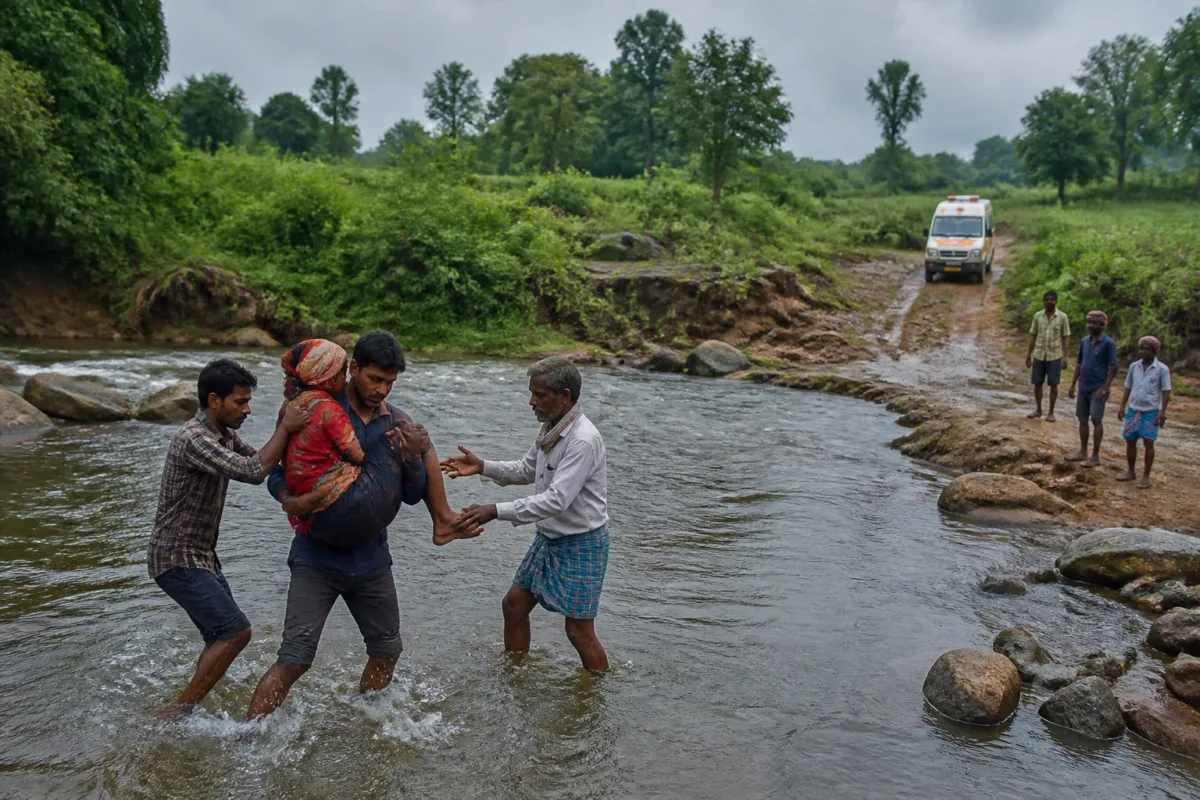
A pregnant woman being carried across the Silgi river on a sling before walking 3.5 km to an ambulance is not only an account of a difficult journey. It is a measure of what the absence of all-weather road connectivity means when a village needs emergency healthcare. In Kalgi Tola, a settlement of around 300 people in Madhya Pradesh’s Dindori district, the route to an ambulance became a physical obstacle course because the vehicle could not reach the village.
The incident took place on October 18, when Yashoda Markam developed labour pains. Her family members and other villagers carried her across the river and then walked with her to Bhiti Tola, where an ambulance was waiting on the road. She was subsequently taken to Shahpura community health centre and delivered safely. The mother and baby later returned home, according to the report by Times of India.
The safe outcome does not reduce the seriousness of the access failure. The case shows how an emergency response system can exist on paper but remain incomplete at the settlement level. An ambulance may be available, and a community health centre may be functioning, but the service becomes conditional when the final stretch to a village is not motorable or when a river divides the settlement from the nearest accessible road.
That final stretch is often treated as a local roads issue. In Kalgi Tola, however, it connects several public systems at once: maternal healthcare, ambulance access, schooling, local administration and the use of public funds for rural infrastructure. The absence of a bridge is therefore not an isolated construction gap. It is the point at which these systems fail to meet residents on the ground.
Kalgi Tola falls under Pakar Baghra gram panchayat and is located about 50 km from Dindori district headquarters. Residents have demanded a bridge over the Silgi river for years. They say the village is especially difficult to access during the monsoon, when the river swells. The report also records a 2014 survey for a bridge, conducted after residents raised the demand, but the proposal did not progress after the then collector was transferred.
This history is significant because it places the present crisis within an administrative chain rather than presenting it as a sudden or unforeseeable event. A survey was carried out, but a survey alone does not create connectivity. The proposal needed to move through decisions on alignment, land, funding, technical design, procurement and construction. The gap between identifying a need and completing the project is where residents have remained cut off.
The district administration has now indicated a different route towards a possible solution. Collector Anju Pawan Bhadauria said the issue had been raised at the chief minister’s Jan Vishwas Shivir. She said engineers from the Rural Engineering Services department would survey an alternative route and assess the extent of government and private land involved.
The proposed process makes land a central part of the infrastructure question. If an alternative road requires private land, the administration must obtain the consent of landowners before pursuing construction. The collector said that, after consent is secured, the administration plans to pursue road construction under the VB-G RAM G scheme. The supplied report does not establish the project’s final alignment, cost, construction schedule or whether landowner consent has been obtained.
That distinction matters. For residents, the immediate requirement is a dependable connection to the road network. For the administration, the project must first be converted into an implementable proposal. A route may be technically possible but still require land agreements, departmental coordination and an approved funding pathway. Until those steps are completed, the village’s access remains dependent on conditions at the river and on the ability of residents to arrange their own movement.
The childbirth emergency also reveals why road access cannot be measured only by the distance between a village and a health facility. Kalgi Tola was not described as being without healthcare in absolute terms. The woman reached an ambulance and then a community health centre. The failure occurred between the settlement and the point where the vehicle could wait. That last-mile gap determined whether medical transport could reach the patient directly or whether villagers had to carry her to it.
For maternal healthcare, the difference between vehicle access and a walk across a river is operational rather than merely geographic. A person in labour may need timely transport, assistance and privacy. In this case, the journey was managed by relatives and villagers, and the outcome was safe. But the episode illustrates how emergency access can depend on informal community labour when formal transport cannot cross the final barrier.
The same barrier affects routine public services. Kalgi Tola has a primary school and an anganwadi centre, while the middle school is located in Pakar Baghra. Residents said children and teachers often struggle to reach the school during the rainy season. The bridge demand therefore concerns not just emergency movement but the continuity of education and the daily functioning of local institutions.
This is the institutional significance of the village’s location. A settlement may have basic facilities within its boundaries and still remain functionally isolated if residents cannot reliably travel to the next level of schooling, health services or administrative offices. Connectivity determines whether those facilities operate as part of a larger public system or remain separated by seasonal conditions.
The account also highlights the difference between a road project and a connectivity project. A road that ends before a river, or an ambulance route that stops where a bridge is missing, does not provide uninterrupted access. The usable network is defined by the weakest link. In Kalgi Tola, the river crossing is the link that prevents the available ambulance service from reaching the village.
The administration’s proposed alternative route suggests that the earlier bridge demand may now be approached through a road-building solution. That could reduce the need for a bridge at the originally proposed location, but the report does not yet confirm whether the alternative route will provide all-weather access, how long it will be, or whether it will remain usable during periods of heavy rain. Those questions will depend on the survey and subsequent approvals.
There is also an accountability question in the history of the proposal. Residents said that repeated representations had been made to officials and elected representatives. The 2014 survey shows that the demand had entered the administrative record years ago. Yet the project did not progress, according to the report. The transfer of an official was identified as a turning point, indicating how continuity of ownership can affect small but essential infrastructure proposals.
For large urban infrastructure, delays are often tracked through tenders, budgets and construction milestones. In a village such as Kalgi Tola, the consequences of administrative delay appear in more immediate forms: a patient carried across a river, children struggling to reach school and residents relying on repeated petitions. The scale of the project may be modest compared with a highway or bridge in a city, but its importance is measured by the number of basic services that depend on it.
The case also cautions against treating viral visibility as the beginning of a public problem. The video of the woman being carried across the river circulated on social media only after the October 18 incident, but residents had reportedly demanded a bridge for years. Public attention arrived after the emergency became visible; the access problem itself was already established in the village’s experience and in earlier administrative action.
What happens next depends on whether the latest announcement moves beyond acknowledgement. The Rural Engineering Services survey is expected to examine the proposed alternative route and the extent of government and private land involved. The administration has said it will seek landowner consent and pursue road construction under the stated rural employment and infrastructure scheme. Until the survey, land process and construction decisions are completed, Kalgi Tola remains a settlement where emergency access can still depend on a river crossing and the physical effort of its residents.

