


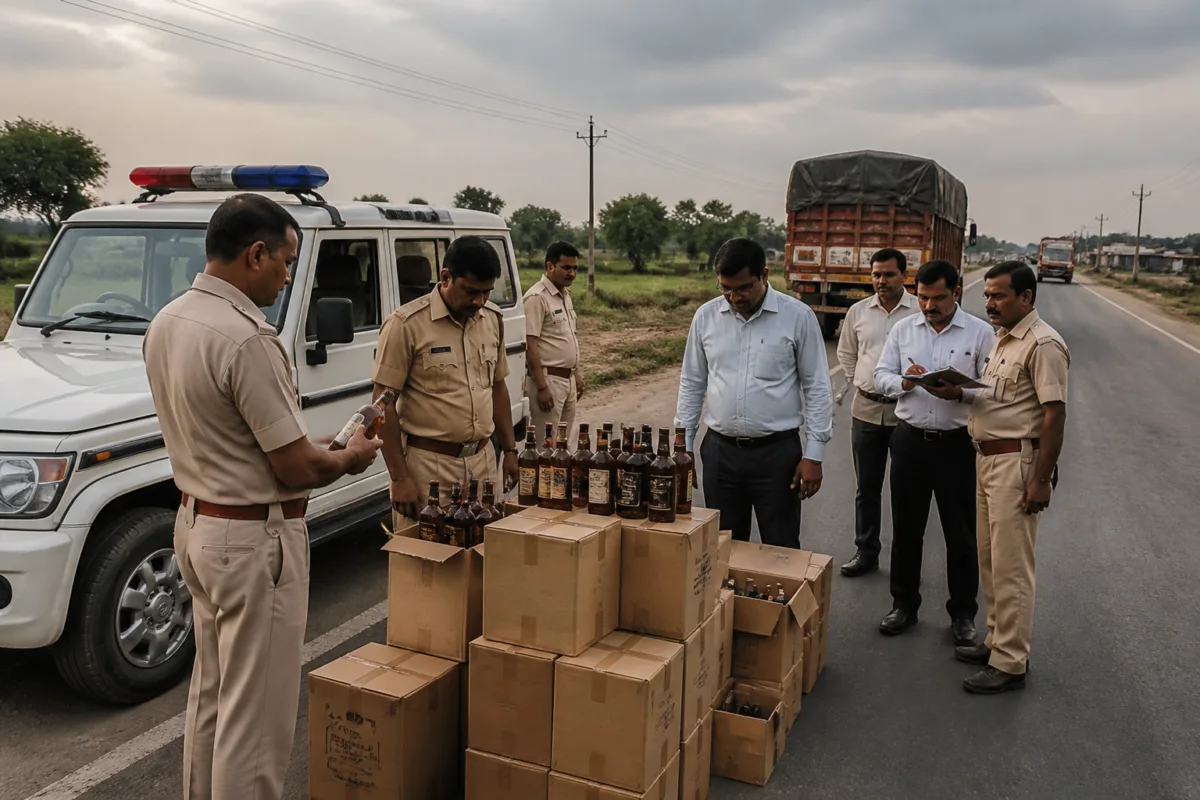
Madhya Pradesh liquor enforcement is facing a two-sided breakdown: illicit alcohol continues to move across state borders, while spurious liquor has reportedly entered the licensed trade and killed drinkers. The death of Khategaon station in-charge Dilip Puri, who was allegedly mowed down by a liquor smuggler in Dewas district, has brought the enforcement crisis into sharper focus. Police recovered more than 1,800 litres of permit-less liquor from the truck involved, according to the report.
The central problem is not simply that illegal alcohol exists despite strict laws. It is that the state appears to be confronting two different markets with tools designed mainly for one. Illicit liquor is produced, transported or sold outside the licensed system. Spurious liquor is counterfeit or adulterated alcohol that may contain methanol or other chemicals and can enter bottles, shops and supply chains that appear legitimate. Raids and seizures can disrupt the first market. They do not, by themselves, guarantee that the second market is safe.
That distinction matters because the most serious recent deaths were linked, according to the report, to alcohol that allegedly passed through licensed channels. In Sagar district, liquor sold in Banda and Shahgarh tehsils reportedly killed 11 people on the first day in September. The state told the High Court that 20 deaths had been confirmed and seven more had unclear causes, while media counts were higher. Police said the counterfeit product resembled the inexpensive “Sagar Gold” whisky and was sold for Rs 20 less per quarter bottle through a licensed seller.
In Dewas, 13 people were reported to have died in Chandana and Binjana between September 27 and October 16, although the administration initially denied the deaths and the Congress put the toll at 22. The report said 10 people were arrested, including staff from three licensed shops, over allegations that chemicals were blended with genuine liquor and branded bottles acquired from scrap dealers were filled. Three excise officials were suspended, while the collector and superintendent of police were transferred.
The disputed numbers are not a minor reporting problem. They reveal how difficult it is to establish the scale of alcohol poisoning when administrative records, police investigations, political claims and media counts diverge. In Sagar, a one-member judicial commission was given three months to investigate. The police traced the alleged supply chain to a gang in Lalitpur, Uttar Pradesh, but Uttar Pradesh police rejected that link. Such disagreements leave families, investigators and courts working with different versions of the same public-health emergency.
### A law that became tougher, but not necessarily safer
Madhya Pradesh strengthened its legal response after Morena recorded one of the country’s major spurious-liquor tragedies in January 2021. Twenty-four people died in Chhaira and Manpur villages, with later reports putting the toll at 26. The collector and superintendent of police were removed. In August that year, the state Assembly amended the Excise Act to provide for the death penalty or life imprisonment and a fine of Rs 20 lakh in cases involving deaths caused by spurious liquor.
The tougher punishment established the seriousness of the offence, but subsequent incidents showed that deterrence depends on more than the severity of the statute. The report records four deaths in Chhatarpur, at least seven in Mandsaur and four in Bhind in 2022. In the Morena case, 14 people were convicted only in November 2025 and sentenced to 10 years of rigorous imprisonment. The time taken between the deaths and convictions illustrates the distance between legal provision and enforcement outcome.
A criminal law can punish a supplier after a tragedy. It cannot independently verify every bottle before it reaches a consumer, protect officials operating on vulnerable transport routes or identify collusion inside a licensed distribution network. Those functions depend on the excise department, police, district administration, licensing controls, forensic capacity and the courts working as one system.
The report also describes an escalation in the risks faced by enforcement personnel. In 2022, an SDM and a naib tehsildar were attacked near Kukshi in Dhar while pursuing a liquor vehicle. In 2025, two men were shot dead in Morena while attempting to stop illegal transport. Puri’s death in Dewas therefore fits a wider pattern identified in the report: officials and citizens confronting the trade are facing increasingly direct violence.
### Seizures show activity, not necessarily control
Police figures for 2024 recorded more than 98,000 cases, over 1.26 lakh arrests and the seizure of more than 15 lakh litres of liquor. In Dhar alone, liquor worth Rs 8.37 crore was seized in 3,955 cases in 2023. After the Sagar deaths, a three-day statewide drive registered 1,554 cases and seized 12,107 litres.
These figures demonstrate the scale of enforcement activity, but they do not establish that the supply chain has been disrupted. The most revealing number from the statewide drive was that only seven cases fell under Section 49-A, the provision dealing with deaths caused by spurious liquor. The drive caught large volumes of illicit alcohol, while the smaller but more lethal problem of poisoning remained harder to identify and prosecute.
That distinction also complicates the use of seizures as a performance indicator. A high seizure count may mean that police are active, that the trade is expanding, or that enforcement is concentrated on visible transport rather than hidden adulteration. Arrest totals similarly do not show whether the people detained were couriers, retailers, suppliers or organisers. The report does not provide conviction figures for the wider 2024 seizure data, making it impossible to assess how many cases resulted in sustained legal consequences.
The routes described in the report show why district-level enforcement is insufficient. Uttar Pradesh is identified as a source or transit connection for Chhatarpur, Morena and Sagar. Rajasthan is linked to Mandsaur. The Harda-Dewas-Indore corridor appears in the case involving Puri. Industry bodies have also alleged that smuggling into dry Gujarat costs the exchequer more than Rs 1,000 crore each year, although that estimate is presented as an industry claim.
These routes connect rural production and transport networks with larger regional markets. Indore’s position as a major commercial centre gives the wider issue an urban dimension even when deaths occur in villages or smaller districts. Urban markets can be endpoints, transit nodes, sources of demand and administrative centres for the systems that regulate surrounding districts. The enforcement challenge is therefore not confined to isolated rural settlements.
### The accountability gap inside the licensed system
The most difficult question raised by the report is how counterfeit or chemically adulterated liquor allegedly reaches consumers through licensed shops. Licensing is intended to create a controlled chain from manufacture and transport to retail sale. When a toxic product is sold through that chain, responsibility cannot stop with the person who physically mixes the chemical or carries the bottle.
The Sagar and Dewas cases point towards the need to examine every layer involved: the origin of the alcohol, the movement of stock, shop-level records, bottle procurement, the role of scrap dealers, laboratory testing and the response of local officials. The report says that staff of licensed shops were among those arrested in Dewas and that excise officials were suspended. It does not establish the full chain of responsibility, but it shows that the investigation has moved beyond street-level sellers.
This is also where administrative classification becomes important. The National Crime Records Bureau recorded 108 such deaths in Madhya Pradesh in 2021, eight in 2023 and none in 2024. The report argues that the decline reflects classification rather than safety. Claims of 19 liquor-linked deaths in Jabalpur were rejected, while the Sagar and Dewas counts changed repeatedly. If toxic alcohol deaths are not consistently identified, recorded and investigated, official statistics can create the appearance of improvement without proving that the underlying risk has declined.
The state’s response therefore involves two accountability tracks. The first is operational: intercept illegal consignments, protect enforcement teams and prosecute transporters and suppliers. The second is institutional: ensure that licensed sellers, inspectors, laboratories and district authorities cannot allow contaminated or counterfeit products to pass as legitimate alcohol. A system that succeeds only at catching unlicensed transport may remain vulnerable to poison entering through authorised channels.
Former director general of police SC Tripathi, quoted in the report, said crime thrives on profitability and that the trade would decline if it became unprofitable. He also described prevention as a joint responsibility involving elected representatives, society and law enforcement. His comments point to the economic structure behind the enforcement problem, but they do not remove the state’s responsibility for licensing, inspection and prosecution.
The report’s evidence ultimately confirms a gap between legal toughness and administrative control. Madhya Pradesh has expanded punishment, conducted large-scale raids and recorded thousands of cases, yet deaths, disputed counts and attacks on officials continue. What remains uncertain is the full size of the spurious-liquor market, the extent of collusion inside licensed supply chains and how many cases lead to convictions. The judicial commission’s findings, the outcome of the Sagar and Dewas investigations, and the state’s ability to track responsibility beyond couriers will show whether enforcement is moving from visible seizure activity towards control of the system that allows dangerous alcohol to circulate.

