


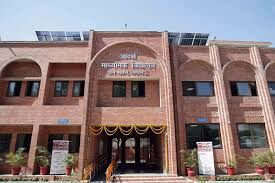
A newly built smart school within the Jan Bhavan complex in Lucknow is emerging as a prototype for future public education infrastructure in the state, signalling a shift towards integrated, technology-enabled learning environments. Developed at a cost of ₹5.17 crore, the facility is being positioned as a replicable model for government schools, with implications for both urban education planning and social equity.
The school introduces upgraded classrooms, laboratories, library systems and sports infrastructure—elements that have historically been uneven across public education networks. Officials indicate that such investments are not only about physical upgrades but about reshaping learning ecosystems where infrastructure directly influences student engagement and outcomes. A key aspect of the project lies in its hybrid funding structure. While the majority of the capital expenditure was supported through state funding, a portion was mobilised through corporate social responsibility (CSR) channels and institutional efforts. This blended financing approach reflects an emerging trend in urban social infrastructure, where public assets are increasingly co-created through government and private participation. Urban planners note that the Lucknow smart school model could serve as a scalable template, particularly as cities expand and demand more inclusive access to quality education. The emphasis on spatial design—ranging from well-lit classrooms to activity-oriented campuses—aligns with broader global thinking that school infrastructure must support cognitive, social and physical development simultaneously.
Importantly, the project also highlights how educational infrastructure is being integrated into civic identity. The Jan Bhavan campus, historically associated with administrative functions, is gradually evolving into a mixed-use public space that combines governance, culture and education. Such adaptive reuse of institutional land is increasingly relevant in dense urban environments where land availability is constrained. Policy signals accompanying the launch suggest that similar Lucknow smart school model principles could be extended to composite schools across the state. This would mark a transition from incremental upgrades to standardised, design-led interventions in the education sector. For rapidly urbanising regions, this approach may help reduce disparities between urban and peri-urban schooling facilities.
However, experts caution that infrastructure alone cannot deliver long-term outcomes without parallel investments in teacher capacity, digital access and curriculum reform. The sustainability of such projects will depend on operational funding, maintenance frameworks and measurable improvements in learning indicators. As Indian cities navigate the intersection of population growth, economic mobility and climate resilience, education infrastructure is increasingly being viewed as foundational urban capital. The Jan Bhavan initiative demonstrates how targeted investments in public institutions can shape not just classrooms, but the broader trajectory of inclusive urban development.
Also Read: India Real Estate Market Attracts Overseas Buyers
Lucknow Jan Bhavan School Sets Infra Benchmark

