


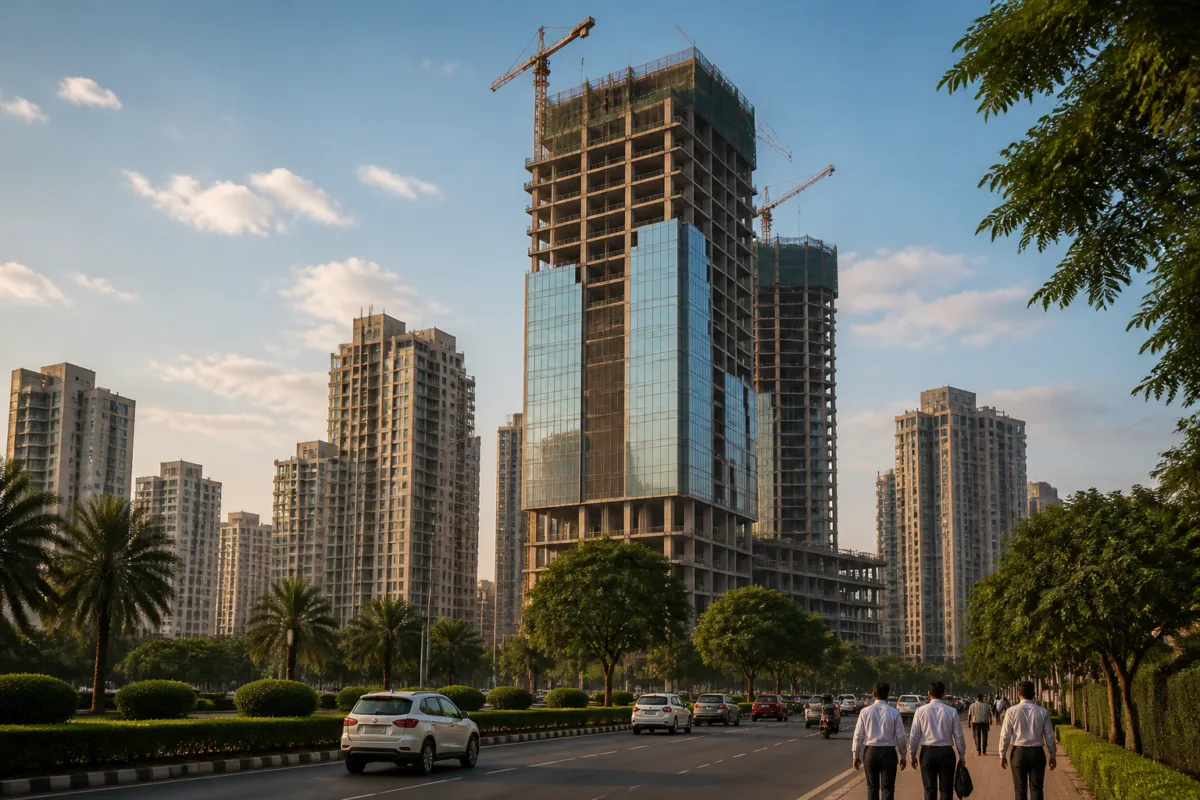
Lodha Developers’ entry into Delhi-NCR with a 4 lakh sq ft office project on Gurugram’s Golf Course Road is more than a new commercial launch. It is a test of whether a developer with an established residential presence in western and southern India can translate its brand, capital and operating model into one of the country’s most expensive and competitive office markets.
The company has launched Lodha Pantheon on a 1.2-acre site, with an estimated project cost of Rs 1,100-1,200 crore. According to Sushil Modi, Executive Director-Finance at Lodha Developers, the Grade A++ complex will rise across 27 floors and offer office spaces for sale. The project is the company’s first in Delhi-NCR and forms part of a wider plan to assess the market before expanding more aggressively.
That sequence matters. Lodha is not entering Gurugram through a large portfolio of simultaneous projects. It is starting with a premium commercial development on Golf Course Road and has separately identified a housing project on Sohna Road for launch in the fourth quarter of the current financial year. The two developments are described by the company as pilot projects for understanding Delhi-NCR before a larger expansion.
The strategy reflects the way large developers often approach a new metropolitan market: establish a foothold in a high-value location, test buyer response and then decide whether the operating environment supports wider deployment of capital. In this case, the first foothold is commercial real estate rather than housing, even though housing remains central to Lodha’s broader business.
The office project is also aligned with a specific demand thesis. Modi said there is strong demand from business houses in Gurugram that want to purchase workspaces instead of taking them on long-term leases. Lodha’s decision to sell office spaces therefore positions the project around ownership demand, rather than the conventional office market model in which companies occupy buildings under lease agreements.
The supplied report does not provide a market-wide estimate of how much of Gurugram’s office demand comes from buyers seeking ownership. It does, however, identify the company’s view that this segment is sufficiently strong to support a premium project. That distinction is important because an office building sold in units creates a different ownership and management structure from a building held by a single institutional owner and leased to multiple occupiers.
Lodha Pantheon’s scale is significant within the project’s compact site. The 4 lakh sq ft saleable area will be distributed across 27 floors, with floor plates ranging from 13,000-15,000 sq ft and 20,000-25,000 sq ft. These large floor plates are intended to serve business users that require substantial contiguous office space, although the report does not specify the targeted industries, expected occupancy schedule or the planned mix of end-users and investors.
The project’s location is central to its positioning. Golf Course Road is described by the company as Gurugram’s most prime location, commanding a premium in both residential and commercial property. For a developer entering a new city, a premium corridor offers visibility and pricing power, but it also places the project in a market where buyers are likely to compare construction quality, access, building services and long-term asset value closely.
The report does not provide the project’s construction timeline, completion date, approvals status, expected sales realisation or financing structure. Those details will be important in assessing how the development progresses from launch to delivery. The stated investment estimate indicates the scale of the commitment, but it does not by itself establish the project’s profitability or absorption rate.
Lodha’s wider financial position provides context for the expansion. The company reported sales bookings of Rs 5,037 crore in the second quarter of the current financial year, a 10 per cent increase from the year-earlier period. Its sales bookings for the first six months rose 7 per cent to Rs 9,670 crore, according to the company’s investors’ presentation. Lodha has set a full-year sales bookings target of Rs 24,000 crore, compared with Rs 20,530 crore in the preceding 2025-26 financial year.
The company also reported a 28 per cent increase in consolidated net profit to Rs 1,013.5 crore for the quarter ended September. Total income rose to Rs 4,584.9 crore from Rs 3,878.9 crore in the corresponding period of the previous year. These figures show that the Delhi-NCR move is being made while the company is reporting growth in its existing business, although the supplied material does not separate the contribution of different cities, segments or projects to those results.
Lodha currently has a significant presence in the Mumbai Metropolitan Region, Pune and Bengaluru. Its move into Gurugram therefore expands its geographic footprint beyond the markets where it has built its established operating base. The company has already entered into a joint development agreement with the MRG Group for two Gurugram projects—one commercial and one residential—indicating that the Delhi-NCR strategy is not limited to a single standalone asset.
Joint development also provides a way to enter a new market without relying entirely on land acquisition. The report does not disclose the terms of the agreement, the land contribution, revenue-sharing arrangement or development responsibilities of the two partners. Those institutional details will determine how risks and returns are distributed between Lodha and MRG Group, but they are not established in the supplied material.
The choice of both commercial and residential projects suggests that Lodha is assessing Gurugram as a broader urban market rather than only an office destination. The commercial project on Golf Course Road targets a premium business corridor, while the proposed housing project on Sohna Road would place the company in a different location and demand environment. Together, they could give the developer a basis for comparing buyer behaviour across two major real estate segments, although the company has not disclosed a formal evaluation framework.
For Gurugram, the expansion adds another large developer to an already competitive premium property market. The implications extend beyond the project’s saleable area. Commercial buildings influence daily travel patterns, demand for supporting services and the concentration of employment along specific corridors. Yet the report provides no information on the project’s expected workforce, parking capacity, traffic impact, public transport access or infrastructure arrangements. These are material questions for a city where office growth and real estate development are closely linked to road and mobility pressures.
The project also highlights a structural divide within commercial real estate: the difference between demand for space and demand for ownership. A company purchasing an office may have a different time horizon and balance-sheet strategy from one leasing premises. The developer’s stated initial response indicates interest, but the report does not identify buyers, booking levels or the proportion of area sold. Without those details, the strength of the ownership trend cannot yet be measured independently.
The project’s Grade A++ positioning is similarly a company description rather than a separately defined market benchmark in the supplied report. The label signals an attempt to compete at the top end of Gurugram’s office market, where location, floor-plate efficiency and building specifications are likely to be central to the sales proposition. The report does not list the building’s sustainability features, certification, amenities, energy systems or construction standards, so those aspects cannot yet be assessed.
Lodha’s expansion is therefore best understood as a measured market-entry exercise backed by a sizeable first project. The company is bringing a premium office product to Golf Course Road, testing a stated preference for owned workspaces and preparing a second housing launch on Sohna Road. Its recent sales and profit figures provide financial context, but they do not establish how the new projects will perform.
The evidence confirms three developments: Lodha has entered Delhi-NCR with Lodha Pantheon; it plans to invest approximately Rs 1,100-1,200 crore in the 4 lakh sq ft commercial project; and it views the commercial and proposed residential projects as pilots before a larger regional expansion. What remains uncertain is the pace of construction, the level of actual sales, the profile of buyers and the effect of the projects on Gurugram’s already intensive office and mobility ecosystem. Those will be the indicators to watch as the company moves from launch announcements to execution.

