


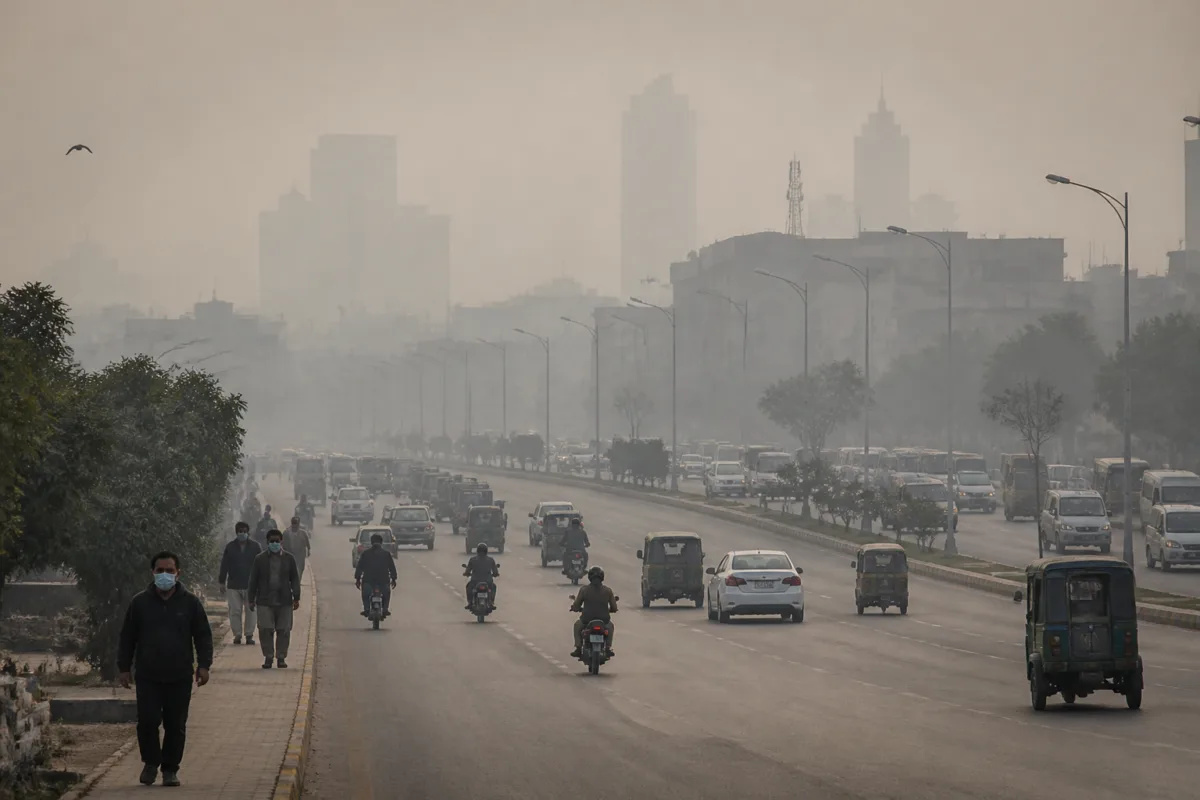
Lahore air pollution has again become a cross-border political dispute, but the underlying evidence points to a more complicated urban problem: hazardous winter air is being produced by multiple sources across a shared airshed that national borders cannot contain. The immediate trigger was Pakistan’s claim that pollutants drifting from India after Diwali contributed to Lahore’s toxic conditions. The wider issue is how cities and governments respond when pollution is generated locally, transported regionally and measured through rapidly changing weather conditions.
Lahore topped IQAir’s ranking of the world’s most polluted major cities for a second day on Tuesday, with an air quality index of 263, categorised as “very unhealthy”, according to the report published by Deccan Chronicle, citing Reuters. The city’s PM2.5 concentration was 37.2 times above the World Health Organization’s annual guideline. PM2.5 particles are small enough to penetrate deep into the lungs, making them a significant public-health concern in dense urban areas.
Pakistan’s Punjab Environment Protection Minister Marriyum Aurangzeb attributed part of the pollution to pollutants carried by light winds from India after Diwali. She also said air pollution was expected to gradually decrease from early afternoon as weather conditions improved and winds shifted direction. That statement places meteorology at the centre of the dispute: the same emissions can produce very different urban conditions depending on wind direction, atmospheric stability and the ability of pollutants to disperse.
India’s foreign ministry had not immediately responded to a request for comment, according to the report. The absence of an immediate response leaves the diplomatic exchange incomplete, but it does not remove the urban management question. Lahore and Delhi are experiencing pollution within a connected atmospheric system, while the institutions responsible for monitoring, regulating and communicating air quality remain primarily organised around territorial jurisdictions.
Delhi was ranked the world’s second-most polluted major city by IQAir on Tuesday, with an AQI of 188. Indian government data cited in the report showed that firecrackers accounted for nearly 55% of Delhi’s PM2.5 on the previous day. That figure identifies a major short-term contributor, but the same report also lists vehicle emissions, construction dust and smoke from crop-waste burning as important sources of winter pollution on both sides of the border.
This distinction matters because a city’s worst air day is rarely explained by a single source. Firecrackers can produce a sharp, concentrated increase in particulate pollution around a festival. Crop-waste burning can add seasonal smoke over a wider region. Vehicles emit pollutants continuously, while construction dust can remain a persistent urban source where building activity, road movement and dust control are poorly managed. When these emissions coincide with weather conditions that prevent dispersion, urban air quality can deteriorate rapidly.
The numbers from Lahore and Delhi show the scale of the exposure, but they do not by themselves establish the precise share contributed by each source or location. The reported 55% contribution from firecrackers relates to Delhi’s PM2.5 on a specific day, while Lahore’s reading reflects conditions in a different city and potentially different mix of emissions. Treating either number as a complete explanation would obscure the way pollution changes by time, place, weather and source.
The cross-border dimension has appeared before. Pakistan similarly attributed toxic air in 2024 to crop-waste burning in India’s Punjab. At that time, officials from India’s weather department said wind direction indicated that airflow was moving from Pakistan into India. The contrasting explanations demonstrate why source attribution is not simply a political statement. It depends on monitoring networks, meteorological analysis and transparent methods capable of showing how pollutants move across the region.
The current dispute also mirrors domestic political arguments in India. Indian Prime Minister Narendra Modi’s Bharatiya Janata Party has blamed crop-waste burning in Punjab for Delhi’s poor air quality this month, while Punjab is governed by a regional opposition party. Local media reported a sevenfold increase in farm fires in the state on Sunday, when Diwali was celebrated. Punjab’s state government, however, says incidents of crop-waste burning have fallen compared with previous years.
These competing claims reveal an institutional problem: pollution is often discussed through the most visible or politically convenient source, even when the urban atmosphere contains several overlapping contributors. A government may focus on farm fires, a city administration on traffic, residents on construction dust, and environmental authorities on festival emissions. Each concern can be valid without being sufficient on its own.
For cities, the governance challenge begins with measurement. Air-quality readings provide an important indication of exposure, but they must be interpreted alongside information about emissions, wind patterns and seasonal conditions. The report gives readings from IQAir and cites Indian government data on firecracker emissions, but it does not provide a joint India-Pakistan assessment that quantifies the movement of pollution between the two countries. That gap limits the ability of authorities and citizens to separate verified source contribution from political attribution.
The administrative structure is equally important. Air pollution is generated by activities regulated at different levels: municipal bodies oversee aspects of construction and road dust; transport authorities influence vehicle emissions; state governments address agricultural practices; national agencies handle broader environmental standards and coordination. Cross-border pollution adds another layer, because the relevant airshed extends beyond the jurisdiction of any one city or government.
A city-level response can still reduce exposure even when it cannot control every source. Authorities can regulate construction dust, enforce vehicle standards, address waste burning and issue timely public-health advisories. But the report’s evidence suggests that these measures operate within a regional system. When smoke from agricultural burning or festival emissions coincides with stagnant or shifting winds, local action may reduce part of the burden without eliminating the episode.
The timing of the pollution is also significant. Diwali-related fireworks created a short-term emissions spike, while crop-waste burning and winter weather contribute to a recurring seasonal pattern. The report does not establish the full duration of the current episode or provide a complete source inventory for either city. It does, however, show how episodic emissions can interact with persistent urban pollution sources to produce hazardous conditions.
The human consequence is expressed most clearly through the PM2.5 measurement. A concentration 37.2 times above the WHO annual guideline indicates an exposure environment far beyond the level used as a benchmark for long-term health protection. The report does not provide hospitalisation or mortality data, so the immediate health impact cannot be quantified from the supplied evidence. The exposure itself, however, makes air quality a core urban-infrastructure and governance issue rather than only a seasonal news topic.
Lahore’s ranking and Delhi’s simultaneous deterioration also challenge the idea that cities can manage air pollution independently. The two cities may have different local emissions profiles and administrative systems, but their air is influenced by regional weather and activities beyond municipal boundaries. A dispute over blame does not alter that physical reality.
The evidence therefore confirms three things. Lahore and Delhi were both experiencing very poor air quality; Diwali fireworks were identified as a major contributor to Delhi’s PM2.5 on the day cited; and pollution from vehicles, construction dust and crop-waste burning remained part of the wider winter problem. What remains uncertain in the supplied evidence is the precise cross-border contribution to Lahore’s reading and the relative share of each source across the two cities.
The next developments to watch are the response from India’s foreign ministry, changes in wind direction and pollution readings, and whether authorities publish more detailed evidence on source attribution. Until then, the episode demonstrates a structural weakness in South Asia’s urban air governance: cities are being asked to manage an atmosphere that is shared, while accountability remains divided by borders and administrative jurisdictions.

