


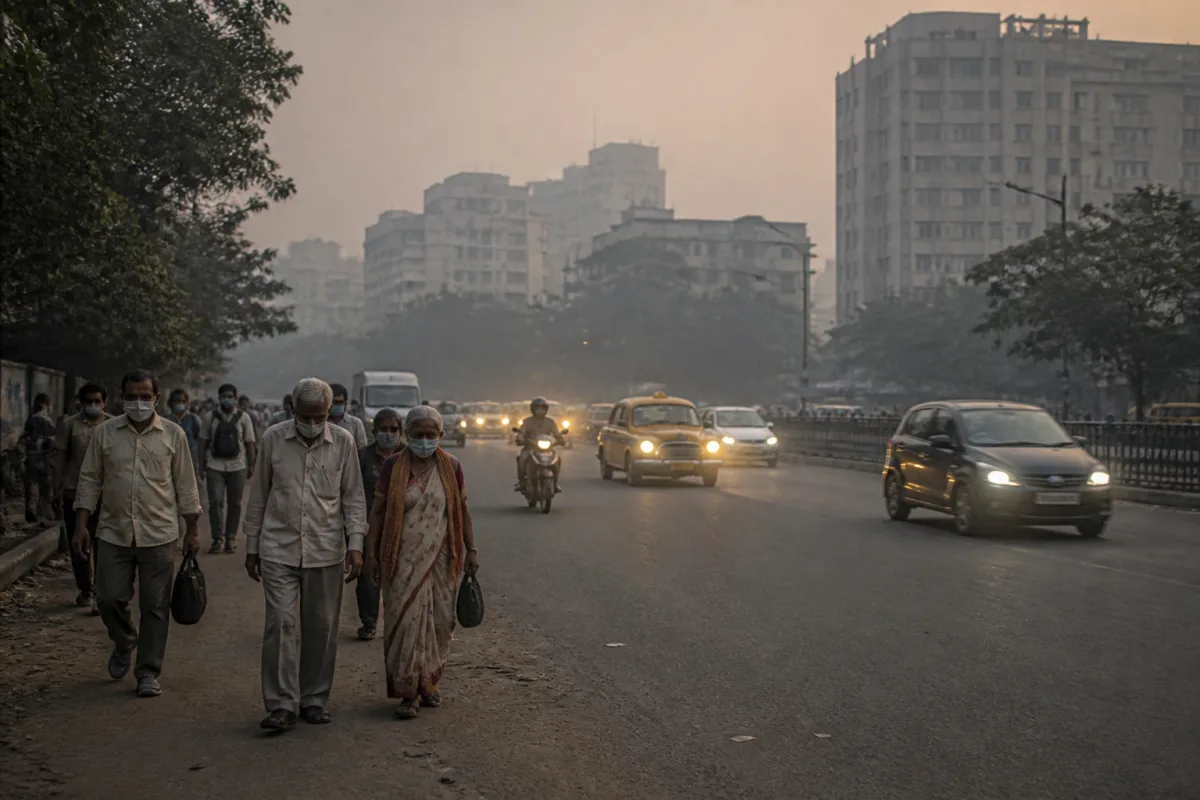
Kolkata air pollution became a direct hospital burden after Diwali, with hospitals reporting a surge in respiratory distress among elderly residents and people living with chronic lung and heart conditions. The episode shows how a short period of intense emissions can expose the vulnerability of a city’s healthcare system, even when official monitoring stations record air quality in a category that appears less severe to the general public.
The Telegraph reported that Belle Vue Clinic on Loudon Street admitted 10 patients with respiratory distress between Saturday night and Tuesday morning, all of them above the age of 70. Peerless Hospital admitted two patients, aged 93 and 76, with breathing difficulties. The 93-year-old woman, who lives in Panchasayar in south-eastern Kolkata, was in the intensive care unit and had a history of chronic obstructive pulmonary disease, or COPD.
The cases were not presented as isolated incidents. Doctors and hospital managers across the city described a wider increase in patients seeking medical advice or hospital care after a particularly noisy Diwali. Their accounts point to a recurring urban pattern: pollution episodes do not affect all residents equally, and the consequences become most visible among people whose respiratory or cardiovascular systems already have limited capacity to absorb additional stress.
At Peerless Hospital, infectious diseases expert Chandramouli Bhattacharya said the 93-year-old patient’s COPD had been stable until the weekend, but her condition began worsening from Sunday night, during Diwali, and deteriorated further on Monday. The 76-year-old man from Sinthi, who also had COPD, had fever but did not initially require admission. During Diwali, he developed respiratory distress and was admitted.
Bhattacharya said hospitals see a rise in respiratory-distress admissions every year during Diwali and that the hospital was anticipating more cases in the following days. The statement is significant because it frames the event not as an exceptional medical spike but as a recurring seasonal pressure point that hospitals have come to expect.
Belle Vue chief executive Pradip Tondon said all 10 patients admitted over the weekend had viral or respiratory infections that worsened during the Diwali period, with most above the age of 70. He added that the clinic normally did not see so many respiratory-distress admissions in such a short period. The evidence therefore suggests that pollution can act as an aggravating factor in patients already affected by infections or chronic disease, rather than being the only cause of every admission.
That distinction matters for understanding how urban pollution operates. People with COPD, asthma and coronary artery disease may not need to be newly diagnosed with an illness for air pollution to become dangerous. Doctors cited in the report said illegal firecrackers increase pollutants and aggravate these conditions. The exposure can worsen coughing, breathing difficulty and other symptoms, turning an existing medical condition into an emergency requiring hospital treatment.
Kolkata’s monitoring data provides a more complicated picture than the hospital experience alone. On the morning after Diwali, all seven monitoring stations named in the report—Victoria, Bidhannagar, Jadavpur, Ballygunge, Fort William, Rabindra Bharati University on BT Road and Rabindra Sarobar—recorded air quality in the “moderate” category under the National Air Quality Index prepared by the Central Pollution Control Board.
The AQI classification itself recognises that moderate air quality can cause breathing discomfort to people with lung or heart conditions. This is an important limitation of citywide air-quality labels: a category that may appear manageable for healthy residents can still represent a serious risk for vulnerable groups. A city can therefore record moderate air quality at its monitoring stations while hospitals simultaneously deal with a concentrated increase in respiratory cases.
The report also cited a much sharper short-term reading. At least one Kolkata monitoring station detected PM2.5 concentrations of nearly 400 micrograms per cubic metre in the early hours of Tuesday. That level was described as nearly 25 times the World Health Organisation guideline of 15 micrograms per cubic metre. PM2.5 particles are small enough to penetrate deep into the respiratory system, making short-duration peaks particularly relevant for people with existing lung and cardiac conditions.
The contrast between the station-wide “moderate” classification and the nearly 400-microgram reading illustrates why averages and snapshots do not fully capture how residents experience pollution. Monitoring stations are fixed at particular locations, while firecracker emissions can vary sharply by neighbourhood and hour. The most intense exposure may occur during late-night bursts, around dense residential areas or near people who are unable to seal their homes effectively from polluted air and noise.
Hospitals reported these effects in different forms. Ruby General Hospital saw several patients with breathing difficulties in its outpatient department on Monday and Tuesday. Its chief general manager, Subhasish Datta, said doctors associated the increase with worsening air quality since the period before Diwali and expected the pressure to continue because of further fireworks during Chath celebrations.
At NH-RN Tagore Hospital, pulmonologist and critical care specialist Saurabh Maji received more than a dozen calls on Monday night from patients with chronic lung disease. Some reported severe cough and others breathing difficulty. Maji advised them to increase inhaler doses and keep doors and windows closed. He later saw two patients with severe cough in his outpatient department and said the worsening appeared directly related to increased pollutants.
These responses also reveal the role of the household in Kolkata’s pollution-management system. Residents with chronic illnesses were advised to modify medication use under medical guidance, reduce indoor exposure and seek help when symptoms worsened. That places a significant share of the response on patients and families, particularly elderly people who may live alone or depend on caregivers. The hospital reports do not establish how many residents were unable to access care, but the calls and admissions indicate that the health burden extended beyond formally recorded hospitalisation.
Noise added another layer to the episode. Doctors said some elderly residents were panicking because of the loud crackers and fear of falling sick as pollution levels rose. A home healthcare facility also received calls from residents asking how to manage pets traumatised by the noise and behaving abnormally. This widens the urban impact beyond air-quality measurements: a festival-related pollution event can affect respiratory health, anxiety, household routines and the ability of residents to feel safe inside their homes.
The institutional question is not limited to whether air-quality standards exist. It is whether monitoring, enforcement, public-health communication and hospital preparedness operate together during predictable high-risk periods. The report describes violations of pollution norms and attributes the sharp pollution increase to rampant firecracker use, but it does not provide enforcement figures, the number of violations recorded, or details of any penalties or preventive action. Those gaps matter because recurring annual pressure is easier to anticipate than an unexpected disaster.
The city’s hospitals appear to have responded through clinical vigilance. Some doctors advised high-risk patients to take extra precautions before the festival. Others handled calls, outpatient visits and admissions as symptoms worsened. Yet the pattern also shows the limits of a response that begins after exposure. By the time patients with COPD or other chronic conditions require admission, the urban system is managing consequences rather than preventing the exposure that triggered the deterioration.
The available evidence does not establish that every reported case was caused solely by firecracker pollution. Several patients had viral or respiratory infections, and one patient had a fever before Diwali. The doctors’ accounts instead describe pollution and noise as aggravating factors that worsened existing conditions. That is a more precise reading of the episode and a reminder that urban health events usually result from overlapping risks rather than a single cause.
The immediate concern was also not necessarily over when the main Diwali celebrations ended. Ruby General Hospital warned that further fireworks during Chath could sustain the pressure on residents and healthcare providers. Desun Hospital’s director of critical care medicine, Amitabha Saha, said the anxiety and health concerns among elderly residents could continue for several days if air quality did not improve.
Kolkata’s post-Diwali experience therefore presents a measurable urban governance problem. The city had seven named monitoring locations, a national air-quality index, hospitals treating identifiable health effects and doctors advising vulnerable patients. But the same evidence shows a gap between knowing when the risk will rise and preventing residents from being exposed to it. The next developments to monitor are whether air quality improves, whether hospitals continue to report elevated respiratory cases, and whether authorities publish evidence of enforcement during the remaining festival period.

