


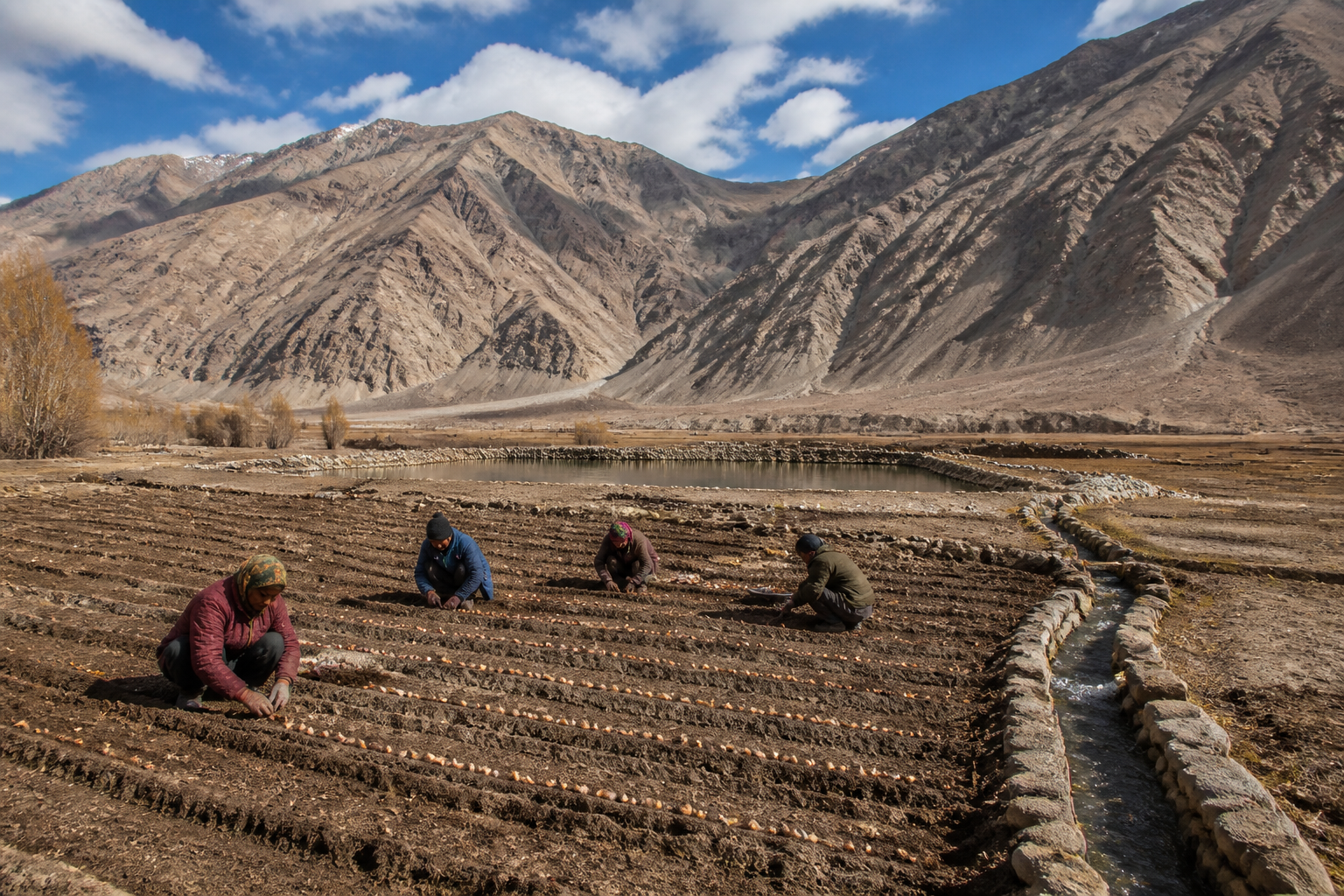
Ladakh has begun what the administration describes as its first saffron cultivation experiment, planting nearly 90,000 Iranian saffron corms across 4,000 square metres of restored land at Spituk Pharka in Leh. The initiative is intended to test whether the high-value crop can grow in the cold desert and whether degraded land can be converted into a productive agricultural asset.
The plot was reportedly dry and unused three months ago. It now contains close to 800 kilograms of saffron corms, selected according to quality specifications that include a circumference of 8 to 10 centimetres, a diameter of at least 2.5 to 3 centimetres and a weight above 10 grams. Agriculture experts cited in the report said the corms’ size and quality could support robust flowering and yield.
The project is being undertaken under the guidance of Ladakh Lieutenant Governor Vinai Kumar Saxena. The administration said the experiment builds on the region’s recent floriculture activity, particularly the cultivation of Lilium and Gladiolus, which has created additional livelihood opportunities for farmers and local entrepreneurs.
Saffron cultivation has traditionally been concentrated in the Kashmir Valley and parts of Jammu, including Pampore and Kishtwar. Pampore’s karewa plateaus are known for their well-drained soil, autumn rainfall and longstanding farming expertise. Together, the Kashmir and Kishtwar areas account for nearly 90 per cent of India’s saffron production, according to the report.
The Ladakh experiment therefore extends beyond the introduction of a new crop. It is also a test of whether irrigation and land-reclamation measures can support high-value agriculture in a region where water availability and harsh climatic conditions constrain cultivation. The saffron site forms part of a larger restoration programme covering 800 acres in Leh.
Water for the restored land is being supplied through the recently revived Igoo–Phey irrigation canal. Four nearby ponds developed under Project Him Sarovar provide additional storage, with a combined capacity of nearly 24 million litres. The administration has presented this combination of canal rehabilitation, water storage and crop diversification as the foundation for expanding agricultural use on moisture-starved land.
Saxena said the project could strengthen Ladakh’s rural economy by adding another premium crop to its high-altitude agricultural profile. He identified two objectives: demonstrating that saffron can grow in Ladakh and showing that degraded land can be revived for productive use.
An official spokesman in Leh said the pilot plantation aligned with the Centre’s stated objective of diversifying traditional agriculture to improve financial sustainability and create opportunities for farmers and young people. If the crop adapts successfully, the administration said saffron could become an additional premium product in Ladakh’s agricultural landscape.
The immediate milestone will be the performance of the pilot plantation, including flowering and eventual yield. Its results will determine whether saffron cultivation can move beyond the initial 4,000-square-metre site and become part of the wider restoration effort in Leh.
