


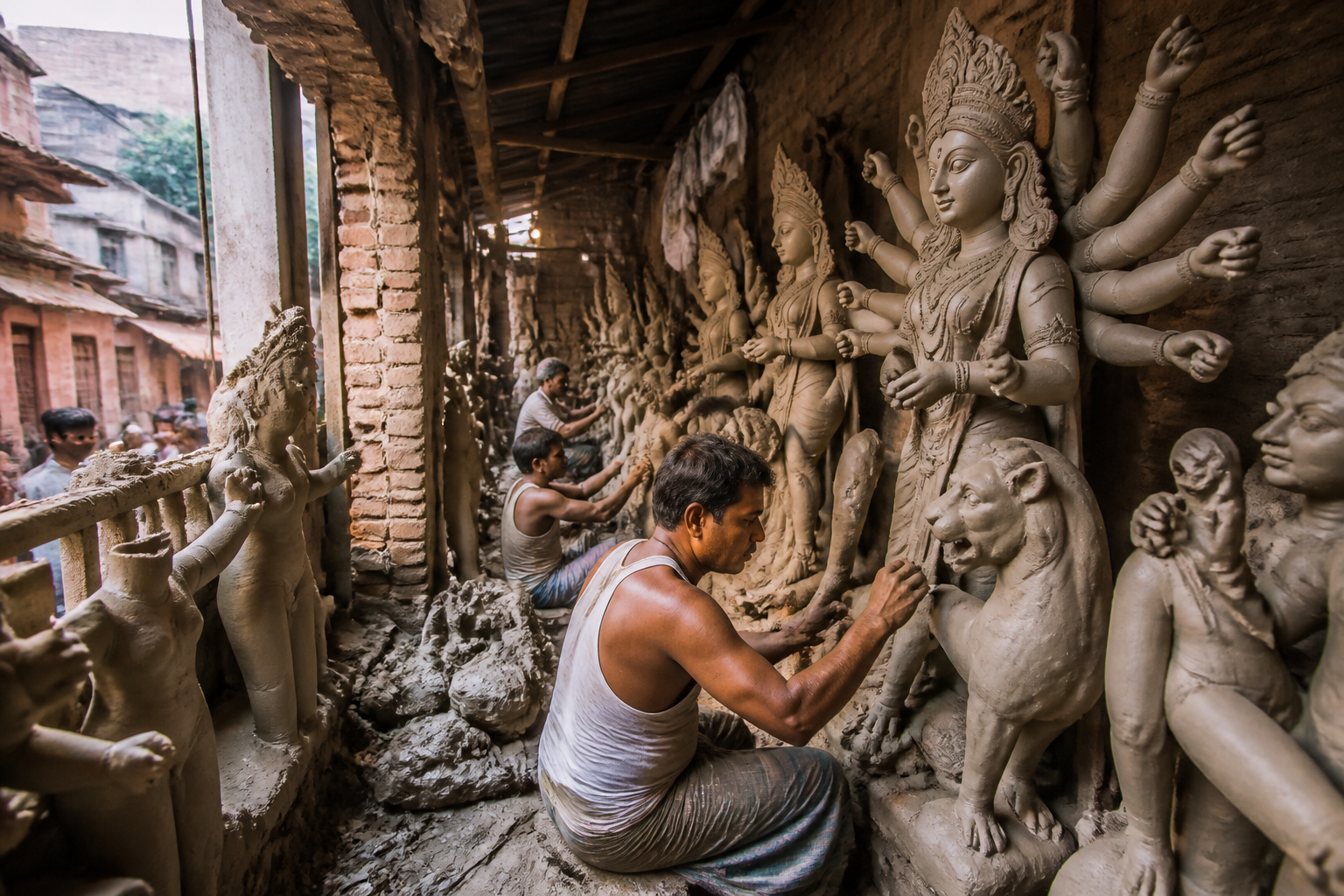
Kumartuli’s Durga idol economy is entering the 2026 Puja season under a combination of formal restrictions, informal caution and rising production pressure. The Kolkata neighbourhood’s artisans say demand for large and theme-based idols has weakened, while a height limit and warnings about preserving religious tradition have encouraged many organisers to choose safer, more conventional designs.
The immediate change is visible in the studios. Artisans told The Telegraph that idols are generally being kept within 11 feet, that traditional faces are being preferred over more experimental interpretations, and that theme-based production has fallen sharply. Babu Pal, joint secretary of the Kumartuli Mritshilpi Sanskriti Samity, said the number of theme-based idols had dropped from around 150 last year to approximately 10-12 this year.
The reported shift is not simply an aesthetic decision. It connects three parts of Kolkata’s urban system: public authorities managing the risks of immersion, Puja organisers working within tighter budgets, and artisan workshops dependent on seasonal orders. Kumartuli has around 166 studios and produces close to 8,500 idols, making the locality both a cultural centre and a concentrated seasonal manufacturing cluster.
The 11-foot restriction has been described by Kolkata Police as an existing rule rather than a new order. A senior officer from Shyampukur police station said the limit was intended to avoid complications during immersion caused by overhead wires. In practical terms, the rule links an idol’s size to the city’s electrical and street infrastructure. What appears inside a studio as a design constraint is also a question of whether large objects can move safely through roads and under utility lines before reaching the river.
Several artisans said the restriction had previously been treated more flexibly. According to their account, organisers could commission taller idols when demand justified them, even though the height limit existed on paper. This year, however, most makers have decided not to test the boundary. Debasish Pal was identified as one of the few artisans continuing to make 12-foot idols, while others said their orders were being designed around the 11-foot ceiling.
That difference between a rule’s formal existence and its practical enforcement is central to the change in Kumartuli. The available report does not establish a new written notification or identify a specific enforcement action that altered the policy. It does show that police visits, conversations with artisans and the broader political climate have changed how workshops assess risk. Several makers said members of the Samity had advised them to avoid being defiant, although most artisans were reluctant to speak openly about the guidance they had received.
The effect has been particularly strong on the part of the market built around artistic experimentation. Ganesh Pal, who works at the studio of theme-based idol maker Soumen Pal, said clients who previously ordered unusual idols were now asking for faces that looked traditionally like Goddess Durga. The ten hands, he said, were expected to remain together rather than be distributed across different positions. This points to a narrower design brief: innovation may still be possible, but it must remain visibly within an accepted visual and religious vocabulary.
The administrative message has extended beyond idol height. Chief minister Suvendu Adhikari has said that no Durga Puja inauguration should take place before Mahalaya, which falls on October 10. At a coordination meeting with Puja organisers, he also urged them not to select an idol, pandal or theme that could hurt the religious and cultural traditions associated with Durga Puja. The festival is scheduled to be celebrated from October 16 to 21.
These directions place Puja organisers in a more cautious operating environment. A theme is not only a creative decision; it can influence sponsorship, public response, permissions and the relationship between organisers and local authorities. The report does not say that all experimental themes have been prohibited. Instead, it records a widespread perception among artisans and organisers that conventional choices are less risky this year. That perception itself is shaping production before any formal dispute occurs.
The economic consequences are visible in the order books. Akhil Pal said that he had delivered at least three theme idols in the previous year but had none this season. Bholanath Pal said he had made 25 idols, with all but one booked, yet none was taller than 9.5 feet. He also described the seasonal rush as noticeably weaker than usual in the weeks before Mahalaya.
A slowdown in visible demand does not necessarily mean that Kumartuli’s workshops have stopped working. Many idols are still booked, and production continues. But the composition and value of orders appear to have changed. Large, high-budget or theme-driven commissions generally require more design work, material planning and labour coordination. If organisers move towards smaller and more conventional idols, artisans may continue to receive work while losing some of the higher-value activity that helped distinguish Kumartuli’s production economy.
Budget pressure is another factor. Akhil Pal said some large Puja organisers had indicated that they were unsure whether they could meet their budgets. He also said not every organiser would claim the government grant of ₹1 lakh, and that this had affected Kumartuli’s business. The report does not provide a complete account of Puja funding or establish how many committees have declined the grant. It does, however, show that artisan demand is tied to the financial confidence of hundreds of organisers who commission idols for neighbourhood and institutional celebrations.
This makes Kumartuli sensitive to changes beyond the workshop. A decision by a Puja committee to reduce spending can affect the scale of an idol, the amount paid to an artisan, the choice of materials and the number of workers required. At the same time, artisans carry much of the risk because their production is seasonal. A delayed or cancelled order leaves them with labour and material costs that cannot easily be recovered after the festival period.
Raw-material supply is adding another layer of pressure. Artisans reported a shortage of bele mati, the soft clay used to shape idols. China Pal, one of the few women artisans mentioned in the report, said she had another 10 idols to make but only scant supplies of clay. Artisans attributed part of the disruption to the government’s crackdown on illegal mining of sand and clay. The report does not quantify the shortage, identify the affected extraction sites or provide an official assessment of the supply chain, but the testimony shows how environmental enforcement can produce immediate consequences for a traditional urban manufacturing cluster.
The clay issue illustrates a difficult administrative balance. Illegal mining can damage land and water systems and undermine regulation of natural resources. Yet when alternative legal supply channels are not clearly available or affordable, enforcement can reach downstream workers who depend on those materials. In Kumartuli, the effect is not abstract: the availability and price of clay determine whether an artisan can complete booked idols on time and whether a workshop can accept more orders.
Kumartuli therefore operates at the intersection of heritage, infrastructure and livelihoods. Its studios are not only sites of cultural expression. They are small production units dealing with material procurement, labour, seasonal finance, transport logistics and public regulation. The 11-foot limit addresses immersion and overhead wires; the preference for conventional forms reflects the political and administrative climate; the clay shortage reveals the vulnerability of traditional production to resource regulation; and weaker Puja budgets affect the commercial base that sustains the cluster.
The reported figures underline the scale of the local economy. Around 8,500 idols are produced across approximately 166 studios, while last year’s turnover was reported to have exceeded ₹200 crore. Even without a current turnover estimate, the combination of fewer theme idols, subdued bookings and higher raw-material costs indicates that the season’s pressure is distributed across the entire production chain. The available evidence does not show whether the overall number of idols will fall, but it does show that the kind of work being commissioned is changing.
The deeper urban question is how cities preserve culturally important production districts while managing safety, environmental regulation and public order. Rules governing movement under utility wires are necessary when large structures pass through dense streets. Environmental action against illegal extraction can also be necessary. The administrative challenge lies in ensuring that such rules do not operate only as sudden constraints for workers at the end of the chain, without clarity about legal materials, transport arrangements, communication or transition periods.
For Kumartuli, the 2026 season will reveal whether the current caution is temporary or whether it marks a more permanent restructuring of the idol market. The supplied evidence confirms a sharp reduction in reported theme production, broad adherence to the 11-foot height limit, weaker confidence among some organisers and continuing clay-supply problems. It does not establish how long these conditions will last, whether official restrictions have changed in writing, or how the season’s final business volume will compare with last year. Those are the developments that will determine whether this is a single subdued Puja season or a more lasting narrowing of the creative and economic space available to Kumartuli’s artisans.
