


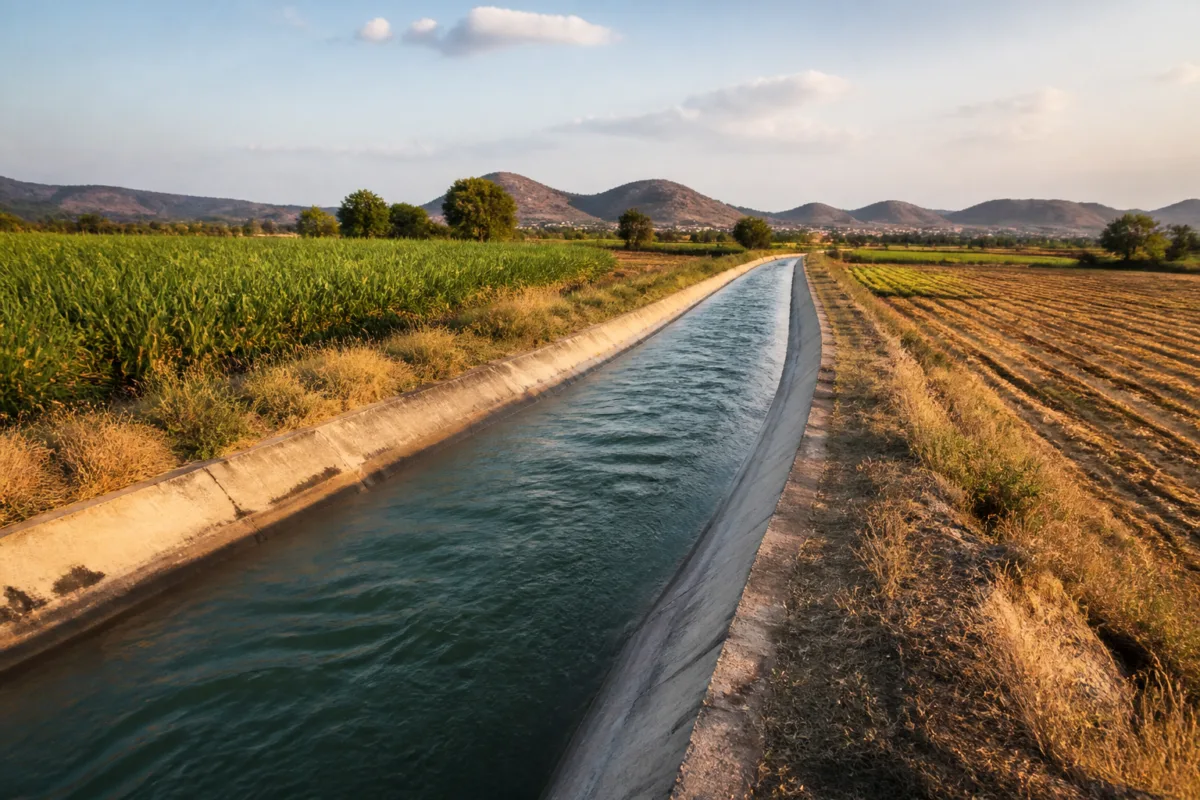
The first rabi-season water rotation through the Kukadi Left Canal will begin on November 5, after the canal advisory committee approved the release of 4.3 thousand million cubic feet (TMC) over 35 days, offering relief to farmers across seven drought-affected talukas in Maharashtra.
The decision was taken at a meeting held in Mumbai under the chairmanship of Water Resources Minister Radhakrishna Vikhe Patil. The meeting reviewed irrigation planning for the Kukadi project and was attended by former minister Dilip Walse Patil, Kukadi Irrigation Circle superintendent engineer Alka Ahirrao and elected representatives from the project’s command area.
The planned rotation will use about 4.3 TMC through the approximately 250-kilometre-long Kukadi Left Canal. The water is intended for agricultural irrigation and non-irrigation use in Junnar, Parner, Karjat, Shrigonda and Karmala talukas, according to MLA Sharad Sonawane, who shared details of the decision. The broader Kukadi command area includes Junnar, Ambegaon, Shirur, Parner, Karjat, Karmala and Shrigonda.
Additional releases totalling about 2.9 TMC will be made as required through the Pimpalgaon Joge, Dimbhe Right, Ghoda Branch and Meena supplementary canals. Taken together, the first rotation is expected to use 7.2 TMC of water. The release plan is intended to balance irrigation needs in areas facing drought conditions despite relatively high storage in the Kukadi project reservoirs.
As of the meeting, the project had 27.88 TMC of live storage, equivalent to 93.96% of its live-storage capacity, Sonawane said. Reservoir-wise storage stood at 1.88 TMC, or 96.78%, in Yedgaon; 9.17 TMC, or 90.15%, in Manikdoh; 1.09 TMC, or 95.39%, in Wadaj; 3.41 TMC, or 87.84%, in Pimpalgaon Joge; 12.31 TMC, or 98.534%, in Dimbhe; and 0.768 TMC, or 95.75%, in Chillewadi.
The water required to complete the rotation will be routed to Yedgaon reservoir from Manikdoh and Dimbhe reservoirs, according to the plan discussed at the meeting. Although storage levels are described as satisfactory, the committee decided that water would need to be managed strictly because the command-area talukas are experiencing drought conditions.
The decision highlights the administrative challenge of managing a connected irrigation system across a large command area. Water stored in several reservoirs must be coordinated with canal releases, local demand and the needs of both agricultural and non-agricultural users. The current schedule covers the first rabi rotation; the next release will be considered at the canal advisory committee’s meeting scheduled for January.

