


The decision to move a proposed polling booth from Neradivalsa to Sariki has temporarily reduced the immediate confrontation between Odisha and Andhra Pradesh, but it has not resolved the administrative dispute that brought election machinery to a contested border village. The Kotia dispute now presents a sharper governance question: how should local elections be conducted when two states claim authority over the same settlements and their institutions act on competing territorial assumptions?
Andhra Pradesh shifted the booth after an election team from the state reached the Odisha-Andhra border ahead of the November 5 rural polls but was prevented by Odisha authorities from entering Neradivalsa. The polling team returned without setting up the booth. Koraput sub-collector Fabi Rasheed confirmed that the Andhra Pradesh officials had attempted to enter the village and subsequently left.
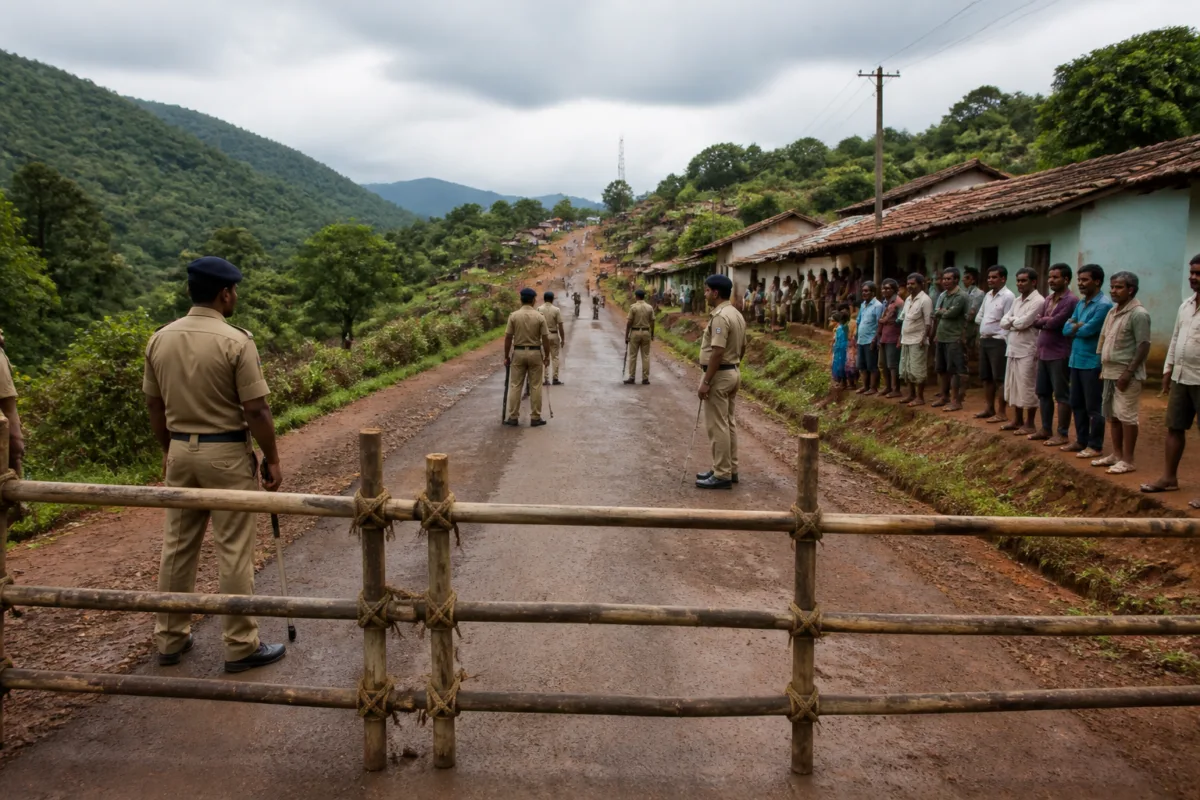
The episode was not simply a disagreement over the location of a temporary polling facility. It brought two administrative systems, two police forces and two political interpretations of jurisdiction into direct contact. Odisha authorities and local residents opposed the proposed booth, while Andhra Pradesh proceeded with election preparations in an area both states claim. The resulting confrontation shows how a territorial dispute becomes operationally difficult when routine state functions—such as elections, policing and local administration—reach the same population through competing channels.
The Andhra Pradesh State Election Commission’s response has added a formal review process to the dispute. In a November 3 letter, the commission forwarded a representation by advocate and human rights activist Anup Kumar Patro to the Parvathipuram Manyam district administration. It asked the district collector and election authority to verify the issues raised and take necessary action under applicable laws and instructions.
The commission’s letter, as reported, did not itself settle the question of jurisdiction. Instead, it directed the district administration to examine the allegations in consultation with the authorities concerned and submit a detailed report along with action taken. That distinction matters. The election commission has sought an administrative fact-finding response, but the supplied report does not indicate that the underlying territorial claim has been adjudicated or that the proposed local-body polls have been cancelled.
Patro questioned Andhra Pradesh’s administrative jurisdiction over Kotia and objected to the decision to hold elections there. He argued that the area falls within Odisha’s notified Fifth Schedule Area. These are the petitioner’s claims and arguments, rather than findings established in the election commission’s communication. The commission’s request for verification means that the factual and legal issues raised remain part of the administrative process.
The dispute is unusually difficult because the contested geography is not limited to a single site. At least 21 of the 28 villages in Kotia gram panchayat are disputed, with Odisha and Andhra Pradesh both staking claims over them. In such a setting, the location of a polling booth becomes a visible marker of state authority. A booth is not merely a place where votes are recorded; it is also evidence of which administration is organising the election, deploying officials and treating residents as part of its local-government system.
That institutional significance helps explain why the Neradivalsa proposal produced a response from several levels of Odisha’s administration. The Koraput administration, political parties and local residents opposed the booth. Odisha authorities prevented the Andhra Pradesh polling team from entering the village, and police personnel from the two states reportedly engaged in a heated exchange after Andhra Pradesh police allegedly attempted to remove barricades erected by their Odisha counterparts.
The use of the word “allegedly” is important because the supplied account does not provide an independent determination of what occurred at the barricades. What is established in the report is that tension escalated, the polling team did not set up the booth, and Odisha subsequently strengthened police deployment at strategic points in Kotia. The immediate governance response therefore shifted from election preparation to territorial control and prevention of unauthorised entry, according to the respective authorities’ actions described in the report.
The booth’s relocation to Sariki may reduce the likelihood of a direct confrontation at Neradivalsa during the polling process. It does not, however, answer the questions raised by the episode. The report does not state whether residents of the disputed villages will be covered by one local-body election, by competing electoral processes, or by a separately agreed arrangement. It also does not establish how the two states will reconcile their administrative records, policing responsibilities and local-government claims.
The institutional chain visible in the episode is fragmented. On one side are the Koraput administration and Odisha police, acting to prevent the Andhra Pradesh team from entering Neradivalsa. On the other are the Andhra Pradesh election authorities and the Parvathipuram Manyam district administration, which had prepared for local elections and must now respond to the election commission’s request. The state election commission has asked the district administration to investigate, but the supplied material does not indicate a joint inter-state mechanism or a final decision by a court or central authority.
This fragmentation creates a practical problem for residents. In a normal local election, voters should know which authority has prepared the electoral roll, designated the polling station, appointed officials and will recognise the result. In Kotia, the competing claims create uncertainty over each of these administrative functions. The source does not provide details of the electoral rolls or the number of voters affected, so the precise citizen impact cannot be quantified from the available evidence. The confrontation nevertheless demonstrates that the dispute has moved beyond symbolic claims and into the delivery of public administration.
The Kotia episode also illustrates why border disputes often persist even when there is no immediate change in the physical boundary. Administrative presence can be expressed through police deployment, election booths, barricades and official correspondence. Each action may be presented as routine within one state’s system, yet appear as an assertion of jurisdiction to the other. The result is an overlapping field of governance in which ordinary public functions become triggers for political and administrative conflict.
The Fifth Schedule issue cited in the representation adds another layer to the dispute. Patro’s submission linked the jurisdiction question to Odisha’s notified Fifth Schedule Area, but the report does not reproduce the relevant notification or set out how the legal provisions would apply to the polling decision. That limitation prevents a conclusion about the legal validity of either state’s position. It does establish, however, that the objection is not confined to the physical location of the booth; it also concerns the legal and constitutional framework governing the area.
The immediate next step is the report sought by the Andhra Pradesh State Election Commission from the Parvathipuram Manyam district administration. The commission has asked for verification of the issues raised and details of action taken. The available account does not indicate that the November 5 polls have been deferred or cancelled. It also does not show whether Odisha and Andhra Pradesh have agreed on a shared operational arrangement for the disputed villages.
What the evidence confirms is narrower but significant: a proposed booth at Neradivalsa could not be established after Odisha authorities blocked the Andhra Pradesh polling team; Andhra Pradesh moved the booth to Sariki; the election commission sought an official report; and police deployment was strengthened in Kotia. What remains unresolved is the larger question of administrative jurisdiction over the disputed villages. Until that question is addressed through a recognised institutional process, election logistics will continue to expose the deeper limits of governance in Kotia.

