


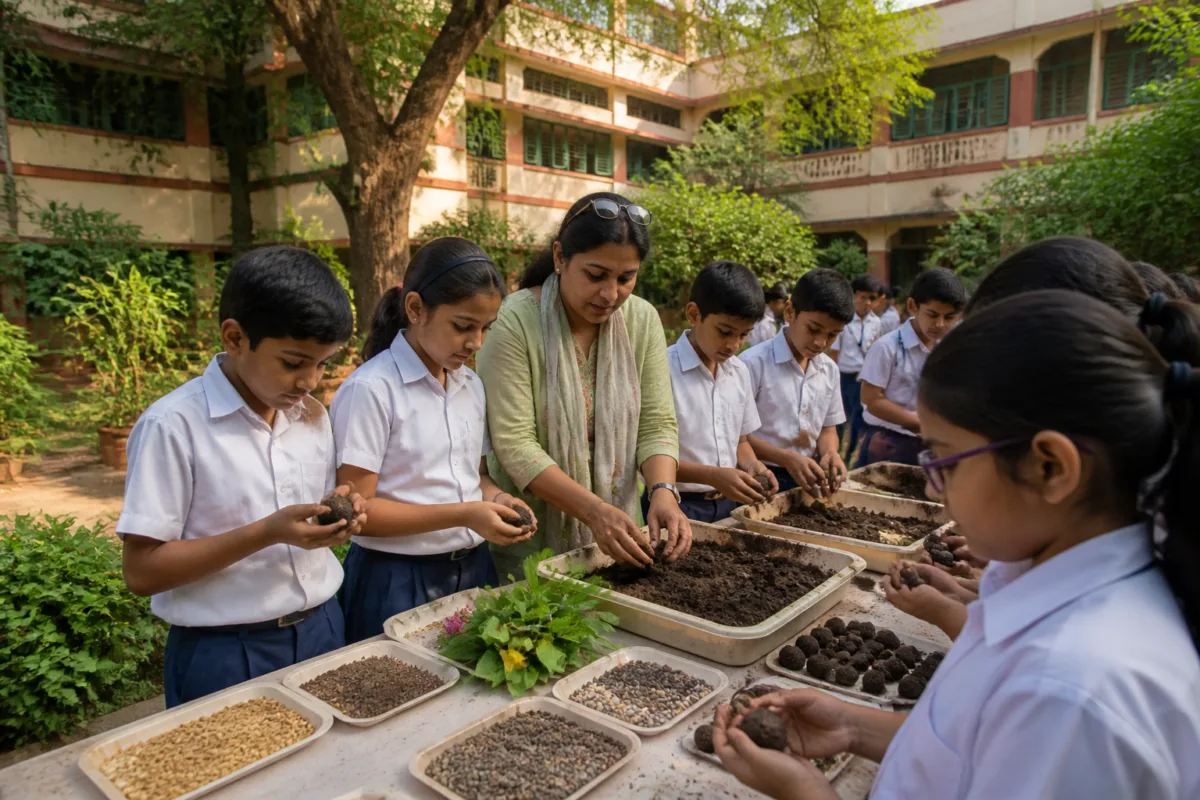
Around 250 Class V students at The Newtown School in Kolkata made and distributed seed bombs as an alternative to conventional firecrackers before Diwali, turning a classroom discussion on a green festival into a small public-awareness campaign.
The students prepared balls of soil containing seeds and gave them to classmates, teachers and other school staff. The initiative was held on November 5, three days before Diwali, according to a report by The Telegraph.
The campaign was conceived against the backdrop of widespread cracker use in the city. The report said the festival was marked by heavy bursting of firecrackers, which worsened air quality and created high noise levels. It also described distress among pets and difficulties for elderly and ailing residents, while noting that the effects continued beyond Diwali.
The school’s principal, Satabdi Bhattacharjee, said the activity followed a discussion in which students were asked what a green Diwali meant to them. One student associated the idea with planting more trees, prompting the seed-bomb activity. The principal said the school conducts similar discussions each year to identify actions that could make a difference.
The seed bombs were designed to be planted in the ground and allowed to germinate. Their value in the school campaign was symbolic as well as practical: the children were asked to replace an object associated with noise and smoke with one associated with planting and growth.
A teacher quoted in the report said some students were initially disappointed that the “bomb” would not burst. The explanation offered to them was that the purpose was precisely to avoid explosions and encourage germination instead.
The initiative also reflects the challenge of communicating environmental concerns across age groups. Bhattacharjee said younger children were more receptive to conversations about the health effects of air pollution and the distress caused by firecrackers. The report quoted her as saying that older students may already have established cracker-use habits, while primary-school children were more willing to listen to teachers and discuss the issue with their families.
According to the report, some children tried to persuade their parents not to burst crackers after learning about their impact on people, grandparents and pets. That places the school’s role beyond a one-day activity: the campaign sought to carry a public-health and environmental message from the classroom into households.
West Bengal had restricted cracker bursting to the 8pm-to-10pm period on Diwali, the report said. It also said the restriction was widely violated. The school’s intervention did not replace enforcement, pollution monitoring or broader city-level measures, and the report provided no data on the number of seed bombs that germinated or any measurable reduction in cracker use.
Its significance lies instead in showing how urban sustainability messaging can be translated into a tangible activity for children. In a city where festival pollution affects shared air, neighbourhood noise levels and household routines, the school used a familiar cultural occasion to connect environmental awareness with an action that students could understand and repeat.
The campaign cannot by itself address Kolkata’s seasonal air-pollution pressures. It does, however, offer a local example of environmental education that links public health, intergenerational responsibility and the everyday experience of living in a dense city.

