


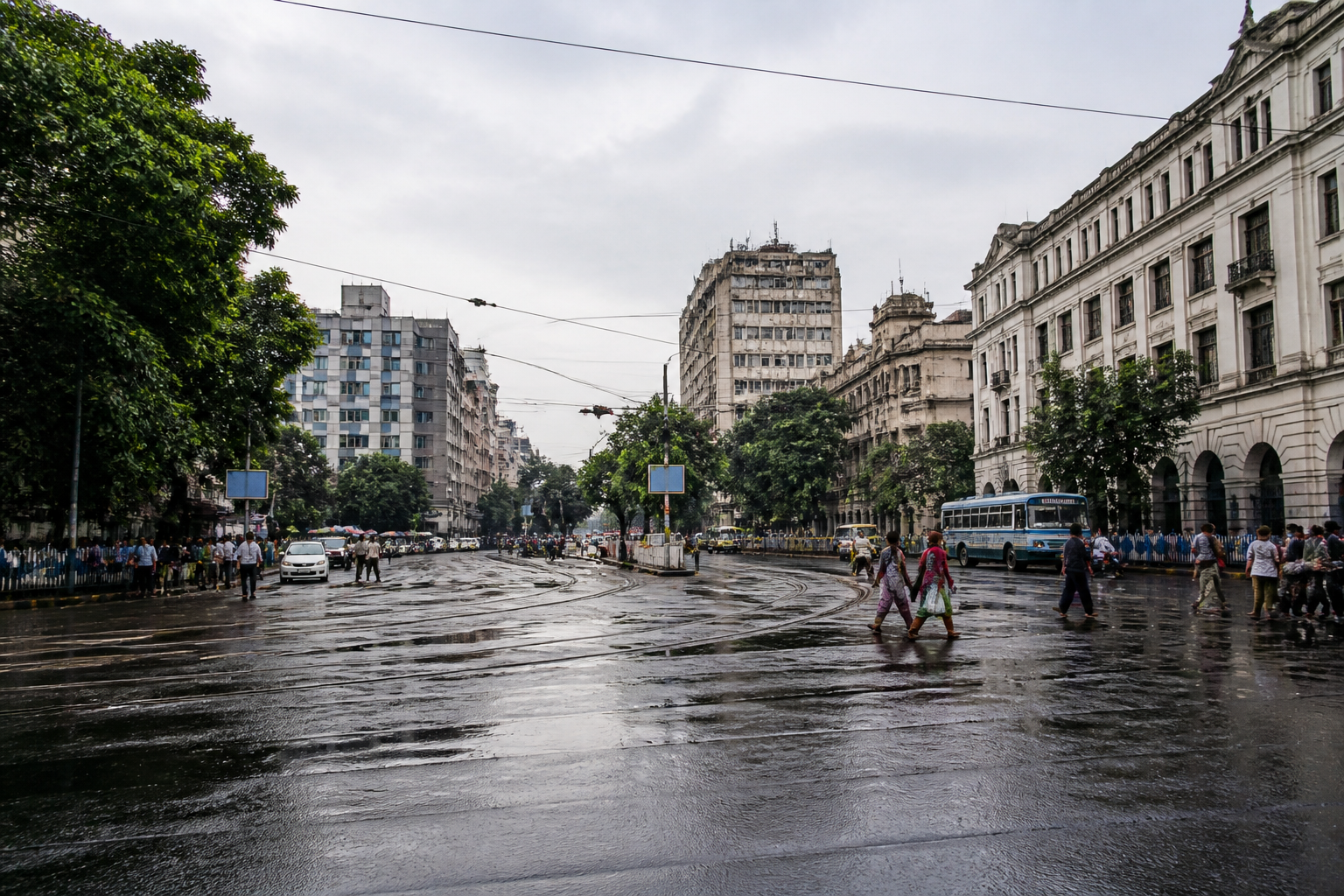
The proposed Kolkata road renaming exercise has not yet changed a single official address, but it has already opened a larger question about who gets represented in the city’s public landscape and how much of its political history municipal institutions are expected to preserve. A 10-member committee formed by the new BJP government in Bengal is examining proposals to rename roads, bridges and public places, including Lenin Sarani, Karl Marx Sarani and Ho Chi Minh Sarani.
The committee is expected to hold its first meeting after Durga Puja, according to a Kolkata Municipal Corporation official cited in the report. The same official said that no decision had been taken and that any change would be based on the committee’s recommendations. The panel is headed by Swami Pradiptananda, popularly known as Kartik Maharaj, of Bharat Sevashram. Its members include former Meghalaya governor Tathagata Roy, chief minister Suvendu Adhikari’s adviser Subrata Gupta and Kolkata Municipal Corporation commissioner Smita Pandey.
That institutional composition matters because road names are not changed only through public sentiment. They are embedded in municipal records, property documents, postal systems, navigation databases, transport references, emergency-service systems and the everyday language residents use to locate themselves. A proposal that begins as a question of historical or ideological relevance therefore becomes an administrative exercise involving the state government, the municipal corporation and the state Assembly.
Kartik Maharaj has said the committee will consider the relevance of the personalities after whom roads have been named in the context of Indian and Bengali heritage and culture. He has also said that proposals have been received for changing the names of other roads. The recommendations are expected to be sent to the state Assembly, placing the process within a formal political and legislative pathway rather than leaving it as an informal municipal decision.
The three Kolkata roads named in the report illustrate how public names accumulate layers of history. Lenin Sarani was earlier known as Dharmatala Street and was renamed in 1970 during celebrations marking Lenin’s birth centenary. Circular Garden Reach Road was renamed Karl Marx Sarani the following year. Ho Chi Minh Sarani is also among the roads identified for possible renaming, although the report does not specify when that name was adopted.
These changes show that Kolkata’s street map is not static. It has already been altered by successive political periods, administrative decisions and commemorative choices. A name can replace an earlier name while the old one continues in local usage, archival references or commercial addresses. The city’s built environment may appear physically unchanged even as its symbolic map is repeatedly revised.
The current proposals are framed by the committee’s leadership as an attempt to evaluate whether existing names reflect Indian and Bengali heritage and culture. Tathagata Roy has reportedly argued for renaming Lenin Sarani after Debaprasad Ghosh, a mathematician and former president of the Bharatiya Jana Sangh. For Karl Marx Sarani in Kidderpore, he suggested the names of Bengali poets Michael Madhusudan Dutt or Rangalal Bandyopadhyay, citing their association with the area. For Ho Chi Minh Sarani, he proposed the name of Martin Luther King Jr., the American civil rights leader.
Roy has also called for the removal of the Lenin statue at the crossing of Jawaharlal Nehru Road and Sidhho-Kanhu Dahar and suggested that an important city road be named after Sardar Vallabhbhai Patel. Separately, he proposed replacing some names associated with Muslim figures with the names of personalities he described as “nationalist Muslims”. Among the alternatives mentioned are writer Qazi Abdul Wadud, educationist Begum Rokeya and author S. Wajed Ali for the Titumir-named bus stand in Barasat near Kolkata.
The proposals consequently involve more than one question. They ask whether public places should commemorate figures who are considered relevant to the present political and cultural framework. They also raise the question of whether the city’s public realm should retain names that document earlier ideological movements, international solidarities and periods of political rule. These are not merely matters of signage. They concern the way a city presents its history through ordinary infrastructure.
For residents, the practical effect of renaming would depend on the scale and implementation of any final decision. A changed road name could require new signs, updates to municipal records and changes across public-facing systems. The report does not provide an estimate of the administrative cost, a timetable for implementation or the procedure for updating addresses and property-related documents. It also does not state whether the committee has consulted residents, businesses, historians, transport agencies or emergency services.
That absence of detail is important because the urban impact of a renaming exercise is determined not only by the final list of names but also by how the transition is managed. A city street is simultaneously a physical route, a legal address, a delivery destination, a transport reference and a cultural marker. If different institutions use old and new names for extended periods, residents may face confusion even when the physical road remains unchanged. The supplied report does not establish whether such a transition protocol has been prepared.
The Kolkata Municipal Corporation’s role is central. The civic body maintains and administers much of the city’s street infrastructure, while the proposed recommendations are to be sent to the state Assembly. This indicates a division between the municipal management of roads and the wider political authority involved in naming public assets. The committee’s work will therefore need to move across administrative levels before any proposal can become an operational change.
The report also highlights the tension between citywide naming decisions and local association. Roy’s proposal for Karl Marx Sarani refers to the alleged association of the Kidderpore area with Bengali poets, while the suggested name for Ho Chi Minh Sarani invokes a figure from the American civil rights movement. These examples show that the criteria for relevance may extend from local connection to broader symbolic recognition. The committee’s stated reference to Indian and Bengali heritage does not, by itself, establish how competing criteria will be ranked.
The historical record contained in the report demonstrates that names can carry both local and international meanings. Dharmatala Street’s renaming as Lenin Sarani connected a Kolkata road to the centenary of a foreign revolutionary leader. Circular Garden Reach Road’s renaming as Karl Marx Sarani connected a local route to an international political thinker. Ho Chi Minh Sarani similarly reflects a global reference within the city’s street network. The current proposals seek to reassess those references through a different understanding of heritage.
What remains unclear is the committee’s complete list, the evidence it will use to assess historical relevance and whether it will recommend changes to names beyond those already identified. The report also does not establish whether the proposed renamings have been approved by the state government, the municipal corporation or the Assembly. At this stage, the public information supports describing the exercise as a review and proposal process, not as a completed renaming programme.
The larger urban question is whether a city’s official map should function as a selective commemorative register or as a layered record of the periods through which the city has passed. Kolkata’s roads already preserve traces of different political, cultural and administrative eras. Replacing some of those names may create a new civic narrative, but it may also make earlier layers less visible in everyday public life.
The committee’s first meeting after Durga Puja will be the next significant milestone. Its recommendations, the response of the Kolkata Municipal Corporation and any subsequent consideration by the state Assembly will determine whether the proposals remain political suggestions or become changes to Kolkata’s official urban address system.
