


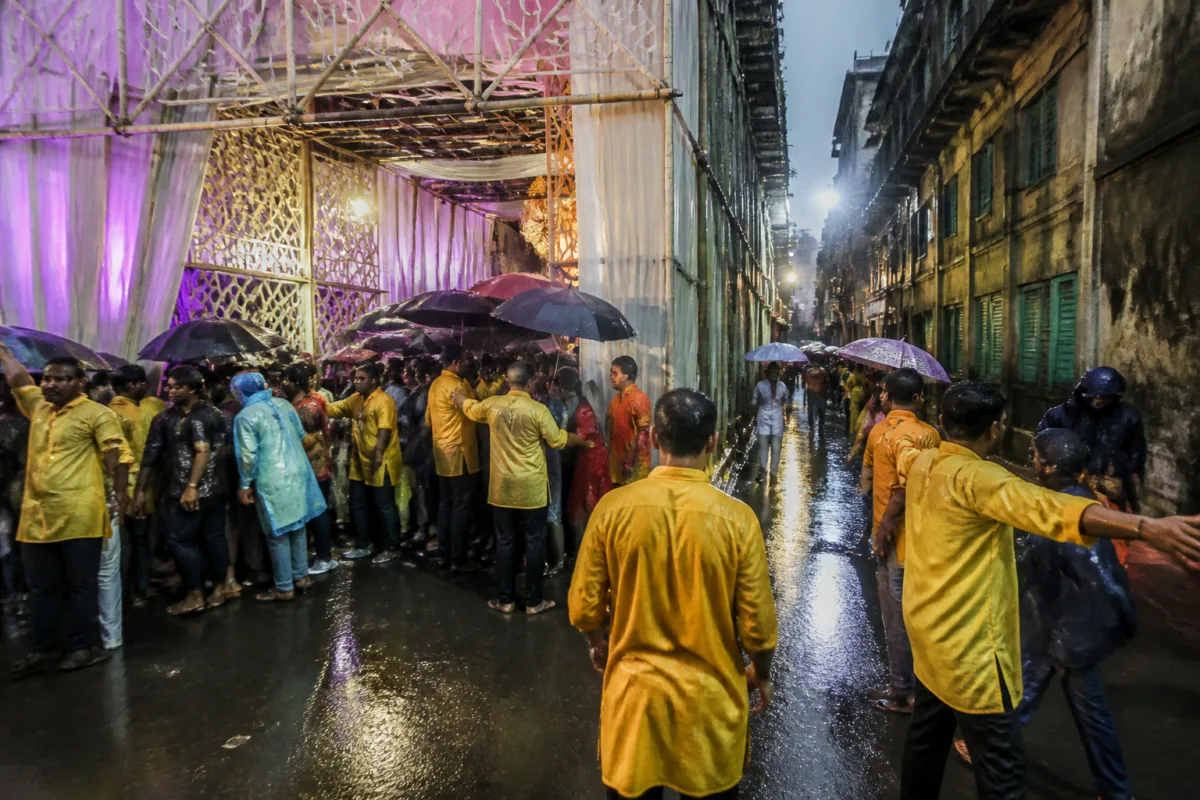
The Chorbagan pandal tragedy, in which 19 people died and 25 were injured after a rain-triggered crowd crush in north Kolkata, has exposed a failure that the city had already encountered several times: managing visitor numbers, movement and emergency access at high-footfall Durga Puja attractions. The incident was not the first warning. It followed the 2015 crisis at Deshapriya Park, the 2021 crowd surge at Sreebhumi and repeated instructions on wider exits, advance coordination, trained volunteers, communication and emergency access.
The immediate circumstances at Chorbagan were specific. The pandal of Chorbagan Sarbojanin Durgotsab Samity stood inside the narrow Radha Madhab Saha Lane and had attracted heavy footfall for several days. Visitors had to descend a flight of stairs from an upper deck to a lower level near the exit. Temporary restrictions on crowd movement had reportedly been imposed several times during the preceding four days, but those measures did not prevent a dangerous build-up on Maha Saptami, October 17.
Thousands were waiting in the lane when heavy rain began. People outside sought shelter inside, while visitors already within the pandal attempted to leave. According to accounts cited in the report, some people were reluctant to exit because rain was falling heavily outside. The conflicting movement created pressure in a confined space. An eyewitness described a sudden push followed by people stumbling down the staircase near the exit as others fell over them. Hospital sources cited in reports said the dead included 13 women and a child.
The investigation has not yet established a definitive sequence of responsibility. The state government has constituted a special investigation team, while Kolkata Police registered a suo motu case of culpable homicide not amounting to murder. Police are examining CCTV footage, questioning organisers and security personnel, and assessing entry, exit and emergency-response arrangements. Seven people, including puja committee secretary Raj Kumar Sewda, also known as Raja, and vice-president Santanu Dubey, have been arrested. Other accused persons are associated with the bamboo structure, crowd control and private security.
That distinction between established facts and competing accounts is important. Minister Umesh Rai said the pandal’s darkness had added to the difficulty but was not by itself responsible for the stampede. Chief minister Suvendu Adhikari said preliminary information suggested that an announcement by a private security agency and whistles blown by guards might have triggered the rush. These claims remain part of the investigation. An eyewitness alleged that announcements about entry, exit and movement were inadequate or confusing, while residents questioned whether police personnel were concentrated near a VIP entrance. These accounts require assessment against CCTV footage, witness testimony and the physical layout.
The available evidence nevertheless points to a broader planning problem: crowd safety was treated as a matter of controlling entry, even though the most dangerous moment came when weather suddenly changed the direction of movement. A normal queue-management plan assumes that visitors will continue through a defined route. Rain altered that behaviour. People waiting outside moved towards shelter, while people inside faced an unattractive or obstructed exit. Once those flows met near a staircase and a narrow lane, the available space became the decisive constraint.
This is the urban lesson from the earlier incidents. In 2015, an 88-foot idol at Deshapriya Park attracted more than a million revellers. The crowds choked Rashbehari Avenue, Sarat Bose Road and adjoining roads, while traffic across a three-kilometre radius stalled. Eleven people were injured, several complained of suffocation, and it took an average of 90 minutes to cover less than half a kilometre on the Rashbehari Connector. Police eventually stopped entry after assessing that the arrangements could not handle the crowds generated by the attraction.
The Deshapriya Park episode also showed that a pandal’s risk does not begin and end at its gate. Buses and Metro trains were delivering visitors to the area, while the surrounding road network lacked sufficient capacity for the sudden concentration. Former chief minister Mamata Banerjee criticised the closure of most gates, saying visitors had been trapped without enough room to leave. She also pointed to the lack of clear communication with police and insufficient space for ambulances and fire engines. The warning therefore involved the entire access system: the attraction, the approach roads, the transport network and emergency routes.
After that incident, the Deshapriya Park committee said it would keep all gates open and remove stalls from inside the park. By 2021, its secretary said nearly half of the Puja budget was being spent on barricading and crowd-prevention measures. The committee had also begun meeting Kolkata Police’s traffic department at Lalbazar six months before the festival to share details of its theme. The institutional response recognised that crowd management could not be improvised after an attraction became popular; it had to begin with an estimate of the number of people a venue could safely accommodate.
The 2021 Sreebhumi episode reinforced the same point through a different type of venue. A 145-foot pandal inspired by Dubai’s Burj Khalifa drew lakhs of visitors and disrupted traffic on VIP Road. By Ashtami, Bidhannagar Police ordered the attraction to shut. The organisers switched off lights and temporarily closed all three channels leading to the pandal, but people who had waited for hours began jostling. Police made pedestrian subways one-way for people leaving, yet congestion continued. The shutdown itself became a crowd-management event, demonstrating that stopping entry without a carefully managed dispersal plan can create a second risk.
The contrast between Chorbagan and the response at Chetla Agrani after the latest tragedy is revealing, although it does not by itself prove that one procedure would have prevented the other incident. At Chetla Agrani, volunteers raised concerns during a sharp spell of rain, police assessed the situation, and an evacuation was ordered. Organisers stopped entry, opened exits and removed barricades to help visitors disperse. Other pandals also changed their operations: Tala Prattoy said it would reassess illumination and entry-exit points; Santosh Mitra Square reduced the number of visitors allowed inside; Suruchi Sangha increased volunteers and asked people to keep moving; and Allen Park stopped its music and laser show.
These steps correspond to safety measures already identified by authorities. In 2025, Kolkata Police issued a stringent safety notice to Santosh Mitra Square after a near-stampede the previous year. The conditions included wider entry and exit paths, at least 60 CCTV cameras, 250 volunteers during peak hours, public-address systems, proper barricading and clear signage. Stalls near entrances and exits, along with Ferris wheels and similar amusement rides, were prohibited. The committee was also asked to prepare a mitigation plan and discuss its implementation with police.
The repeated appearance of the same requirements points to the institutional architecture of festival safety. Organisers control the physical layout, volunteer deployment and visitor flow inside the attraction. Police manage public order, traffic and enforcement. Municipal and emergency agencies must preserve access for ambulances and fire services. Weather conditions can alter the plan within minutes. A safe system therefore depends not only on each actor performing its own task, but on a shared operating plan that defines who can stop entry, who can order evacuation, how messages are communicated and how emergency vehicles reach the site.
The Chorbagan case also raises a capacity question. A venue in a narrow lane with a staircase close to an exit cannot be assessed using the same assumptions as an open park or a broad road frontage. The safe visitor load must reflect the narrowest section, the ability of people to turn or exit, the number of personnel available to guide movement, and the time required to clear the space. The source material does not establish the approved capacity at Chorbagan or the number of people inside at the critical moment. Those are among the facts the investigation will need to determine.
Lighting and communication are similarly operational, not decorative, issues. Visitors need to identify routes, exits and instructions when visibility falls and movement becomes compressed. Sudden whistles, conflicting announcements or unexplained changes in access can affect how people respond. The available accounts do not establish whether a particular announcement caused the surge, but they show why communication systems must be clear, consistent and controlled by an identified authority during an emergency.
Emergency access is the final link in the chain. Ram Sarkar, whose wife Arati died, alleged that an ambulance took more than an hour to arrive and that he could not find volunteers, police personnel or organisers as the crowd pressure escalated. These are personal accounts and will require investigation. They nevertheless raise a measurable governance question: whether rescue personnel, equipment and ambulances can reach a crowded venue quickly when the approach lane is narrow and visitors are still trying to enter or leave.
Kolkata’s Durga Puja pandals are temporary structures, but their risks are not temporary in the administrative sense. The city has accumulated experience, prior incidents and written safety requirements. Deshapriya Park showed the danger of an attraction whose popularity exceeded its access arrangements. Sreebhumi showed that closing a venue can itself produce dangerous pressure. The 2025 directive demonstrated that authorities can specify concrete requirements for cameras, volunteers, exits, barricades and communication. Chorbagan has brought these lessons together under the pressure of rain, a confined approach, a staircase and competing movement.
The investigation will establish the precise sequence of events and accountability. What is already clear from the supplied evidence is that the warning signs were not unknown: high footfall, a narrow lane, a constrained internal route, repeated temporary restrictions and the possibility of sudden weather-driven crowd movement had all become relevant before the crush. The immediate administrative response has been to shut or restrict several prominent pandals and reassess their arrangements. The remaining question for Kolkata’s festival governance is whether these measures will become a consistent capacity-and-evacuation system, rather than another set of precautions activated only after a tragedy.

