


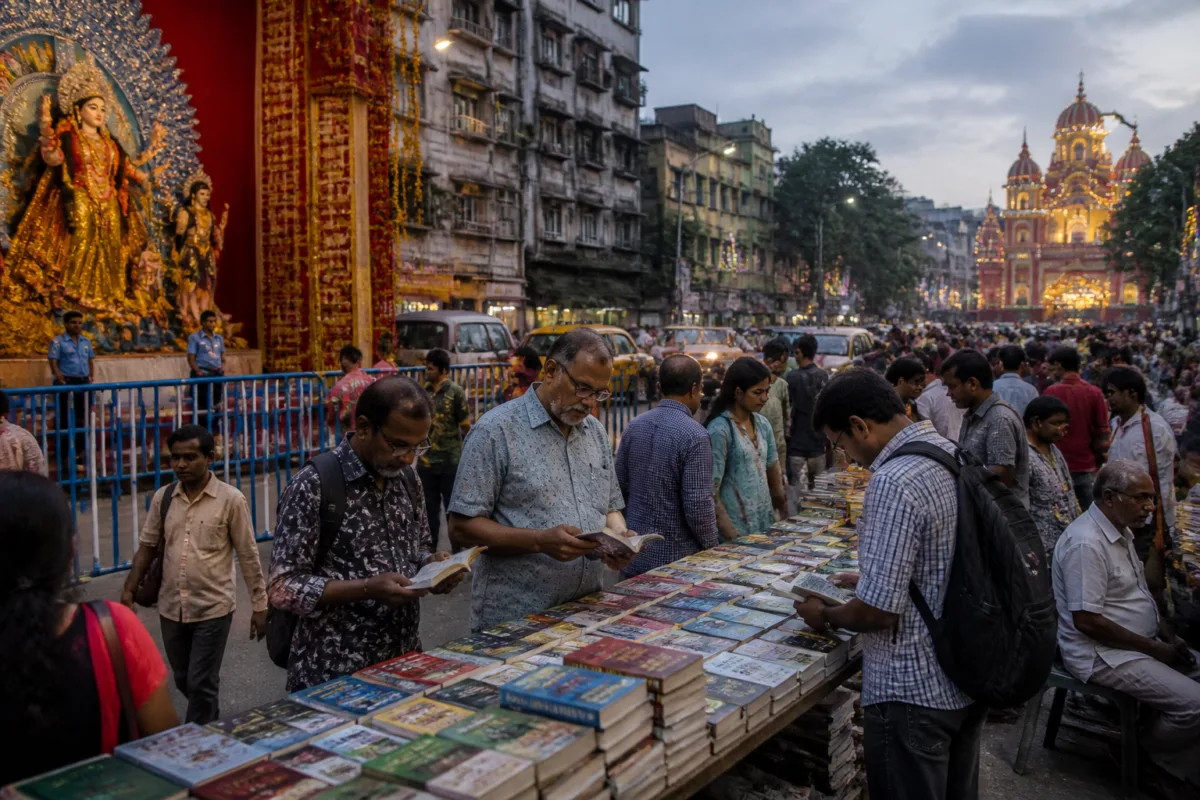
Kolkata’s Left-affiliated bookstalls became an unexpected measure of the city’s public-space tensions during Durga Puja. Sales rose sharply at several stalls even as others faced alleged vandalism, demolition attempts and restrictions on where political groups could operate. The contrast points to a conflict that extends beyond party politics: who can use civic space during a major festival, how permissions are enforced, and whether public areas around pandals remain open to competing forms of expression.
The figures reported by the Times of India show that demand for the stalls’ books did not weaken in response to the disruption. The Communist Party of India (Marxist), or CPM, reported sales of Rs 16 lakh at its stall near the Jadavpur 8B bus stand, compared with Rs 4.5 lakh last year. At the same location, the All India Students’ Association said its sales rose from Rs 50,000 to Rs 80,000. The Jadavpur stall operated in a contested setting: a bulldozer reportedly attempted to demolish bookstalls on a Saturday before resistance from local residents stopped the move.
The reported increase was not limited to Jadavpur. The CPM said its stall at Bagbazar Sarbojanin generated Rs 4.5 lakh this year, against about Rs 1.5 lakh last year. Its Bijoygarh stall recorded sales of Rs 1.3 lakh, while the Netaji Nagar stall generated Rs 2.2 lakh. The CPI(ML) Liberation reportedly sold books worth Rs 25,000 from its Moulali stall, almost twice last year’s figure, even though it was not allowed to establish a stall at Dhakuria.
The sales data comes from party and organisation representatives, rather than an independent audit. Even with that limitation, the reported pattern is significant. The stalls were not simply commercial points attached to the festival economy. Their performance became part of a wider public argument over whether political literature could be displayed near puja pandals, and whether attempts to remove the stalls would suppress or amplify public interest in them.
The CPM’s Kolkata district secretary said that more than 30 of the 119 bookstalls set up by the party in Kolkata faced disruptions or vandalism. The locations named in the report include Rashbehari, Lake Market, Behala, Haridevpur, Nagerbazar and Boral, along with places outside Kolkata such as Howrah and Siliguri. The CPI(ML) Liberation and the Socialist Unity Centre of India also reported disruption or damage involving their stalls. SUCI said its stall at Jadavpur was pulled down around midnight, but volunteers resumed selling books from makeshift tables and chairs.
A video from Nagerbazar circulated on social media showing people described in the report as right-wing supporters throwing books from a CPM stall onto the road. One of the books identified was Sarat Chandra Chattopadhyay’s Pather Dabi. The report also described 73-year-old CPM worker Bipul Dasgupta asking those involved to look through the books before discarding them. The video’s circulation gave the dispute a wider audience, but the supplied report does not establish the identities of all those involved or the outcome of any police investigation.
That distinction matters because public-space disputes can quickly move from an administrative question to a political confrontation. A stall may require permission from a civic body, land-owning agency or local authority, particularly when it is placed near a busy festival venue. But an attempt to remove it, or damage its books, raises a separate question about how permission disputes are handled. The report describes both administrative action and alleged attacks, but it does not provide the relevant written permissions, demolition order or police records. Those documents would be necessary to establish the precise legal basis for each intervention.
The Calcutta High Court has now entered the dispute through a petition by the Association for Protection of Democratic Rights. The organisation moved the court against the demolition of a bookstall near Jadavpur Super Market and sought accountability and compensation. The matter is scheduled to be heard on October 29. Until the court considers the case, the supplied report does not establish whether the demolition was authorised, whether due process was followed or who would be responsible for compensation.
The institutional question is made more complicated by the different explanations offered by political actors. BJP state president Samik Bhattacharya said that no genuine party worker could carry out the alleged vandalism and that damage to Left bookstalls could not be supported. The report also quoted Swapan Dasgupta describing repeated incidents as a matter of shame, while RSS spokesperson Jishnu Basu criticised those who used force to destroy bookstalls and linked the issue to India’s traditions of tolerance and freedom of expression.
At the same time, Suvendu Adhikari argued that police and the Kolkata Municipal Corporation had acted according to an order issued by the Calcutta High Court. He said groups that did not participate in or share the religious practices associated with Durga Puja should sell their literature from inside party offices rather than near pandals. That position places festival access and political identity at the centre of the dispute. It also raises an unresolved administrative question: whether access to a public area should depend on an organisation’s religious affiliation or on neutral criteria such as safety, congestion, land use and compliance with permissions.
The report does not reproduce the court order cited by Adhikari, nor does it specify whether the order applied generally to bookstalls, to a particular location or to a particular set of circumstances. Without that document, the relationship between the court’s directions and the civic action described at Jadavpur remains unclear. This is precisely the kind of gap that can turn a local enforcement action into a larger contest over institutional legitimacy.
Kolkata’s festival geography makes the issue especially visible. Durga Puja pandals temporarily reshape roads, footpaths, markets and neighbourhood gathering points. These spaces carry heavy pedestrian movement and often require traffic restrictions, crowd management and temporary permissions. At the same time, they become some of the city’s most prominent public platforms. Political parties, cultural groups, vendors, residents’ associations and visitors all seek access to the same limited urban space.
The bookstalls therefore sit at the intersection of several systems: municipal permissions, festival management, political campaigning, cultural activity and informal public commerce. The supplied report does not state the fees paid, the permission conditions, the exact land ownership arrangements or the criteria used to approve or reject stalls. It also does not establish whether the same rules were applied to all political or cultural organisations. Those are the administrative details that would determine whether the controversy reflects a one-off dispute or a broader pattern in the management of temporary public spaces.
The reported sales figures provide another layer to the story. CPM representatives said sales at several stalls rose by roughly three to four times, while SUCI reported an overall increase of 40% to 50% across districts. These figures cannot by themselves measure public sentiment or political support. They may reflect curiosity after the incidents, the availability of books at locations with heavy footfall, renewed interest in political literature, or the mobilisation of supporters. But they do show that the stalls retained a functioning public audience despite disruption.
That audience is important because the stalls were not only distribution points. They offered books associated with political history, literature and ideological debate in places where large numbers of residents were already gathering. The reported presence of buyers from different political backgrounds, including Trinamool Congress MLA Kunal Ghosh and West Bengal Congress president Subhankar Sarkar, suggests that the stalls also became sites of public solidarity and political signalling. The source does not provide a breakdown of buyers or titles sold, so the broader composition of demand remains unknown.
The central urban question is not whether a political party should receive favourable treatment. It is whether cities can regulate contested public spaces through transparent, consistently applied rules while protecting lawful civic and cultural activity. Festival areas are temporary, but the principles used to manage them can influence how residents experience streets, markets and neighbourhood gathering places throughout the year.
Kolkata’s bookstall dispute also shows how enforcement can produce consequences beyond the original administrative objective. The reported attempts to remove or damage stalls coincided with higher sales at some locations and greater public attention. That does not establish causation, but it demonstrates that physical control of a public space does not necessarily control the conversation taking place there.
What the available evidence confirms is that Left-affiliated bookstalls experienced both disruption and increased sales during the festival period. It also confirms that the dispute has reached the Calcutta High Court and drawn statements from leaders across political and ideological positions. What remains unresolved is the documentary basis for individual removals, the findings of any investigations into vandalism, and the exact scope of the court order cited in the political debate. The October 29 hearing, along with the authorities’ records on permissions and enforcement, will determine whether the controversy remains a political confrontation or becomes a clearer test of Kolkata’s rules for using public space.

