


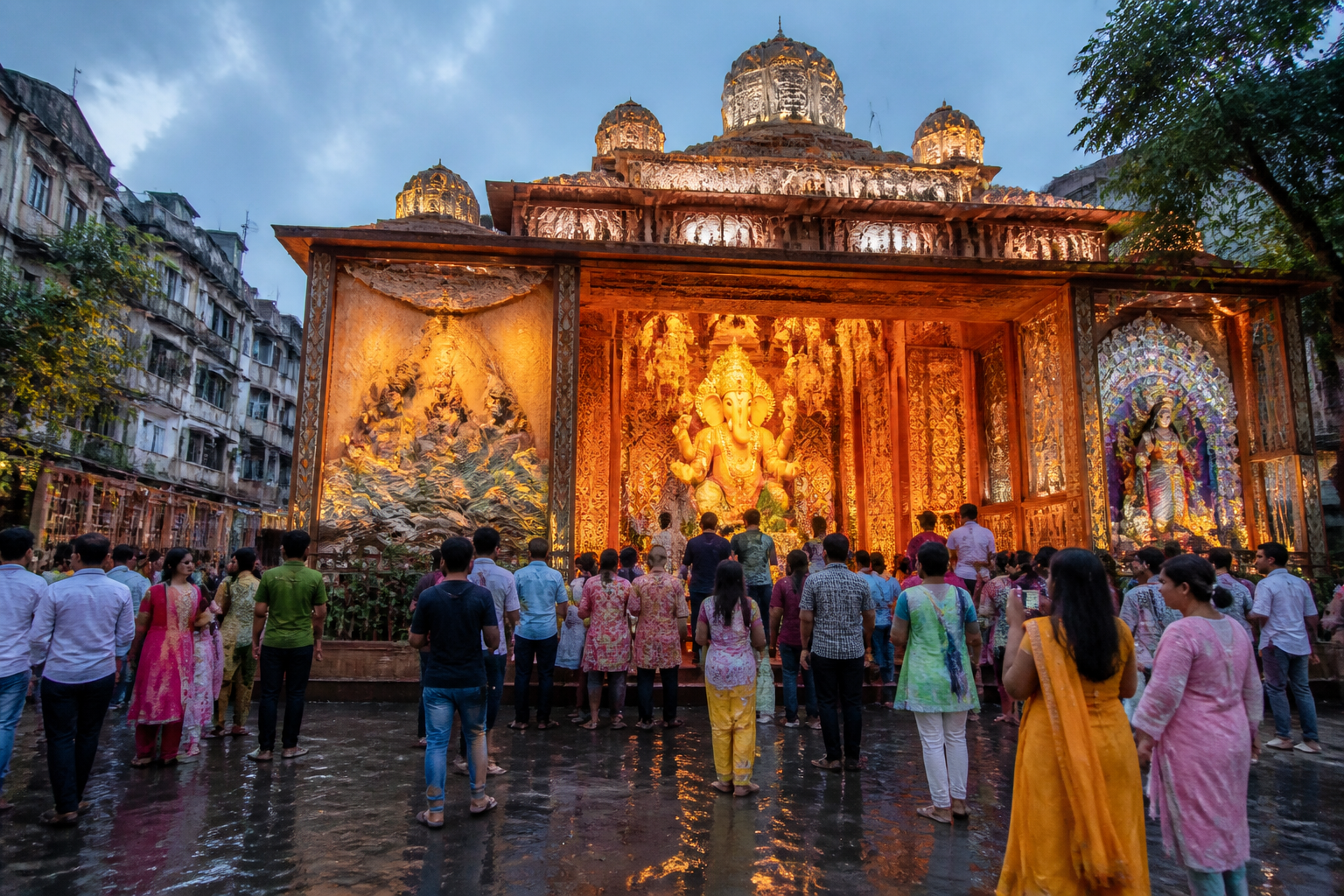
Kolkata’s Ganesh Puja pandals are becoming more than temporary religious spaces. Across the city, organisers are using them to present political messages, assert competing ideas of Bengali identity, remember contested historical figures and attach charitable activity to neighbourhood celebrations. The shift is most visible at Janbazar, where a Ganesh Puja committee has combined an image of Durga with a half-bust of Gopal Mukherjee, a meat seller associated with armed resistance during the 1946 Great Calcutta Killings.
The Janbazar puja was inaugurated on Sunday evening by state BJP chief Samik Bhattacharya, while the main day of Ganesh Chaturthi falls on Monday. Ashish Sharma, vice-president of the Janbazar Sri Sri Ganesh Puja Utsav Committee and a BJP supporter, described the installation as a statement about a changed Bengal. He said the committee wanted to invite Durga into this new political and cultural environment through Ganapati worship.
The choice of Gopal Mukherjee is significant because he is being promoted by sections of the Right-wing political ecosystem as a Bengali Hindu figure. Sharma said the committee had wanted to honour him earlier but had been unable to do so because of political pressure. The statement places the pandal within a wider effort to shape which historical personalities are remembered in public cultural spaces and how their histories are presented to visitors.
The committee’s increased spending also points to the expanding scale of the festival. Its budget this year is more than ₹7 lakh, twice the amount spent the previous year. That rise does not by itself establish a citywide financial trend, but it illustrates how some Ganesh Puja committees are investing more heavily in displays that compete for public attention during Kolkata’s crowded festive calendar.
For decades, Durga Puja has been Kolkata’s dominant platform for elaborate themes, public art and neighbourhood-level cultural expression. Ganesh Puja was generally seen as a smaller and quieter prelude to the main festive season. The reported changes suggest that the format associated with Durga Puja is travelling to other festivals: pandals are increasingly being designed around a theme, and the theme may address politics, social conflict, identity or public memory rather than remaining limited to religious decoration.
The shift is not ideologically uniform. At Anwar Shah Road, a Ganesh Puja pandal used lines from Pratul Mukhopadhyay’s song “Ami Banglay gaan gai” last year. The song celebrates Bengali identity and, according to the report, the theme was presented as a protest against the alleged harassment of Bengali-speaking people, mostly working-class Muslims, by police in BJP-ruled states. The issue had become a major electoral theme for the Trinamool Congress. Organisers of that puja were perceived as being close to the erstwhile ruling party, although they said their budget was much lower than in previous years.
The political contrast between Janbazar and Anwar Shah Road shows how pandals can operate as competing public communication platforms. The same festival can accommodate different understandings of Bengal: one may frame the moment through nationalist politics and a Hindu historical figure, while another may use language, music and allegations of discrimination to defend a broader regional identity. In both cases, the pandal provides a physical setting in which political ideas can be encountered outside conventional campaign venues.
The relationship between puja committees and political figures is also visible through inaugurations. Papiya Adhikari, the BJP MLA from Tollygunge, inaugurated the Anwar Shah Road puja last year. In earlier years, the event had been inaugurated by Aroop Biswas, a former Trinamool heavyweight and defeated candidate from Tollygunge. These appearances do not establish control over the committees, but they show how inaugurations connect neighbourhood festivals with party networks and elected representatives.
Not every themed pandal is intended as political messaging. In Kasba, the P. Majumdar Bridge Indu Park Garden Committee’s puja, now in its sixteenth year, is modelled on a lotus. Its secretary, Shankar Das, said there was no politics involved and that the committee tried to incorporate a theme every year. This distinction matters because the growing use of themes does not mean that every design carries an explicit political claim. Some themes remain aesthetic, symbolic or devotional, while others are deliberately linked to current events and political debate.
The history of these pandals shows how quickly temporary public spaces can absorb major events. In previous years, the campaign for justice in the RG Kar rape and murder case found resonance in Ganesh Puja pandals. During the pandemic, designs incorporated masks and social distancing. These examples indicate that pandals can become responsive civic stages, reflecting issues that residents are discussing in homes, workplaces and public life.
This responsiveness is partly enabled by the temporary and decentralised nature of the festival. Pandal committees operate at the neighbourhood level and can decide their themes, invite political figures, organise public activities and shape the visitor experience without waiting for a formal civic programme. Their installations occupy streets, parks and other shared urban settings for a limited period, creating a form of cultural infrastructure that is outside the permanent institutions of the city but still affects how public space is used.
The social role of the pujas is equally important. Blood donation camps, meal distribution and the distribution of clothes are part of several celebrations. In Bhowanipore, the Ganapati Bhakt Mandal Ganesh Puja, now in its fourteenth year, planned to distribute more than 1,000 fresh laddus to visitors. In Behala, the Sri Sri Ganesh Puja on Brajamani Debya Road, which also completed fourteen years, planned to distribute clothes among around 500 underprivileged people on Tuesday.
These activities show that the festival is not only a visual or political platform. It also supports neighbourhood-level welfare and voluntary action. The scale of such initiatives varies, and the supplied report does not provide a consolidated assessment of their reach. Still, the combination of worship, public gathering, food, charity and cultural messaging gives the pandal several overlapping functions within the urban neighbourhood.
The physical conditions surrounding the festival also influence how it is experienced. Persistent rain and overcast weather had kept organisers worried, with light to moderate rain expected on Monday. Weather affects temporary structures, visitor movement, electrical arrangements and the viability of outdoor celebrations. At the same time, sweet shops were reporting strong demand for laddus and modaks, showing the economic activity generated around the festival at the street and neighbourhood level.
The 19-foot idol at the Behala puja illustrates another aspect of this changing scale. Large idols and themed structures increase visibility and can draw more visitors, but the report does not establish whether this growth is consistent across the city or how it affects traffic, waste, sound levels and public-space management. Those questions remain important because the expansion of temporary festivals can place additional demands on local streets and civic systems even when the events are organised by community committees.
Kolkata’s Ganesh Puja therefore sits at the intersection of religion, neighbourhood organisation, electoral politics, cultural memory and urban public life. The evidence does not support the conclusion that all pandals have become political, nor does it show that one political formation has captured the festival. It does show a widening range of themes and a stronger willingness among some organisers to use temporary public installations to make claims about Bengal’s history, identity and present political direction.
The next phase of the festival will reveal how these themes are received by visitors and whether committees continue to increase spending and public programming. For now, the reported pandals confirm that Kolkata’s festive landscape is not merely reflecting political and social change from the outside. Through images, statues, songs, charity drives and public gatherings, neighbourhood committees are actively giving that change a physical form.
