


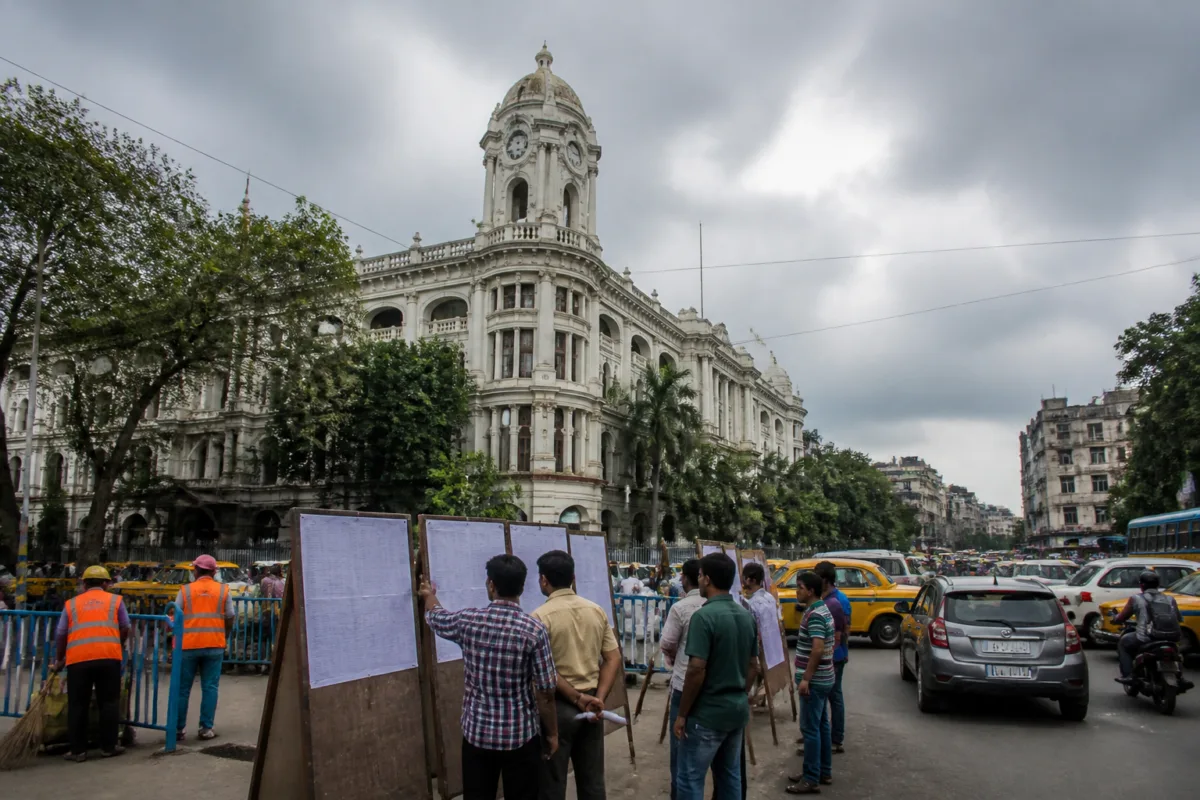
The possible delay in civic elections to the Kolkata and Howrah municipal corporations is not only a question of when voters will cast their ballots. It has exposed a coordination gap between the West Bengal government and the State Election Commission (SEC) at a time when both corporations are preparing for a substantial increase in their elected ward structures.
According to The Statesman, the SEC has sought the state government’s clearance to conduct the polls by the end of November, but the government had not responded when the report was published. The notification, earlier expected on November 28, was therefore likely to be delayed, with the elections possibly moving into December. SEC sources said December 28 is the deadline for constituting the boards of the two civic bodies, making the timing of every stage in the election process significant.
The immediate uncertainty is administrative rather than electoral. The SEC has said it is prepared to conduct the polls and has already drawn up a list of observers. It is also expected to publish ward-specific final draft electoral rolls on November 12 and has approached the Election Commission for an amended electoral roll reflecting the position as of October 1. These steps indicate that the election machinery has been working towards a defined schedule, even though the final political and administrative clearance remains pending.
A senior state government official, speaking informally to journalists at the state secretariat Nabanna, acknowledged that the government had yet to communicate its position on the proposed elections. The official said the civic polls would be held “at an appropriate time”. State Urban Development Minister Agnimitra Paul separately said the government had not decided to defer the elections, while adding that Chief Minister Suvendu Adhikari was monitoring the developments.
The statements do not amount to a formal postponement. They do, however, show that the two institutions are not yet operating on a publicly settled timetable. That distinction matters because a civic election is not complete with polling day alone. The process includes finalising electoral rolls, notifying wards, appointing observers, conducting nominations, holding the poll and constituting the municipal boards. A delay at the beginning can compress the time available for the remaining stages, particularly when the number and boundaries of wards are also changing.
The ward reorganisation is central to the uncertainty. In August, the West Bengal Assembly passed two separate Bills proposing an increase in the number of wards in the Kolkata Municipal Corporation (KMC) and the Howrah Municipal Corporation. Kolkata’s wards are proposed to rise from 144 to 209, an increase of 65. Howrah’s are proposed to rise from 50 to 68, adding 18 wards. Together, the two corporations would move from 194 existing wards to 277 proposed wards, an increase of 83.
The state government said the expansion was intended to ensure better civic services for residents. In administrative terms, however, more wards also mean a larger electoral and representational framework. The election authorities must work with ward-specific electoral rolls and ensure that voters are assigned to the correct constituencies. Political parties and candidates must also organise across the revised structure, while the municipal administration must prepare for the constitution of boards with a different number of elected representatives.
The proposed expansion therefore links two distinct processes: the redesign of local representation and the conduct of the election that will give that redesign democratic legitimacy. If the ward increase is already part of the election framework, the poll schedule cannot be treated as an isolated calendar decision. The timing must also accommodate the administrative work created by the new structure.
Kolkata’s proposed increase is particularly large in absolute terms. The KMC would add 65 wards to its existing 144, while Howrah would add 18 to its existing 50. The changes are smaller in scale in Howrah but still significant because they alter the corporation’s representative map and the number of constituencies through which residents engage with local government.
The available report does not establish the precise boundaries of the new wards, the population distribution across them, or the administrative basis on which the state government calculated the increases. It also does not specify whether the proposed ward structure has received all necessary procedural clearances for the election notification. Those details are important because the quality and timing of a civic election depend not just on the number of wards but on the clarity of their boundaries, the accuracy of voter lists and the readiness of local election administration.
The SEC’s request for an amended electoral roll as of October 1 adds another layer to the process. Electoral rolls are a foundational document for municipal elections: they determine who is registered to vote and in which ward. A revised roll must be integrated with the ward structure before polling can proceed. The SEC’s decision to identify a specific qualifying date suggests that the commission is attempting to establish a common administrative basis for the election, but the report does not state when the amended roll will be received or published.
The December 28 deadline for constituting the municipal boards creates the clearest institutional constraint in the report. The boards of the two corporations must be formed by that date, according to SEC sources. To meet that deadline, the election programme must leave enough time for notification, nominations, scrutiny, withdrawals, polling, counting and the formal constitution of the boards. The source does not provide the duration of each stage, but the existence of a fixed constitution deadline means that a delayed notification could have consequences for the entire sequence.
This is where the difference between election readiness and government clearance becomes visible. The SEC says it has prepared observers and is working on electoral rolls. The state government, meanwhile, has not formally communicated its position on the proposed timetable. The result is not yet a confirmed postponement, but an unresolved institutional dependency: the commission may be operationally prepared while the election cannot move forward until the government completes its part of the process.
For residents, the issue is connected to how municipal accountability is organised. Kolkata and Howrah civic bodies are responsible for the everyday systems through which urban services are delivered and managed. The source does not provide a detailed account of service performance or the current administrative status of the corporations, so it would be premature to link the possible delay to any particular service failure. The immediate public concern is instead whether the transition to the new ward structure will happen through a clear, timely and constitutionally settled process.
The proposed ward expansion also raises a basic administrative question: whether additional representation will be accompanied by clearer responsibility and stronger service delivery at the local level. The government has presented the increase as a measure for better civic services. That claim will ultimately depend on how ward-level administration, budgets, councillor responsibilities and municipal decision-making operate after the boards are constituted. The supplied report does not establish how those mechanisms will change, but it shows that the institutional redesign is arriving at the same time as an uncertain election schedule.
The next formal milestones are therefore more important than informal assurances. The SEC’s publication of the ward-specific final draft electoral rolls, its request for an amended roll from the Election Commission, the state government’s communication on the election proposal and the eventual notification will determine whether the process remains on track. The December 28 board-constitution deadline provides the measure against which those decisions will be judged.
What the available evidence confirms is limited but consequential: the SEC has prepared for the elections, the state government has not publicly settled the proposed schedule, the notification expected on November 28 may be delayed, and both corporations are undergoing a major ward expansion. What remains unresolved is whether the polls will be held before December 28 and whether the revised electoral and ward arrangements can be completed within the remaining timetable. Until the government communicates its position and the SEC issues a formal notification, the civic elections remain possible but procedurally unsettled.

