


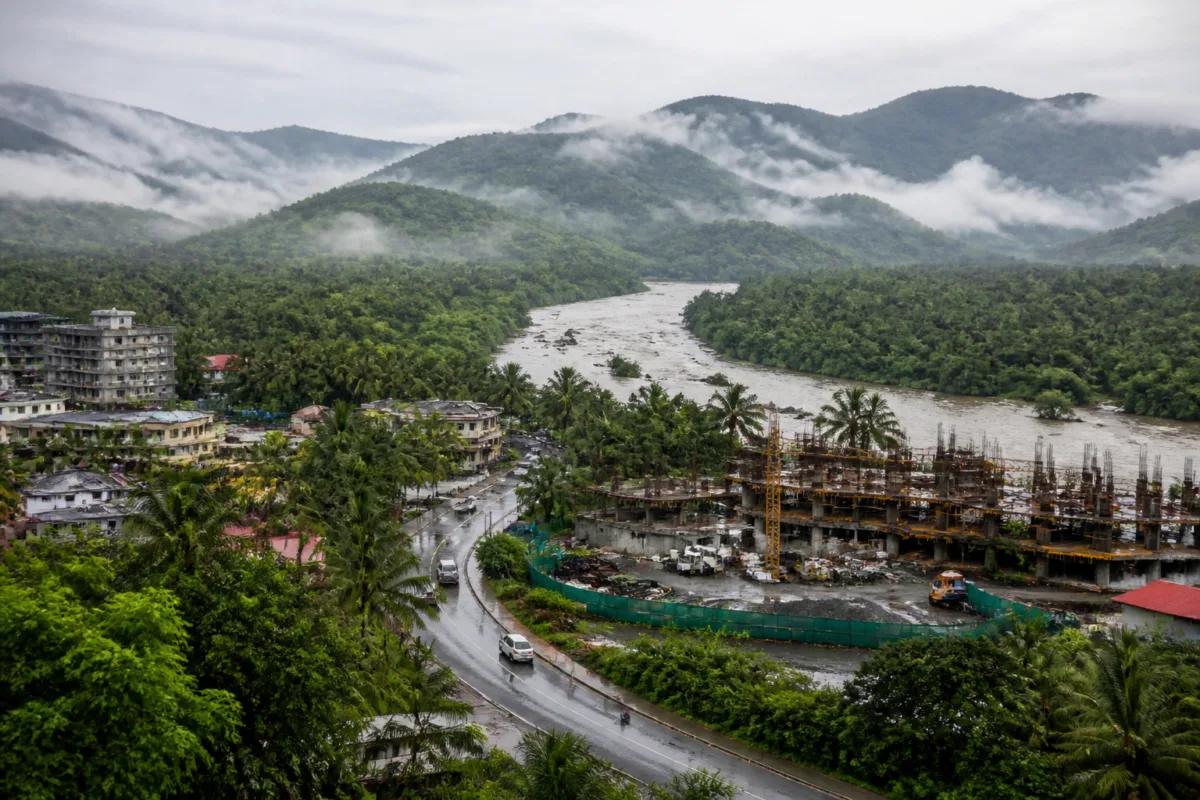
Kerala’s 15th Five-Year Plan is being framed around a difficult policy balance: sustaining economic growth while accepting that parts of the state cannot be developed without regard to ecological limits. The position outlined by Kerala State Planning Board vice-chairperson K M Chandrasekhar places environmental protection alongside development as an equal planning priority, while also raising a less discussed question—who should compensate states when conservation restricts revenue-generating activity?
That question matters because Kerala’s ecological assets are not confined to the locations where they exist. Chandrasekhar said the Western Ghats provide carbon sequestration, biodiversity conservation and the sustenance of rivers. These benefits extend beyond Kerala, creating a case for treating ecological protection not merely as a state-level constraint but as a service with national value. The proposal for compensation from the Centre therefore links environmental planning to fiscal federalism, or the way financial resources and responsibilities are shared between different levels of government.
The comments were made at the fifth annual conference of the Society for Pathways to Sustainability, organised by the Gulati Institute of Finance and Taxation in association with Nalanda University and PathS at the GIFT campus in Thiruvananthapuram. They are significant not because they announce a completed policy, but because they indicate the principles that could shape Kerala’s next five-year planning cycle.
The central idea is that development cannot be assessed only through the economic activity it generates. The report says Kerala’s development policy will be based on economic growth while safeguarding ecologically fragile regions. It also says the plan will account for both the social foundations required for people’s quality of life and the ecological limits defined by the state’s environmental characteristics.
That combination places the plan within a broader planning challenge faced by many Indian states. Public authorities must provide housing, livelihoods, transport, infrastructure and services, but the land, water and ecological systems supporting those activities have limits. When those limits are ignored, the resulting costs can emerge through damaged ecosystems, weaker water security or greater pressure on communities. The supplied report does not quantify these impacts for Kerala, but it makes clear that ecological boundaries are intended to be part of the plan’s design rather than an afterthought.
The institutional significance lies in the reference to “clear development limits” for the 15th Five-Year Plan. The report does not specify the geographic boundaries, sectors or regulatory instruments that would define those limits. It does, however, indicate that the planning exercise is being shaped by the state’s environmental characteristics and by directions attributed to Chief Minister V D Satheesan. That leaves an important implementation question open: how will a broad principle of ecological limits be translated into decisions on land use, construction, quarrying, infrastructure and local development?
Planning documents often become consequential through these operational details. A statement that development and environmental protection deserve equal priority establishes a direction, but the effect on cities and towns will depend on how authorities classify sensitive areas, assess projects, coordinate across departments and reconcile local economic needs with wider ecological objectives. The report does not provide those mechanisms, so the eventual plan will need to clarify them if the principle is to guide decisions consistently.
The proposal for Centre-funded compensation adds an economic dimension to the debate. Chandrasekhar argued that states that give up revenue-generating activities such as quarrying to protect ecologically sensitive areas should be considered for compensation. This suggests that conservation can create an uneven fiscal burden: a state may bear the immediate cost of restricting an activity, while the environmental benefits extend across administrative boundaries.
The argument is particularly relevant to Kerala because the Western Ghats support functions that are not limited to the state in which particular landscapes or river systems are located. Carbon sequestration and biodiversity conservation have wider public value, while rivers support communities and economic activity. Chandrasekhar said these contributions should be considered when determining the criteria for sharing central tax revenues. In effect, the proposal seeks to connect ecological stewardship with the formula through which states receive financial resources from the Centre.
The report does not say whether the Centre has accepted this proposal or whether a compensation mechanism has been designed. It also does not identify the revenue foregone by Kerala, the activities that would qualify, or the method by which ecological contributions would be measured. Those gaps are important because any such system would require an agreed definition of conservation costs and benefits, as well as a transparent way to determine which states and activities qualify.
Without those details, the proposal remains a policy demand rather than an established funding arrangement. Yet its significance is clear. If states are expected to protect nationally valuable ecosystems, their planning and finance systems may need to recognise conservation as a public service rather than treating it only as a restriction on economic activity. That would alter the way development choices are evaluated and could make ecological protection more visible in budgetary discussions.
The plan’s reference to social foundations also broadens the discussion beyond environmental regulation. At the same conference, P K Anand, a former IAS officer and senior research fellow at Nalanda University, said the right to skill development for all is essential to addressing poverty and inequality. The comment places human capability alongside economic growth and ecological protection as part of the planning framework described in the report.
Taken together, the remarks point to a three-part planning model: economic activity must continue, environmental systems must remain within their limits, and people must have the social and economic capabilities needed to benefit from development. The report does not explain how these priorities will be ranked when they conflict. That is likely to be one of the most important tests for the 15th Five-Year Plan.
For urban areas, the implications are indirect but substantial. Cities and towns are connected to the ecological systems around them through water, land, transport networks, construction materials and employment. Restrictions on quarrying, for example, could affect the availability and cost of construction inputs, although the report does not quantify such effects. Protection of river systems and fragile regions could also shape the location and pace of future development, but no specific projects or urban areas are identified in the supplied material.
This is why the planning process cannot be treated as an exercise limited to government departments. Decisions about ecological limits can influence local bodies, builders, workers, households and communities that depend on land-based activity. At the same time, decisions to permit development in sensitive areas can impose costs that are not immediately reflected in project accounts. A plan that gives equal priority to development and environmental protection will need to make these trade-offs visible and assign responsibility for them.
The available evidence confirms the direction of the proposed plan but not its final architecture. Kerala has identified ecological limits and social foundations as considerations for the 15th Five-Year Plan, and a senior Planning Board official has called for national recognition of the Western Ghats’ wider benefits. The report does not establish the final policy, the compensation formula, implementation timetable or list of restricted activities.
The next stage will therefore be important. The plan’s credibility will depend on whether its broad principles are converted into measurable criteria, institutional responsibilities and funding decisions. The conference report indicates that Minister Sunny Joseph was scheduled to address the event on Tuesday, while further details of the plan itself were not provided. Until those details emerge, Kerala’s green-growth debate remains a statement of direction—but one that puts the fiscal cost of conservation at the centre of development planning.

