


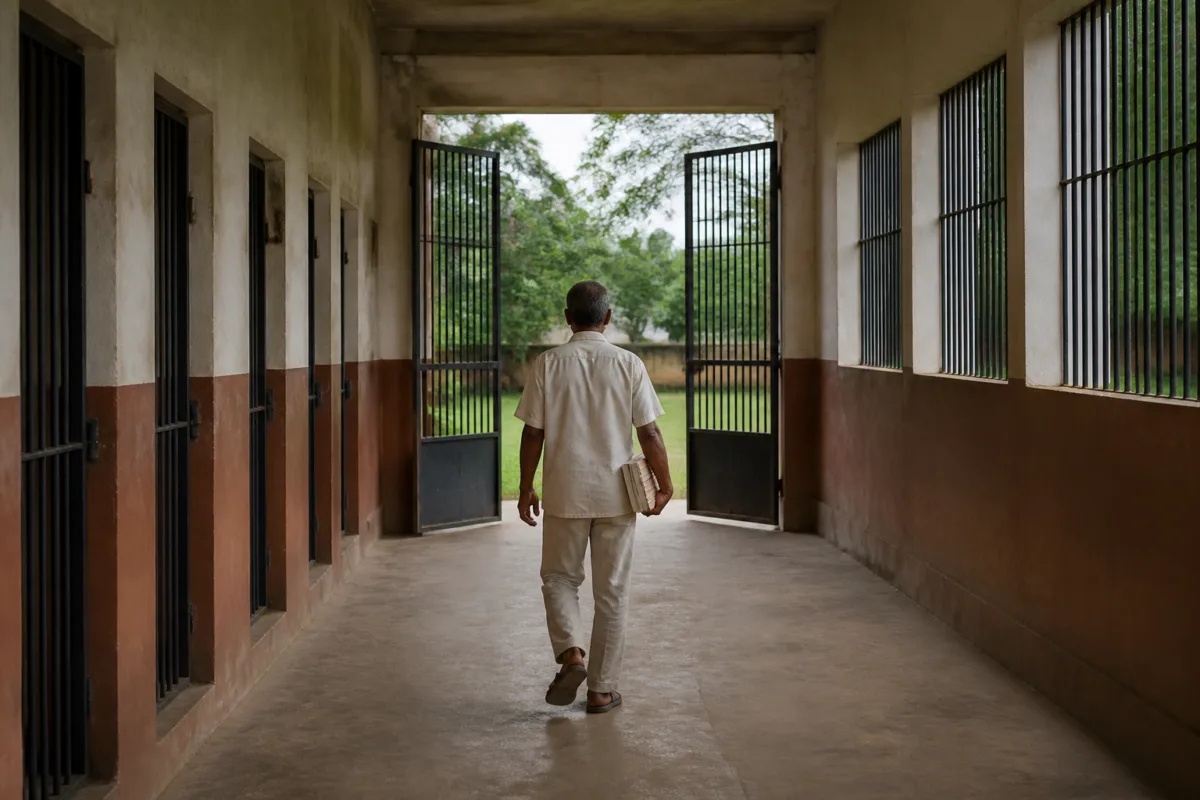
The Kerala State Human Rights Commission’s direction to rehabilitate prisoners who have undergone positive transformation puts a neglected question before the state: what happens to people after the prison system has finished holding them? The order, issued while considering a complaint by 67-year-old C Sajeevan, also asks the government to ensure that letters sent by prisoners receive appropriate replies. Together, the directions connect rehabilitation, dignity and administrative responsiveness within one institutional problem.
The commission member who issued the directive, V Geetha, directed the chief secretary, the additional chief secretary of the home department and the director general of prisons to take steps to support prisoners after their release. The order, as reported by the Times of India, says people who may have been driven into a life of crime should be enabled to lead dignified lives and should not be ostracised by being branded as thieves indefinitely.
That framing is important because it shifts the discussion from punishment alone to reintegration. The case does not establish that every prisoner has been rehabilitated, nor does it prescribe a detailed statewide programme. But it does establish that the state human rights body sees a responsibility extending beyond confinement, particularly when an individual has demonstrated a positive transformation and seeks an opportunity to return to society.
Sajeevan’s complaint gives the order a specific human and administrative context. He has spent around 36 years in prisons across Kerala, primarily in connection with theft cases. He is described as a voracious reader who used part of the money he stole to buy books and later donated books to a prison library. He also became known as “Vakkeel Sajeevan” because he argued his case personally in court.
The account of his prison history is not linear. Jail sources cited in the report said Sajeevan had been released about two years earlier but was arrested again following alleged involvement in another theft case in Thiruvananthapuram. The report also said he may have submitted the complaint when he was housed earlier at Viyyur Central Jail, while the commission was considering it in the context of his incarceration at the high-security prison in Viyyur, Thrissur. This sequence matters because it shows how release does not necessarily mark a clean break from the prison system.
For Sajeevan, the immediate request was framed around the remainder of his life. Now 67, he sought an opportunity to live in peace and with dignity after a prolonged period of incarceration. His complaint also alleged that letters sent to the government had gone unanswered. The commission’s instruction on correspondence therefore addresses more than courtesy. It raises the question of whether prisoners can effectively access the institutions responsible for decisions affecting their rights and future.
A letter from a prisoner can contain a request for rehabilitation, a grievance, a legal concern or a plea for administrative intervention. When such correspondence receives no response, the person inside prison remains separated not only from the wider society but also from the government that administers the prison system. The SHRC’s direction to the additional chief secretary of the home department to ensure appropriate replies identifies communication as an accountability function rather than an informal administrative task.
The institutional routing of the order is equally significant. The chief secretary represents the highest level of state administration named in the directive. The additional chief secretary of the home department is directly connected to the department responsible for internal administration and prisons, while the director general of prisons heads the prison administration. By addressing all three levels, the commission has placed rehabilitation and prisoner correspondence across the administrative chain rather than treating them as matters for an individual jail alone.
The report says Sajeevan pointed to rehabilitation measures available for Maoists who surrendered and argued that comparable support was not available to prisoners. The commission’s order does not, according to the supplied account, confirm that the two situations are identical or prescribe that the same scheme must apply. But the comparison reveals the kind of institutional inconsistency that can shape whether a person is able to leave a cycle of incarceration. Different categories of people may receive different forms of state support, while prisoners who seek reintegration may not have an equally visible route to assistance.
That distinction also highlights a basic policy problem. Rehabilitation cannot be assessed only by what happens inside a prison. Reading, donating books to a prison library or personally arguing a case may show individual effort, but the state’s role begins where individual effort meets administrative access. The supplied report does not provide details of a statewide rehabilitation budget, a release-support mechanism, employment assistance or a housing programme for former prisoners. It therefore does not establish how Kerala currently supports people after release. What it does show is that the human rights commission has asked the government to address the gap identified in this individual case.
The case also demonstrates why prison administration belongs within the wider built-environment and governance conversation. Prisons are physical institutions, but their effects extend into families, neighbourhoods, courts, welfare systems and public administration. A person who has spent decades moving through prisons does not return to society with the same social and economic position as someone who has remained outside the system. The report does not quantify these effects, but Sajeevan’s age, long incarceration and subsequent arrest illustrate how difficult reintegration can become when release is treated as an endpoint rather than a transition.
The commission’s intervention places dignity at the centre of that transition. Its observation that society should not permanently label reformed individuals as thieves challenges the assumption that a past conviction or prison history should define a person’s entire future. This is not a finding that erases the alleged offences or later allegations. It is an administrative and human-rights question about whether punishment should permanently prevent a person from rebuilding a life after release.
The facts in the case also show the limits of a release-only approach. Sajeevan was reportedly released and later arrested again in connection with another alleged theft case. The supplied material does not establish why the later arrest occurred, whether any rehabilitation support was offered, or whether the previous release included assistance. Those questions cannot be answered from the commission’s directive as reported. They are, however, central to understanding whether reintegration measures are being designed as a structured process or left to individual resilience.
The order’s significance therefore lies less in the personal history of one prisoner than in the administrative duties it identifies. First, prisoners who have undergone positive transformation may require support to return to society with dignity. Second, communication from prisoners to government must receive an appropriate response. Third, responsibility for these issues must be visible at the level of the state administration, the home department and the prison directorate.
The next stage will determine whether the directive produces more than an acknowledgment of principle. The supplied report does not state what specific steps the government will take, whether Sajeevan will receive individual assistance, or whether Kerala will create a broader framework for prisoners approaching release. It also does not establish how officials will monitor responses to prisoner letters. These details remain unresolved.
What the order confirms is that rehabilitation is not simply a question of personal reform. It is also a question of whether public institutions recognise that reform, respond to requests and provide a credible route back into society. In directing senior officials to act on both rehabilitation and correspondence, the Kerala SHRC has exposed a gap between confinement and reintegration. The government’s response will show whether that gap is treated as an individual grievance or as a wider responsibility of the prison system.

