


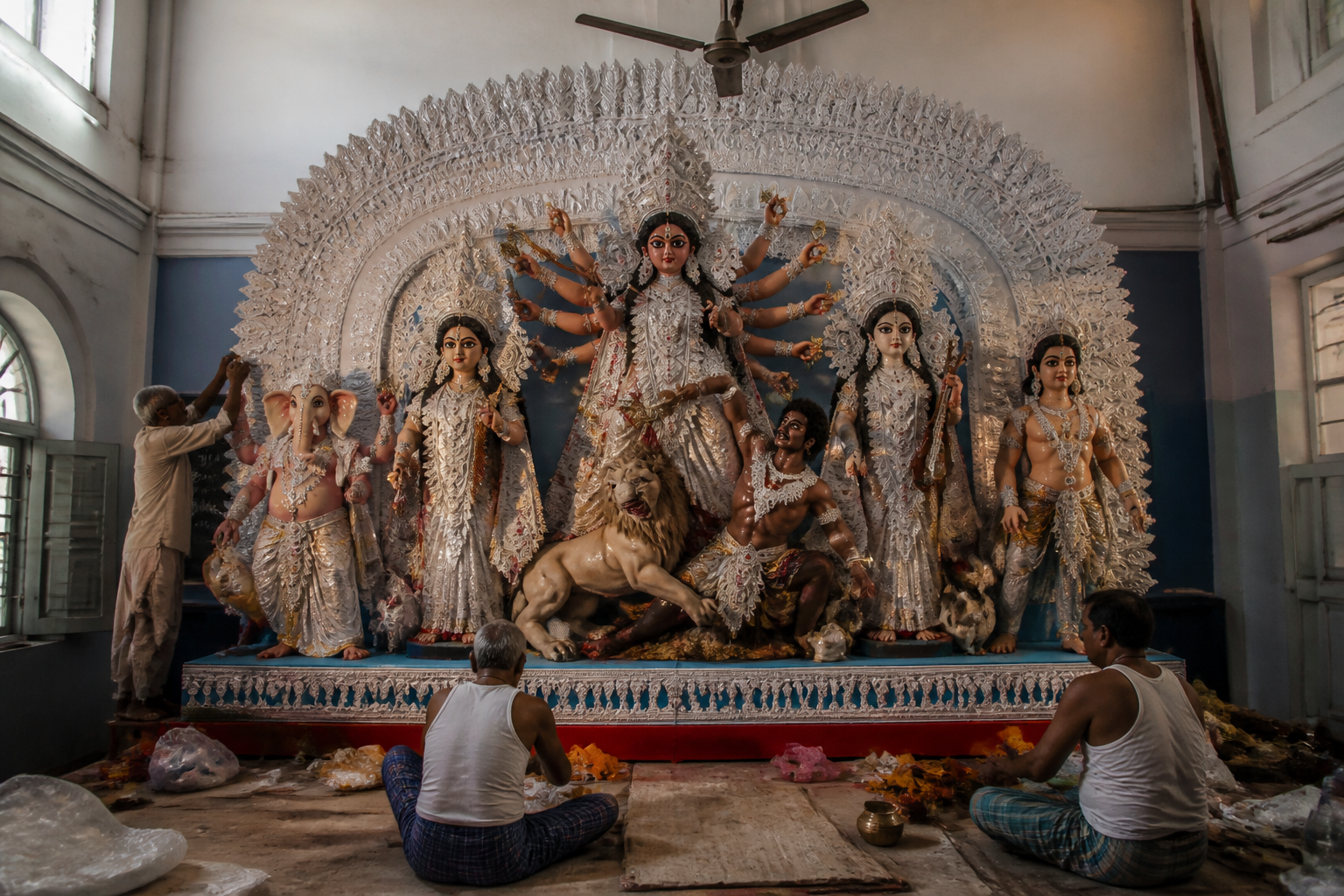
The 117th Kashmere Gate Durga Puja is more than a seasonal religious gathering. Its movement across Delhi, its continued association with a school in Civil Lines and its unchanged ek chala idol show how an urban community can preserve memory while adapting to a city that has repeatedly changed around it.
The Puja is now held at Bengali Senior Secondary School on Shamnath Marg, where it has been organised since 1968. But its history reaches back to 1909, when the Bengali community in Delhi was still small and the first celebrations were held at Roshanpura Kali Mandir near Nai Sarak. For the first two years, devotees worshipped a sacred pot, or kalash, rather than an idol. The kalash remains part of the ritual even after the idol became central to the celebration.
That origin is significant because it places the Puja within the history of Delhi’s expanding migrant and professional communities. Dr Hemchandra Sen, who worked with the Railways, is remembered by organisers as one of the people who helped bring the community together. The first idol was brought from Kashi, now Varanasi, in 1912 with the help of Railway employees. From 1926, the idol was made in Delhi, although the artisans continued to come from West Bengal.
The Puja’s locations trace a parallel history of the city. After beginning at Roshanpura, it moved to the Dharamshala of Lala Laxminarayan near Fatehpuri Mosque, where it remained from 1913 to 1946. After Independence, it shifted towards Kashmere Gate, first to Delhi Polytechnic and then to the Women’s Polytechnic. In 1968, it reached the Bengali Senior Secondary School, where the celebration continues.
The sequence shows that the Puja has not been tied to one permanent purpose-built religious structure. It has used available institutions and spaces as Delhi’s urban geography evolved. Its continuity has therefore depended not only on devotion but also on access to schools, educational campuses, community facilities and the people who maintain them.
## An urban institution inside a school
The Bengali Senior Secondary School is central to the current arrangement. During the six days of the Puja, its classrooms become makeshift bedrooms for workers associated with the celebration. Students’ classes are conducted online while the festivities are under way. This arrangement illustrates how a public-facing institution can temporarily absorb a large community event, while also revealing the practical negotiations required when civic, educational and cultural uses overlap.
The Puja is organised by the Delhi Durga Puja Charitable and Cultural Samiti. Arun Ghosal, president of the Puja Committee and chairman of the school, is described by members as having played an important role in sustaining the arrangement. The relationship between the committee and the school has given the celebration a stable address, but the event still depends on a substantial annual effort involving organisers, artisans, workers, donors and volunteers.
Its continuity is also reflected in the people who return to it across generations. Arun Roy, 77, a former student and an artist, oversees the making of the idol. Monish Mukherjee, the general secretary of both the Bengali Club and the charitable and cultural samiti, is a fourth-generation member of the committees. His son is involved in the current Puja as secretary of the Sports department.
Another form of continuity is visible among the workers. Bhimal Kumar, a farmer from Uttar Pradesh, has worked with the committee for 20 years. His father worked there for 35 years, and Kumar continued after his father’s death. His nephew, Atul Kumar, joined for the first time this year. During the Puja, the classrooms provide accommodation not only for an event but also for a temporary workforce whose involvement has itself become intergenerational.
## The ek chala idol as a fixed urban marker
The idol has remained largely unchanged since 1912. Roy describes it as ek chala, meaning that Durga, Lakshmi, Saraswati, Ganesha and Kartikeya are placed together beneath a single arch. Unlike arrangements where the figures are positioned separately, the unified design has been retained since the Puja began.
The murti is made from clay in three layers, with natural colours brought from Bengal. Its details are also treated as part of the inherited form. The lion is white rather than yellow, representing the snow lions of Mount Kailash. Mahishasura emerges from the severed body of the buffalo, while Durga’s trident pierces the left side of his chest.
These details matter because the idol functions as a visual archive. The city around the Puja has changed locations, institutions and patterns of public life, but the central image has acted as a stable marker through those changes. The ritual does not preserve Delhi by freezing it in place; it carries one form through different urban settings.
The Puja’s public visibility has also expanded over time. Former Prime Minister Indira Gandhi and former Delhi Chief Minister Sheila Dikshit are among the prominent visitors remembered by organisers. Bengali musicians including Anup Ghoshal, Mamta Shankar and Saikat Mitra have performed during the celebrations. The event has therefore operated both as a community ritual and as a public cultural gathering in North Delhi.
## Funding, food and the work of continuity
Maintaining a tradition for more than a century requires organisational systems as much as inherited sentiment. The Puja’s centenary was celebrated in 2009. The same year, sponsors were introduced as costs increased. Dipayan Mazumdar, vice-president of the samiti, said younger members have taken initiatives to collect and contribute funds, while the traditions have remained unchanged.
The community meal, or bhog, is one of the clearest examples of the event’s material scale. It runs for three days and feeds around 5,000 people each day. Members donate ingredients in kind. This system connects the Puja to a wider civic practice in which community institutions pool money, food and labour to create a temporary public service.
The arrangements also depend on long-standing external relationships. On the final day, the idol is carried to a pond on a bullock cart. Tushar Kanti Mukherjee, head of the Visarjan Department, said the same person has provided the cart for 60 years. Such relationships rarely appear in formal accounts of urban infrastructure, but they are part of the informal systems that allow large public gatherings to function.
The event’s organisers have also had to modify established practices in response to environmental regulation. Because of pollution guidelines, a pond has been arranged in Burari for immersion. The change demonstrates the tension between ritual continuity and the ecological limits of the contemporary city. The form of the celebration remains recognisable, but its final procession must respond to rules governing water bodies and pollution.
## What the Puja reveals about Delhi’s changing city
The story of Kashmere Gate Durga Puja is ultimately a story about accommodation. It has moved through religious, educational and institutional spaces rather than relying on one permanent venue. It has retained an inherited image while changing the location, funding arrangements and logistical systems that support it. Its survival has depended on the ability of successive generations to negotiate with the city as it exists at different moments.
That makes the Puja relevant to the broader question of how Delhi preserves urban memory. Heritage is often associated with monuments, protected buildings and officially designated precincts. This celebration points to another category: living institutions whose physical settings may change but whose routines, relationships and objects create continuity.
The school, the classrooms, the temporary sleeping arrangements, the community meal and the immersion pond form a temporary urban infrastructure. None is sufficient on its own. Together, they make it possible for thousands of people to gather, eat, work, worship and participate in a common tradition. The infrastructure is partly institutional and partly informal, sustained by committees, family networks, workers, donors and service providers.
The Puja also demonstrates that cultural continuity is not necessarily opposed to urban change. Its organisers have adopted sponsorship as costs rose, shifted immersion to Burari because of pollution guidelines, and used online classes during the festival. At the same time, they have preserved the ek chala idol, the sacred pot and the six-day structure of the celebration.
The evidence in the account does not establish how other Delhi festivals manage similar pressures or whether comparable traditions face greater difficulty. It does, however, show the mechanisms visible in this case: intergenerational participation, institutional support, in-kind contributions, inherited craft practices and the repeated adaptation of space.
For the people associated with the Puja, the cycle does not end with immersion. Roy said preparations for the following year begin as soon as visarjan is completed, although official work starts in July. That rhythm captures the central lesson of the Kashmere Gate celebration. Its permanence does not come from an unchanging city or a single fixed building. It comes from the repeated rebuilding of a shared urban arrangement around an unchanged memory.

