


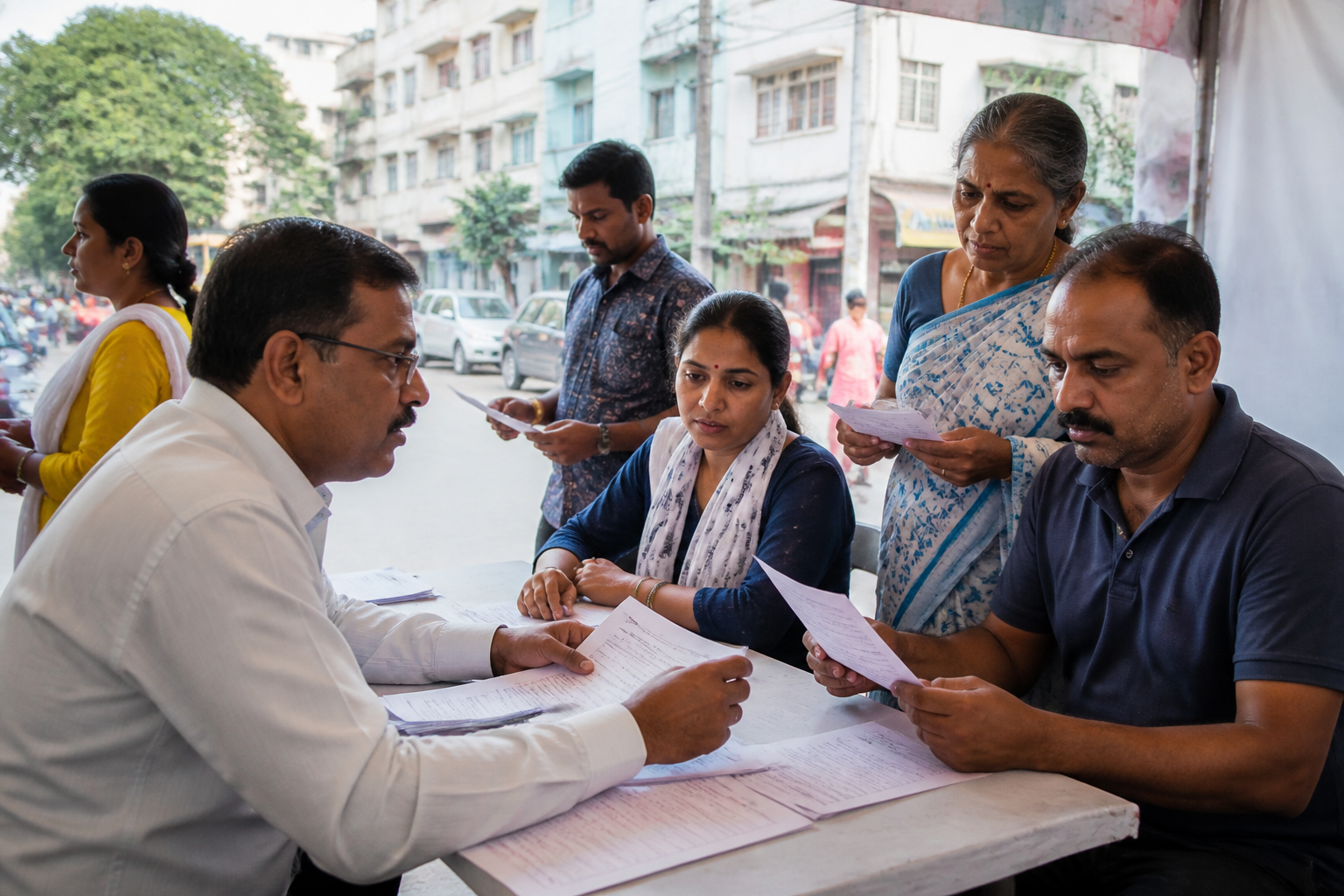
Karnataka’s special intensive revision (SIR) of electoral rolls has moved beyond a routine administrative exercise in several constituencies, with Congress and BJP workers helping voters respond to notices, gather documents, file Form 6 applications and attend hearings. The mobilisation is especially visible in Bengaluru and other districts where lakhs of voters are being asked to participate in the verification process.
The immediate story is about political parties activating booth-level networks. The larger urban question is why a process affecting access to the electoral roll is being experienced by many citizens through party offices and local functionaries rather than through a clearly visible, uniformly accessible public support system.
In BBMP South, more than 4 lakh voters are scheduled to receive notices, according to the report. Congress workers, including booth-level agents, are assisting voters during verification. Ramalinga Reddy, minister and Congress MLA from BTM Layout, said party workers were helping people respond to the process and argued that minor errors leading to notices should not be treated as serious infractions.
The scale is also significant outside Bengaluru. More than 1.4 lakh notices were issued in Kolar, while BJP MLA Rajesh Naik U said 8,000 notices had been issued in Bantwal, against more than 1.5 lakh in the district. These figures show that the revision is not being experienced as a single statewide event. Its administrative burden is being distributed unevenly across constituencies, with local party organisations becoming the most visible intermediaries for voters.
That matters because electoral-roll revision is fundamentally a documentation and verification exercise. A voter who receives a notice may need to produce records, complete paperwork or attend a hearing. The report does not establish that every voter requires political assistance, nor does it describe the official support available in each constituency. It does, however, show that both major parties have identified a large demand for help and are responding through their organisational structures.
The party response has different operating models. Congress leaders said booth-level agents, district members and block presidents were visiting homes, checking whether voters were facing difficulties in obtaining certificates and helping those omitted under the ASDDO category submit Form 6 applications. In Kolar, Congress MLA Kothur G Manjunath said voters had been told to attend hearings in person; he also said that his gunman, Vinod Kumar, had received a notice.
The BJP described a more centralised monitoring system. Dattatri S, the party’s SIR programme convener, said the organisation had divided the state into 10 divisions, each covering several districts, with coordinators monitoring the work. He said the party held daily discussions at 8.30pm to review issues and set targets for the following day. The party also said it had more than 54,000 active BLA-2 representatives assisting voters and had set a target of recovering at least 50% of voters lost in the ASDDO category.
These details reveal how electoral administration intersects with the geography of Indian cities and constituencies. A notice sent to a voter is not the end of the process. The voter must understand what it means, locate the relevant authority, secure the required documents, meet a deadline and, where necessary, attend a hearing. Each step can become harder for residents who have moved homes, changed addresses after marriage, lack easy access to certificates or cannot take time away from work.
The report gives one indication of the underlying data-cleaning exercise. In Bantwal, Rajesh Naik attributed the lower number of notices in his constituency to groundwork over three years, including the removal of names of deceased voters and the updating of addresses of married women. This suggests that electoral-roll revision is connected not only to current verification but also to the maintenance of records over time. Yet the supplied material does not provide statewide figures on additions, deletions, objections, hearings or final changes to the rolls.
That absence is important when assessing the process. The number of notices alone does not establish how many names will ultimately be retained, corrected or removed. Nor does party assistance demonstrate whether the underlying notices are accurate or erroneous. It does show, however, that the scale of the exercise is large enough to generate extensive political mobilisation, particularly in places such as BBMP South, where the reported number of notices exceeds 4 lakh.
## Karnataka SIR electoral roll revision and the role of intermediaries
The growing role of party workers creates a practical advantage for voters: an existing booth-level network can make a complex process easier to navigate. Political workers may know local streets, identify households and help residents assemble documents. Their presence can be particularly useful where official communication is formal, fragmented or difficult to access.
At the same time, reliance on political intermediaries raises an institutional question. Access to electoral-roll correction should be available to citizens regardless of party affiliation, political preference or ability to reach a local representative. When parties become the most visible source of assistance, the public may find it difficult to distinguish between official requirements and political guidance. The supplied report does not document specific cases of coercion, misinformation or partisan exclusion, so those claims cannot be made. But the structure described makes the boundary between administrative service and political mobilisation more prominent.
The situation also highlights the importance of local administrative capacity. Notices are issued and hearings conducted through the election machinery, while voters interact with the process at the level of homes, booths and constituencies. The work therefore depends on the quality of address records, the clarity of notice communication, the availability of certificates and the ability of citizens to complete a time-bound response. Political organisations can supplement this chain, but their intervention does not replace the need for a transparent and accessible official process.
The numbers cited by party leaders also show why a uniform administrative response matters. More than 4 lakh scheduled notices in BBMP South, over 1.4 lakh in Kolar and more than 1.5 lakh in Bantwal district represent very different local workloads. The report does not provide comparable staffing, hearing capacity or timelines for these locations. Without those details, it is not possible to assess whether the official system is equipped to process the volume or whether party networks are compensating for gaps in capacity.
For voters, the immediate concern is procedural rather than political: whether they understand the notice, can obtain the required documents and complete the response. For the administration, the challenge is to ensure that the revision produces accurate rolls without creating avoidable barriers for legitimate voters. For political parties, the exercise is both a service opportunity and an organisational test, as shown by the BJP’s daily monitoring system and Congress’s constituency-level visits.
The evidence supplied by the report confirms a large-scale mobilisation around voter notices, not the final outcome of the revision. It establishes that party workers are assisting voters across Bengaluru, Kolar, Bantwal and other areas, and that the process involves Form 6 applications, document submission and hearings. It does not establish how many voters will be removed or restored, how many notices contain errors, or whether official grievance mechanisms are sufficient.
Those are the developments that deserve monitoring as the revision progresses: the number of hearings completed, the number of names retained or changed, the accessibility of official assistance and the treatment of voters who cannot obtain documents or attend in person. The central lesson so far is that the integrity of an electoral roll depends not only on the accuracy of its database but also on whether ordinary residents can navigate the administrative process without needing a political intermediary.

