


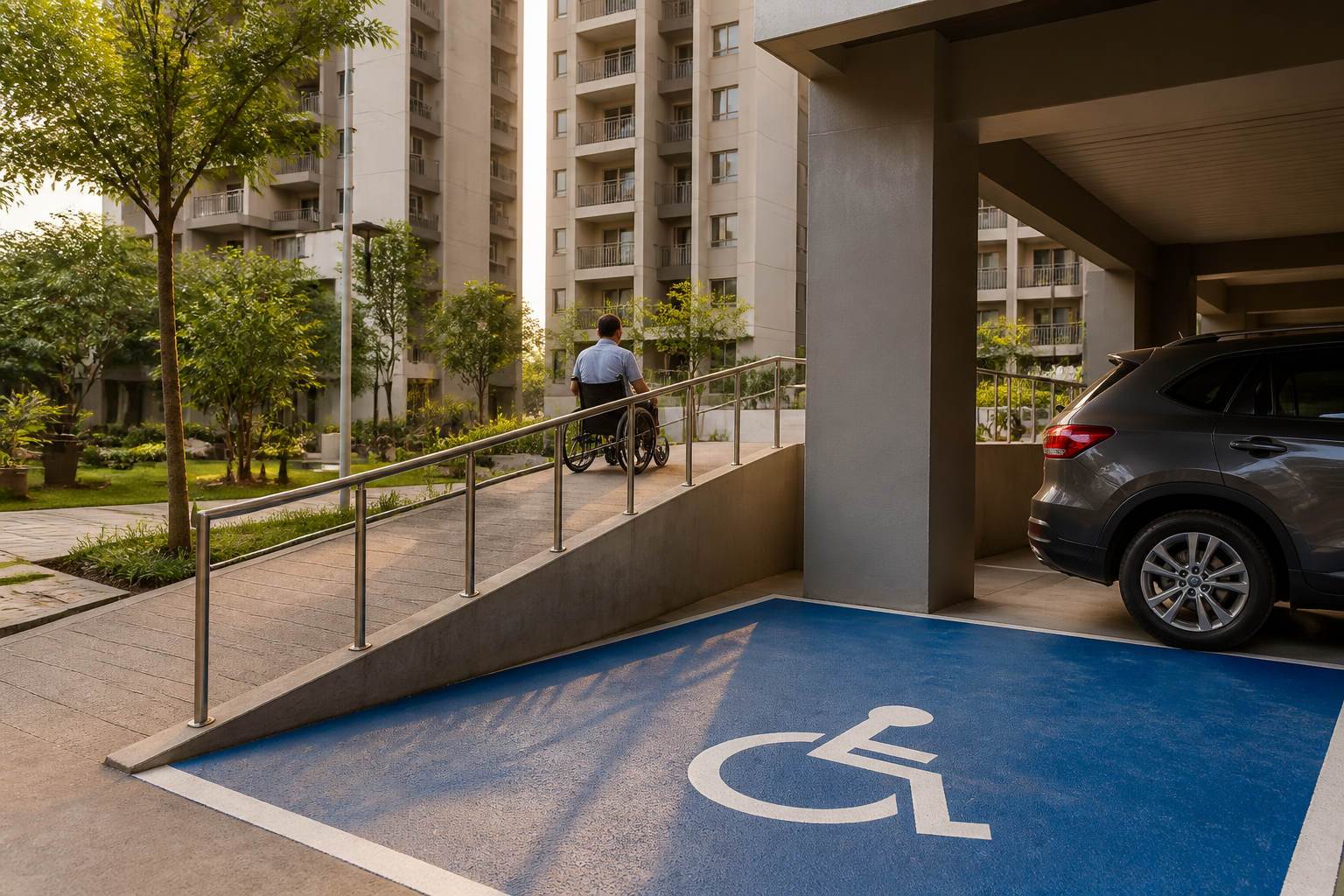
A Karnataka RERA ruling in favour of a Bengaluru homebuyer has done more than order a builder to provide a specially enabled parking space. It has brought into one dispute several recurring weaknesses in apartment ownership: promises made in project documents, accessibility conditions imposed through environmental clearance, delayed formation of residents’ associations and unexplained maintenance charges.
The case concerns a 3BHK flat in Konappana Agrahara, Begur, Bengaluru, purchased by Ms Candy and her family for Rs 1,03,28,979. According to the account published by Economic Times, the project’s brochure and sale arrangements referred to two parking spaces. After the family informed the builder that one of the homebuyers was physically challenged, it sought a separately earmarked parking facility. The Karnataka RERA authority held that the builder was bound to provide it.
The order, described in the report as being issued on September 7, 2026, also directed the builder to provide audited accounts and revised maintenance charges during the process of executing the deed of declaration, after completion of the project, procurement of the occupancy or completion certificate and formation of an association of allottees.
The significance of the ruling lies in how the authority connected documents that are often treated separately. The homebuyer’s claim did not rest only on a sales brochure or a general expectation of accessibility. The authority examined the project’s Environmental Clearance certificate dated May 6, 2015, particularly Clause 32, which provided that facilities such as ramps and separate parking should be made available for physically challenged persons.
That condition became central because it attached an accessibility obligation to the project itself. The issue was therefore not simply whether the builder had made a marketing promise to an individual purchaser. It was whether a project-specific regulatory condition, read with the purchaser’s communication to the builder and the sale deed, required the facility to be delivered.
Economic Times quoted Subrata Mukherjee, Partner at SNG & Partners, Advocates & Solicitors, as saying that the decision followed from the combined effect of the sale deed, the Environmental Clearance conditions, the homebuyers’ disclosure of the disability and the builder’s response to the request. The source report said the sale deed recorded the purchase of the apartment with provisions for two-car parking, although the order did not state that the deed itself contained a specific promise to provide a separate disabled parking space.
That distinction is important for apartment buyers. A project document may contain several layers of obligations: the sale deed governs the transaction between purchaser and promoter; approvals and environmental-clearance conditions govern what the project is required to provide; and correspondence can establish that the promoter was informed of a specific need and had an opportunity to respond. In this case, the authority considered these elements together rather than examining the parking dispute only as a private contractual disagreement.
The chronology also shows why written communication matters in housing disputes. The report said the builder sent an email on December 7, 2023, assuring Ms Candy that the specially enabled parking space would be provided. The facility was allegedly not delivered. The buyer then wrote to the builder, referring to the applicable guidelines and requesting the parking space. The authority recorded that correspondence and noted that the builder had indicated it would examine the request.
The ruling’s practical direction was specific: the builder was ordered to provide parking for specially enabled persons in the housing project within 60 days from the date of the order. The order, as reported, therefore moved beyond recognising an entitlement and set an implementation period for the facility.
Accessibility is also a project-delivery issue
The case places accessibility within the ordinary delivery obligations of a housing project. Ramps and designated parking are sometimes treated as supplementary features that can be negotiated after possession. The ruling described in the source instead treats the relevant Environmental Clearance condition as part of the project’s obligations.
This has an institutional implication. Accessibility requirements can lose force when responsibility is divided between the developer, approving authority, facility manager and apartment association. A buyer may see the promise in a brochure, the requirement in an approval document and the final allocation in a parking plan, but the project can still fail if those documents are not reconciled during construction and handover.
The case also shows the value of project-specific approvals in consumer disputes. The authority relied on Clause 32 of the project’s Environmental Clearance rather than on an abstract assertion that accessible parking would be desirable. The source material does not establish how widely the ruling will be applied beyond this project, but it does show that conditions attached to an approval can become relevant evidence in a dispute between a homebuyer and a promoter.
## The apartment association remains a missing institution
The parking dispute was accompanied by a second governance problem. The sale deed was executed on August 6, 2024, but the builder had not formed an apartment association, according to the source report. The builder was also alleged to be charging high maintenance fees without providing proper justification or audited accounts.
These issues matter because an apartment project is not complete merely when individual sale deeds are registered. Residents also need a functioning institutional structure to manage common areas, services, accounts and collective decisions. Until that structure is transferred or established in accordance with law, buyers can remain dependent on the promoter or an entity controlled by the promoter for maintenance and financial information.
The reported direction on audited accounts and revised maintenance charges links financial transparency to the transition from promoter-led management to an association of allottees. It does not, on the evidence supplied, establish the exact amount of the disputed charges or determine whether every charge was illegal. What it does establish is that the authority required accounts and revised charges to be addressed as part of the association and deed-of-declaration process.
This is a recurring built-environment problem: ownership is individual, but apartment living is collective. A buyer may have a registered flat, yet depend on common systems such as parking, access ramps, lifts, water supply, security and maintenance. If the collective institution is delayed, practical control over these systems can remain with the promoter long after residents have moved in.
Documents become the enforcement infrastructure
The case underlines the importance of maintaining a complete documentary trail from booking to possession. The source report identifies the brochure, sale deed, Environmental Clearance certificate and email correspondence as relevant material. Each document answered a different question: what was represented to the buyer, what was recorded in the transaction, what was required of the project and whether the builder had been notified of the specific accessibility need.
For homebuyers, this does not mean that every brochure statement automatically creates an enforceable right. The reported legal explanation specifically distinguished the sale deed’s parking provisions from the separate requirement for specially enabled parking. The lesson is narrower and more useful: project approvals and written representations should be examined together when a promised facility is not delivered.
For builders, the ruling indicates that accessibility conditions cannot be treated as disconnected from project handover. A facility mentioned in an Environmental Clearance or other approval may become part of the evidence used to assess whether the project has complied with its obligations. The supplied material does not say whether the builder has challenged the order or whether the facility has since been delivered.
For regulators and apartment residents, the case raises a question about handover monitoring. The authority’s intervention came after a buyer approached RERA. The source does not establish whether the project’s accessibility facilities were inspected before possession, or whether the approval conditions were checked at the occupancy stage. That gap is significant because a condition can exist on paper while remaining absent from the completed site.
The larger urban question is whether housing regulation is being enforced at the point where residents experience a project: in the parking area, the entrance ramp, the maintenance ledger and the association office. The Bengaluru dispute shows how these elements are connected. A project may be sold through private contracts, approved through public regulatory conditions and operated through a collective residential institution. Failure in any one layer can affect the others.
The Karnataka RERA ruling confirms, on the facts reported, that the builder must provide the specially enabled parking facility within 60 days and address association formation, audited accounts and revised maintenance charges through the prescribed completion and handover process. What remains unclear from the supplied material is whether the builder has complied, whether the order has been appealed and how the project’s other accessibility facilities are being maintained. Those are the next developments that will determine whether the ruling produces a completed facility or remains only a legal direction.
