


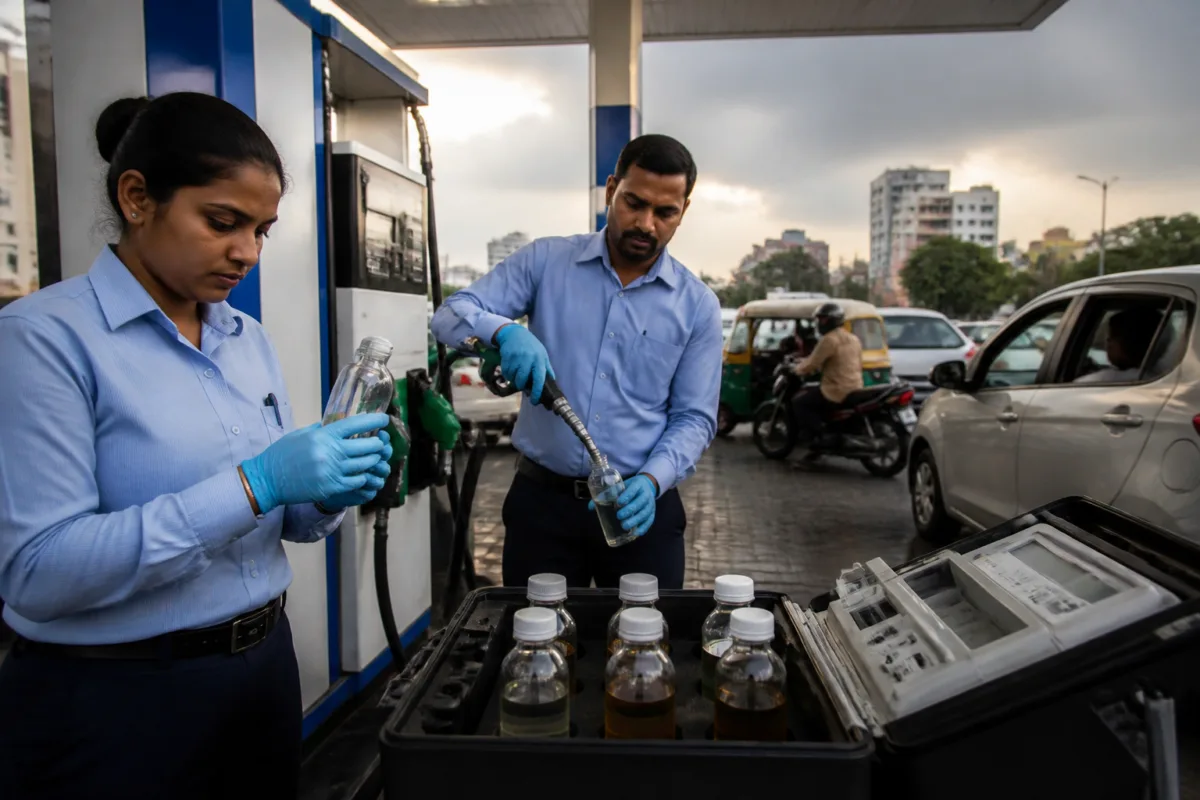
The Karnataka government has reported ethanol content above the prescribed E20 limit in several petrol samples collected from fuel stations across the state, with tests recording blends as high as 31.2 per cent in Indian Oil Corporation petrol and 30.5 per cent in Hindustan Petroleum Corporation’s MS Power petrol.
Food, Civil Supplies and Consumer Affairs Minister Rizwan Arshad said the Department of Legal Metrology conducted inspections under the direction of Chief Minister DK Shivakumar to verify ethanol blending levels. The samples were collected from Bengaluru, Kolar, Chikkaballapur, Bengaluru Rural, Ramanagara, Mangaluru and Tumakuru.
According to the state government’s statement, the samples were tested at laboratories accredited by the National Accreditation Board for Testing and Calibration Laboratories and certified under ISO standards. The reported ethanol content varied across oil companies and fuel types. HPCL petrol recorded 27 per cent, BPCL Speed petrol 26.5 per cent, Nayara petrol 26.1 per cent and Shell petrol 25.5 per cent.
Other samples recorded 24.2 per cent and 22.6 per cent in BPCL petrol, 22.4 per cent in HPCL MS petrol, 20.8 per cent in IOCL petrol and 20.6 per cent in Nayara petrol. The tests also found ethanol levels below the E20 limit in some samples, including 19.9 per cent in BPCL petrol, 19.2 per cent in MRPL petrol and 13.5 per cent in Shell petrol.
The department alleged that samples initially sent to oil companies’ laboratories, including IOCL and BPCL, did not disclose the ethanol percentage even though testing was mandatory. The state government said this had raised concerns about whether excessive blending was being concealed. The allegations and laboratory findings were presented by the minister; the report does not include responses from the oil companies.
The government said ethanol content above E20 could reduce vehicle mileage and damage fuel filters, pumps, injectors, hoses and seals, especially in vehicles not designed to operate with higher ethanol blends. It cited an estimate that nearly 99 per cent of India’s 35 crore vehicles were not designed for blends exceeding E20, while vehicles introduced after April 2023 were certified for blends up to E20.
Using its own estimates, the department said India consumes around 6,200 crore litres of fuel annually. Assuming a 10 per cent reduction in mileage and a petrol price of Rs 100 per litre, it estimated an annual consumer burden of around Rs 62,000 crore. It separately estimated vehicle repair costs at Rs 39,000 crore, putting the combined potential burden at about Rs 1.01 lakh crore annually. These figures were estimates cited by the department and were not independently assessed in the statement.
The Karnataka government also questioned whether the foreign exchange savings cited in support of ethanol blending had translated into benefits for consumers. It referred to combined profits of IOCL, BPCL and HPCL of Rs 77,821 crore in the 2025-26 financial year. The state has sought disclosure of the actual ethanol content in petrol supplied to consumers, action against companies supplying fuel above the prescribed limit and a transparent audit of blending levels at fuel stations.

