


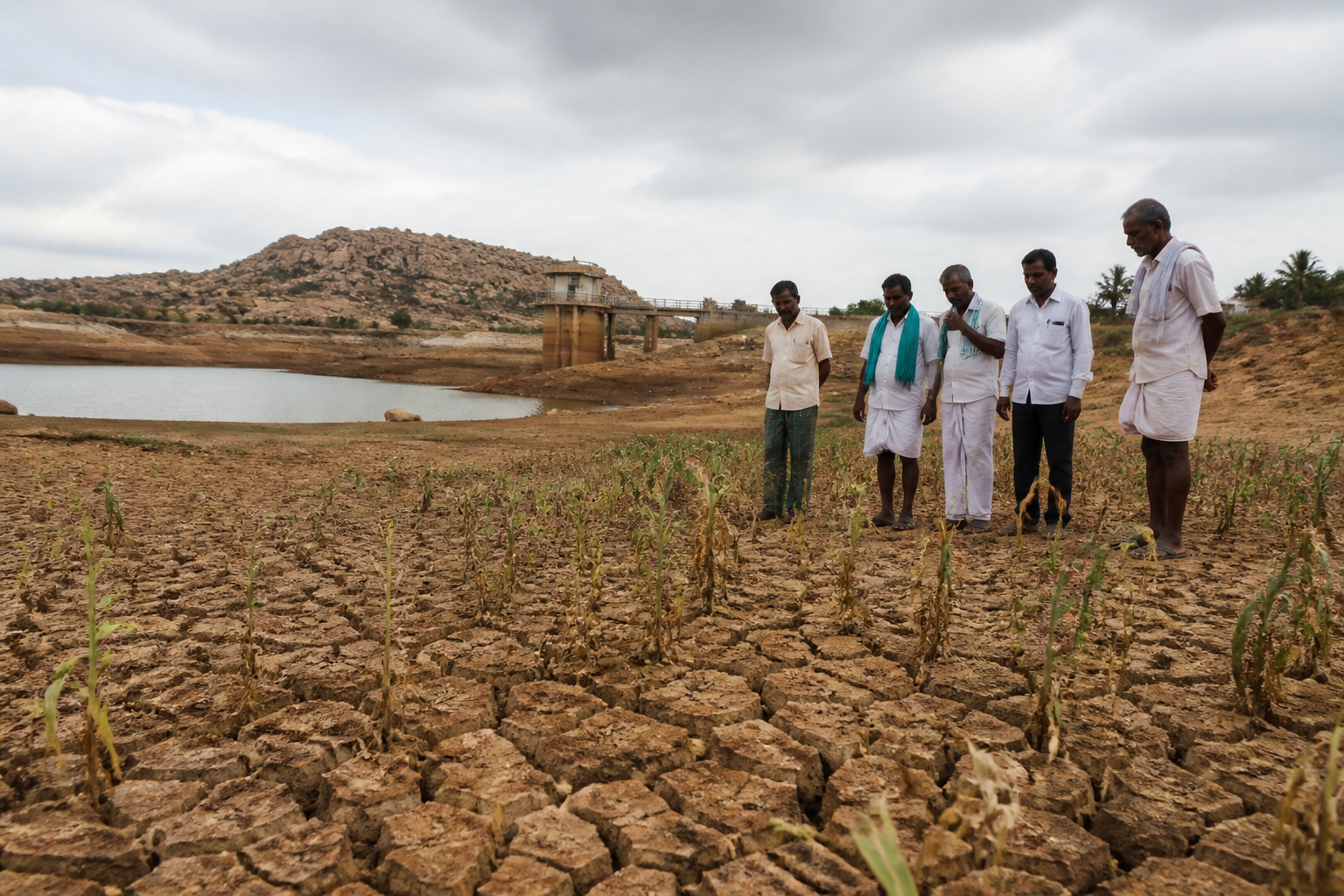
Karnataka’s drought has moved beyond a rainfall shortfall into a wider failure of the state’s water security system, with 217 of its 240 taluks declared drought-affected, reservoirs holding only 65% of their full capacity and drinking water concerns spreading across rural communities. The figures were presented by Chief Minister D.K. Shivakumar to a central drought assessment team visiting the state.
The immediate trigger is a weak southwest monsoon. Between June 1 and September 30, Karnataka received 35% less rainfall than normal on average, according to the state government’s presentation. The deficit was not confined to the traditionally dry northern districts. South Interior Karnataka recorded a 41% shortfall, North Interior Karnataka 42%, Malnad 38% and the coastal region 28%.
That geographical spread is significant because Malnad and coastal Karnataka are usually among the state’s wetter regions. The government said reduced rainfall had weakened inflows into irrigation systems and lowered water availability in catchments, affecting agriculture, horticulture and irrigation. It also said 237 of the state’s 240 taluks had gone without rain for three weeks.
The drought is therefore not a single crop-loss event. It is affecting the linked systems through which Karnataka stores, distributes and uses water. Lower rainfall reduces soil moisture and groundwater recharge. Poorer inflows restrict reservoir operations. Reduced reservoir storage then places pressure on irrigation, drinking water supply and hydropower-linked facilities. The effects are distributed unevenly, but the underlying stress is statewide.
The state’s 13 major reservoirs held 529 thousand million cubic feet of water, equivalent to 65% of their full capacity, according to the chief minister’s presentation. Storage in reservoirs connected to hydropower projects stood at 54% of capacity, while reservoirs in the Cauvery basin were at 47% and those in the Krishna basin at 78%. The government said inflows into all major reservoirs during 2026 were below the average of the previous 10 years.
These numbers show why the drought cannot be assessed only by counting rainy days or measuring agricultural damage. Reservoir levels determine how long irrigation and drinking water systems can continue under stress. They also reveal the differences between river basins. The Cauvery basin, with storage at less than half of capacity, faces a tighter water position than the Krishna basin, even though both are part of the same state-level drought response.
The state government said 217 taluks had been identified as drought-affected. Of these, 101 were declared in the first phase, 76 in the second and 40 in the third. A further review was under way. The government estimated crop loss across 19.52 lakh hectares in the first group of 101 taluks and 26.08 lakh hectares in the 76 taluks declared in the second phase.
The figures presented to the central team also show how drought administration works through stages. A taluk is not simply classified on the basis of one rainfall reading. The state has to compile information on rainfall, crop conditions, water availability and other indicators before seeking relief under disaster-management norms. The chief minister said the drought declarations had been made through a scientific assessment and without yielding to pressure.
The scale of the request reflects the extent of the damage recorded by the state. Karnataka sought ₹7,142.64 crore in drought relief under National Disaster Response Fund norms. The government estimated total losses of ₹46,324.50 crore across the 177 taluks declared drought-affected at that stage. Its earlier request for the first 101 taluks had been for ₹3,701 crore.
The central team’s visit is intended to test these claims on the ground. Led by Agriculture and Farmers Welfare Ministry Joint Secretary Ajit Kumar Sahu, the team met Shivakumar at Krishna, the chief minister’s home office. The chief minister and officials explained the rainfall deficit, drinking water problems and sowing conditions. The team was scheduled to visit different parts of Karnataka and obtain data from state officials before submitting an assessment report.
Sahu said the team would understand conditions through a field visit and submit an objective report after collecting information from government officers. The report said the team would inspect drought conditions across the state over four days, while Sahu separately described the field assessment as a three-day visit. The key institutional step is the same: the state’s estimates will be examined through field observations and official data before a report is submitted.
The government’s presentation also indicates that the consequences are extending beyond standing crops. Karnataka receives more than 74% of its annual rainfall during the southwest monsoon. The state said 88 taluks had experienced at least three consecutive weeks without rain, 120 had gone four to six weeks without rain and 22 had gone seven to 10 weeks without rain. The absence of rainfall during the principal recharge and cultivation season increases pressure on both surface water and groundwater sources.
Groundwater is a particularly important part of the drought picture. The state said groundwater levels had fallen sharply in 200 taluks. Unlike reservoir storage, groundwater decline is less visible to the public and can affect drinking water supply, irrigation wells and livestock access at the same time. A failed monsoon can therefore continue to shape water availability after the immediate rainfall deficit has disappeared from daily headlines.
The government said Karnataka had feed available for 30 weeks and had sanctioned ₹25 crore under the State Disaster Response Fund for mini fodder kits. It also said 4.72 lakh mini kits had been supplied to farmers with irrigation facilities. These measures address an important secondary risk: drought reduces not only crop yields but also fodder availability, potentially increasing pressure on livestock-dependent households.
However, the state government’s own description suggests that limited late rainfall will not reverse the damage already recorded. Deputy Chief Minister G. Parameshwara said the rain received in some places could help grass grow but would not benefit crops that had already been damaged. He also said it was insufficient to resolve drinking water problems. That distinction matters for relief planning: rain after crop failure may improve short-term fodder conditions without restoring the lost agricultural income or replenishing depleted water systems.
The drought response also has a direct connection to cities and towns. Urban water security depends on the same reservoirs, river basins and groundwater systems that support farms. When rural sources weaken, towns and expanding urban settlements compete for a smaller volume of available water. Drinking water supply then becomes a question of storage management, tanker dependence, local distribution networks and administrative prioritisation rather than rainfall alone.
The state’s reservoir data underline this institutional challenge. Water is managed through basin-level systems, but relief is assessed through taluks and departmental categories. Agriculture, revenue administration, drinking water agencies, irrigation authorities and disaster-management institutions must work from compatible data. If rainfall, reservoir storage, groundwater conditions and crop loss are measured separately, the response can become fragmented even when the drought is interconnected.
Karnataka’s recent history adds another layer to the situation. The government said the state had faced drought conditions in 16 of the 25 years between 2001 and 2025. That record presents drought not as an exceptional administrative interruption but as a recurring condition that must be absorbed into infrastructure and land-use planning. Repeated drought years place pressure on farm incomes, public relief budgets, groundwater reserves and the reliability of rural and urban water supply.
The current episode also exposes the limits of treating reservoir storage as a complete measure of water security. A reservoir may hold a substantial percentage of its capacity while inflows are falling, groundwater is declining and rainfall is absent from large parts of the state. Conversely, storage levels differ sharply between basins, making a single statewide percentage an incomplete description of local conditions.
For residents, the most immediate concerns are practical: whether drinking water sources will last, whether crops can be harvested, whether livestock can be fed and whether relief will reach affected households. For the administration, the next stage is more technical. It must reconcile field observations with the state’s loss estimates, validate the list of drought-affected taluks and determine the scale of assistance that can be released under national disaster-management norms.
The evidence supplied to the central team confirms a drought with wide geographic reach, significant crop exposure and declining water availability across multiple systems. It also shows that the crisis is being managed through a sequence of declarations, field assessments and compensation requests rather than through one immediate intervention. The central team’s report, the progress of the state’s further review and the condition of reservoirs and groundwater will determine how Karnataka’s drought response develops from assessment into relief.
