


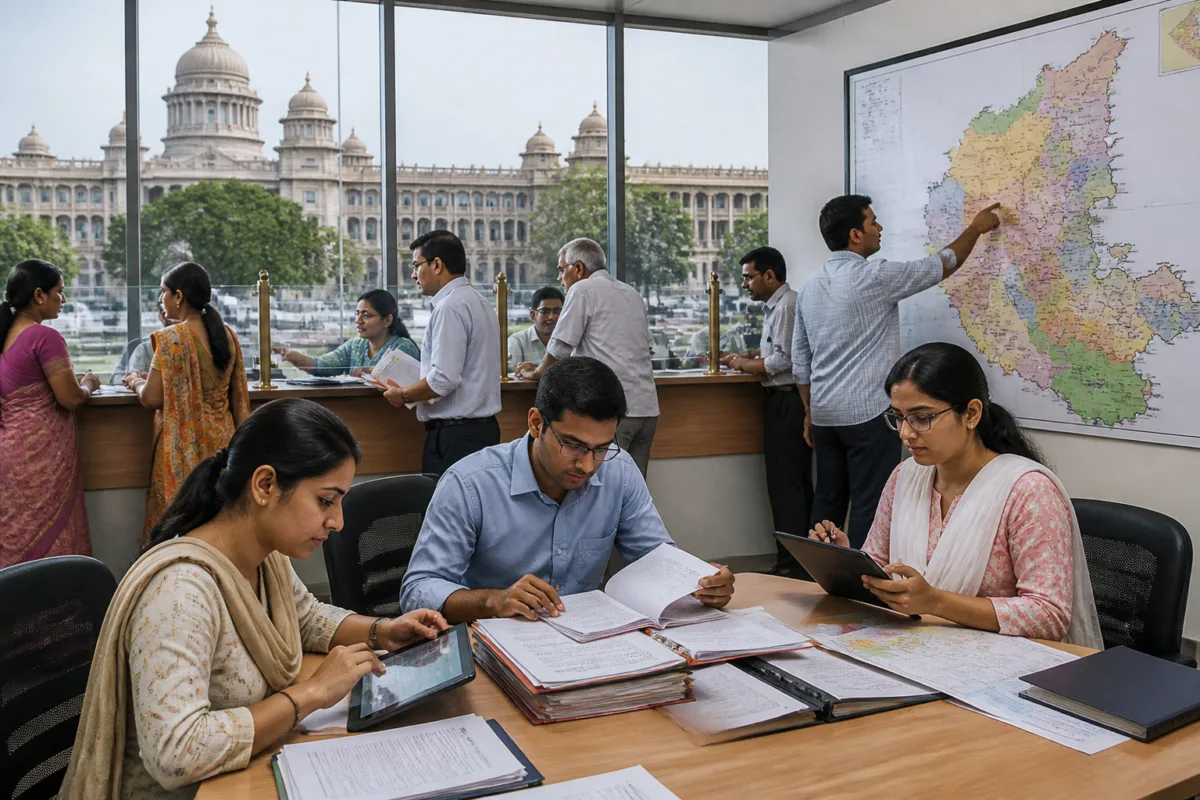
The Karnataka government has approved a ₹14 crore survey to evaluate the implementation of its guarantee schemes and other government programmes, including the benefits reaching citizens across all 224 Assembly constituencies. The initiative, named Project K-Monitor, will examine the educational, social and economic impact of the schemes on beneficiaries.
Greater Bengaluru Development Minister Krishna Byre Gowda announced the decision after a Cabinet meeting. He said the survey would collect public feedback and place respondents under a tracking system as part of the evaluation process. The government expects the exercise to generate comprehensive information on the performance of its schemes and programmes.
The evaluation will be conducted in two stages over eight months. In the first stage, the government plans to review the progress of 1 lakh schemes or works. The second stage will evaluate 60,000 schemes or works in greater detail, according to the minister.
The survey will cover programmes implemented by the water resources, agriculture, health, education, urban development and other major departments. The stated purpose is to assess whether public programmes are delivering measurable educational, social and economic benefits to their intended recipients, while also examining the use of public funds and the efficiency of implementation.
The decision places the state’s guarantee schemes within a wider review of government delivery rather than treating them as a separate administrative exercise. The supplied report does not specify which individual guarantee schemes will be assessed, the criteria that will be used to measure outcomes, or how the findings will be made public.
The government has also not yet decided whether the survey will be conducted directly by state departments or outsourced to a private agency. Asked about the implementation arrangement, Byre Gowda said the concerned department would take the decision.
The survey’s statewide coverage is intended to provide information from all Assembly constituencies rather than limiting the review to selected districts or departments. Its use of public responses and beneficiary tracking is expected to create an administrative record of how schemes are being accessed and what benefits recipients report receiving.
The Cabinet also approved the establishment of the Karnataka Tribal Development Corporation for the social, educational and economic development of 33 particularly vulnerable and other tribal communities. The corporation has been allocated ₹33.36 crore and is intended to support economic empowerment, entrepreneurship, skills development, market access and livelihood enhancement. The government approved the proposal after its establishment had been announced in the 2026-27 state Budget.
Other Cabinet decisions included approval of ₹228.95 crore for construction and infrastructure development at the Krantiveera Sangolli Rayanna Sainik School in Sangolli, ₹21.11 crore for laboratory equipment to strengthen diagnostic services in government hospitals and medical institutions, and a one-year extension for the special investigation team formed to curb illegal mining. The Cabinet also approved the Karnataka Lokayukta (Cadre and Recruitment and Conditions of Service of Officers and Employees) Rules, 2026.
The Project K-Monitor survey is scheduled to be conducted in two phases over the next eight months. The departments concerned will determine the survey’s implementation method and oversee the evaluation of the identified schemes and works.

