


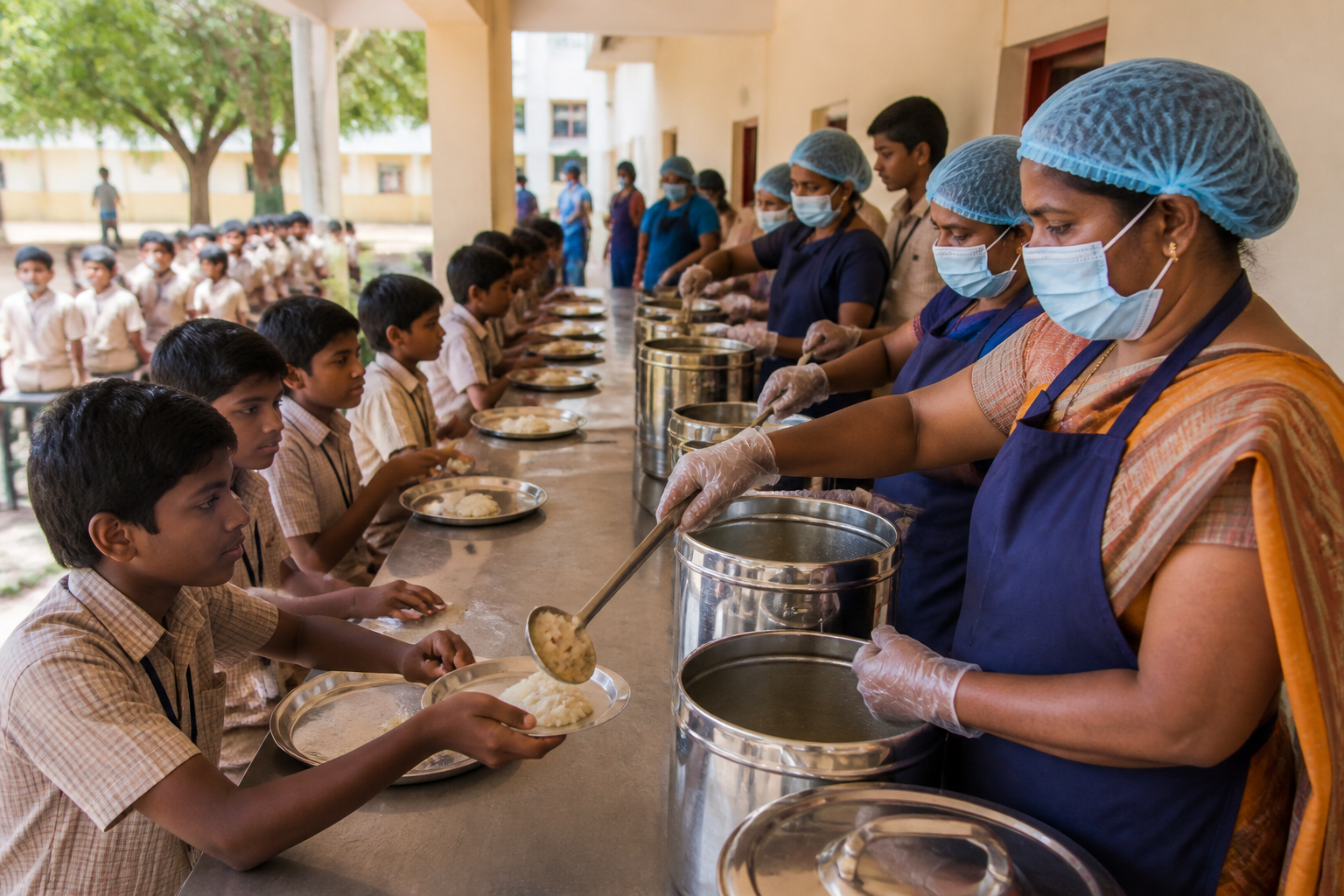
Tamil Nadu will expand its Kamarajar breakfast scheme to students in Classes 6 to 8 from September 22, bringing an estimated 15.30 lakh additional students in 15,454 government and government-aided schools under the programme. Chief Minister Vijay is scheduled to launch the expansion in Chennai, according to a state government press release cited by Dinamalar.
The expansion extends the breakfast programme beyond students up to Class 5, who are currently covered in government and aided schools. The state government has allocated an additional Rs 217.63 crore for the programme in the current financial year, taking the total allocation to Rs 724 crore.
The launch was initially scheduled for September 17 but was postponed to September 22 because of the Chief Minister’s overseas visit. A review meeting on the expansion and its implementation was held at the Tamil Nadu Secretariat on September 18 under the Chief Minister’s chairmanship.
The government said the decision to extend the scheme to middle-school students followed instructions issued at a June 15 review meeting on the work of the Social Welfare and Women’s Rights Department. The expansion is intended to address students’ health, nutrition, school attendance and learning as part of the state’s school education system, the press release said.
Implementation will use different delivery models depending on the location of the schools. In Greater Chennai Corporation, meals for students in 447 government and aided schools will be prepared through integrated kitchens operated by the corporation administration. In other corporations, municipalities and adjoining town panchayat areas, 2,150 schools will receive meals prepared through integrated kitchens managed by the Directorate of Municipal Administration.
In rural areas and panchayat areas adjoining rural locations, meals for 12,857 government and aided schools will be prepared at the respective schools by members of self-help groups through the Tamil Nadu State Rural Livelihoods Mission, according to the government communication cited in the report.
The distribution model places responsibility across the Greater Chennai Corporation, the Directorate of Municipal Administration and the Tamil Nadu Women’s Development Corporation. This makes coordination between local bodies, school administrations, kitchen operators and self-help groups central to the rollout. The government has directed officials to ensure that cooking facilities and serving areas remain clean and hygienic and are monitored continuously.
The Chief Minister also instructed officials to ensure that every student receives hot, tasty, properly portioned and nutritious food. Departments involved in the programme were asked to coordinate their responsibilities for implementation.
The expansion will therefore operate through both centralised kitchens and school-level preparation. The government’s stated implementation priorities include food quality, hygiene, portion size and inter-departmental coordination. The September 22 launch will mark the formal start of the expanded coverage for students from Classes 6 to 8.
