


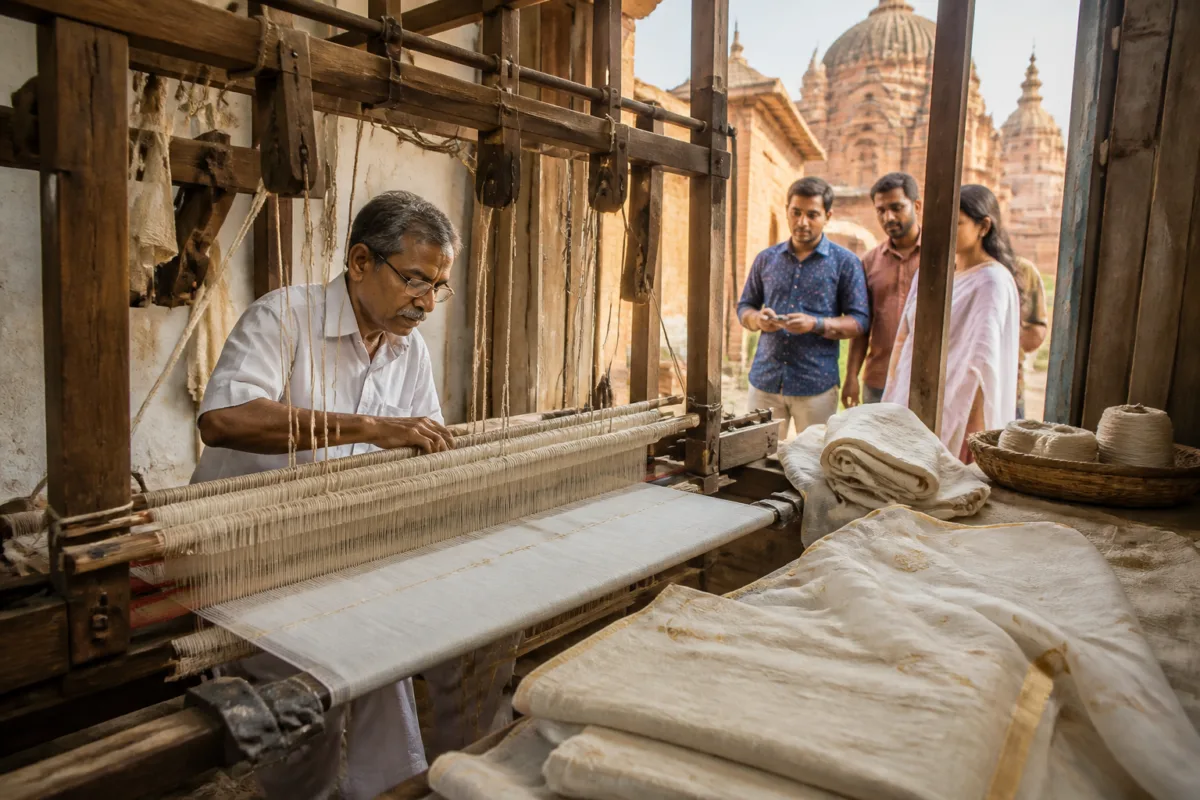
A 45-member tourist group from the United States and Australia recently visited a muslin workshop in Baruipara, Kalna, bought sarees and learnt about the craft’s history. The visit is a small but revealing event: in a town known for its temples and terracotta architecture, a family-run weaving unit is becoming part of the tourism economy while preserving a fragile, labour-intensive tradition.
The workshop belongs to Padma Shri awardee weaver Jyotish Debnath and his son Rajib Debnath. Their muslin sarees are described as light enough to pass through a ring and compact enough to fit inside a matchbox. One saree weighs about six grams and is made with yarn ranging from 300 to 600 count. Producing it takes four to five months, making the product less a mass-market garment than a high-value craft object built around time, skill and inherited knowledge.
The significance of the Kalna workshop lies in the way it connects cultural heritage with the physical economy of a town. Foreign visitors who come to see Kalna’s historic temples and architecture are now also visiting the weaving unit, learning how muslin is produced and purchasing finished products. The source report says this activity is strengthening the local economy, although it does not provide figures for visitor spending, employment or sales. What is established is the mechanism: tourism creates a route through which a traditional craft can reach customers beyond its immediate market.
That route did not emerge overnight. Rajib Debnath reportedly produced a nearly 10-minute CD in 2011 on Kalna’s terracotta architecture, the Bhagirathi and the process of making muslin. The material was divided into two sections, titled ‘The City of Temple Kalna’ and ‘The World of Muslin’, and about 500 copies were sent to different countries. According to the report, foreign tourist visits began increasing from 2017.
This sequence matters because it shows how a local artisan enterprise attempted to connect two parts of Kalna’s identity: its built heritage and its textile tradition. The workshop was not presented only as a place of production. It became part of the visitor experience, alongside the town’s historic architecture. The approach also gave the craft a narrative that could travel beyond the workshop itself, linking a saree to the place, its history and the process required to make it.
The family’s weaving history provides another layer to the story. The Debnath family has been associated with the craft for six generations. Jyotish Debnath’s father, Krishnamohan Debnath, was described as a ‘master weaver’. Rajib Debnath has said that the tradition of Indian muslin is more than 800 years old. These details place the current workshop within a longer chain of transmission, where the survival of the craft depends not only on demand but also on the continuation of specialised knowledge inside families.
The international demand reported for the sarees includes customers from the United States, Australia, Russia, England, Scotland, Italy and Spain. The report does not establish the volume or value of these orders, but the geographical spread indicates that the workshop’s market is not confined to Kalna or India. International interest is arriving through two channels: orders from abroad and direct contact with visitors who reach the workshop during trips to the town.
That distinction is important for understanding the local economic effect. A product can travel outside a town through online sales, intermediaries or exports, but a visitor who comes to the workshop creates a wider local chain of activity. The tourist may spend on transport, food, accommodation, other purchases and entry to attractions, although the supplied report does not quantify these linkages. In Kalna, the muslin workshop appears to be benefiting from the same cultural geography that brings visitors to the town’s temples and architecture.
The model also reveals the limits of heritage tourism when the attraction is dependent on a very small production base. The source identifies Jyotish and Rajib Debnath’s workshop as a special attraction, but it does not say whether other weavers in the area are receiving similar demand or whether the activity is supported by a formal tourism programme. Nor does it provide information on the number of workshops, the number of people employed, annual tourist arrivals or the share of household income derived from muslin.
Those gaps do not diminish the importance of the reported visit. They show what would be needed to assess whether Kalna’s craft-tourism connection is a durable local economic model or a successful but limited family enterprise. Visitor numbers alone would not be enough. The relevant evidence would include how many visitors reach workshops, how much they spend, whether younger residents are entering the trade, how orders are fulfilled and whether weavers can maintain quality while meeting demand.
The production process itself makes the challenge clear. A saree requiring four to five months of weaving cannot be expanded in the same way as an industrial product. Its value depends on the time involved and the technical ability to work with very fine yarn. The reported weight of six grams and the use of 300- to 600-count yarn communicate the precision of the craft, but they also underline its vulnerability to interruptions in raw-material supply, skills and household labour.
The most direct risk identified in the report is climate-related. Rajib Debnath has said that global warming is reducing the quality of cotton, creating difficulties for the industry. The report does not specify the source of the cotton, the nature of the quality decline or the effect on production costs. Even so, the concern connects a local craft to a wider material chain. Muslin is often discussed as an object of cultural history, but the workshop’s future also depends on the quality and availability of the natural fibre from which its yarn is made.
This is where the story moves beyond tourism promotion. A heritage craft can attract visitors and international orders, yet remain exposed to changes taking place far from the town where the final product is woven. Climate pressure on cotton can affect the quality of yarn, the time required to produce a saree and the ability of artisans to maintain established standards. In a craft where a single product may take months, even a small change in input quality can have consequences for household income and customer trust.
The institutional picture remains less developed in the available account. The report records the family’s own effort to publicise Kalna and muslin through the 2011 CD, as well as the subsequent rise in foreign visitors from 2017. It does not identify a municipal, state or national agency responsible for integrating the workshop with the town’s tourism circuit. It also does not mention public funding, formal signage, visitor facilities, training schemes, export assistance or a climate adaptation programme for the craft.
That absence is significant because place-based tourism depends on more than an individual attraction. Visitors need to find the location, understand what they are seeing and move between different parts of the town. Artisans need a way to receive visitors without disrupting production. International customers may require reliable communication, payment, packaging and delivery systems. None of these arrangements is documented in the supplied report, so it would be premature to describe Kalna’s muslin economy as an established tourism cluster.
What can be said is that the workshop has developed an unusual form of cultural visibility. The same visitor who comes to see built heritage can encounter a living production tradition. This creates a stronger connection between tourism and local livelihoods than a static monument can provide on its own. The workshop demonstrates how a town’s economic identity can be built from several layers: architecture, river geography, craft skill, family history and contemporary international demand.
The central urban question is whether such connections can be sustained without reducing the craft to a spectacle. The supplied account shows visitors learning about the production method and buying sarees, while the family continues to preserve a six-generation tradition. It does not establish how the work is shared, how artisans are paid or whether demand is placing pressure on production. Those are essential questions wherever heritage tourism becomes part of a local economy.
Kalna’s muslin story therefore contains both an opportunity and a warning. International visitors and overseas orders are creating visibility for a highly specialised craft and linking it to the town’s architectural tourism. At the same time, the craft remains dependent on scarce skills, long production cycles and cotton quality that the family says is being affected by global warming. The next developments to watch are whether visitor interest expands beyond one workshop, whether more measurable local economic benefits emerge and whether the material risks facing muslin receive an institutional response.

