


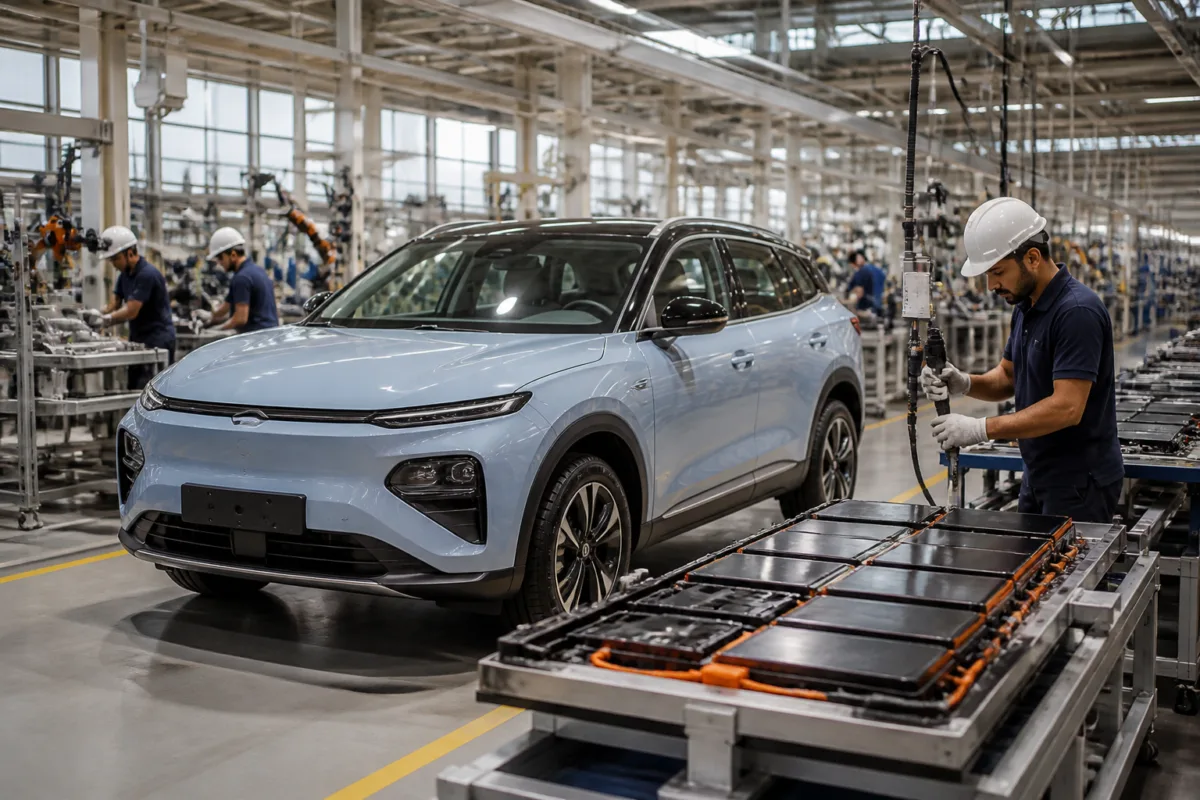
JSW MG Motor India’s plan to invest up to ₹4,500 crore over three years is more than a capacity expansion announcement. It is a test of whether an automaker can make electric vehicles more profitable in India by moving beyond assembly and building a deeper local supply chain. The company says localisation, rather than sales volume alone, will determine the strength of its next phase of growth.
Anurag Mehrotra, managing director of JSW MG Motor India, told The Hindu BusinessLine that the company is looking at investments of approximately ₹3,000-4,500 crore over three years. Capital expenditure this year is expected to be close to ₹1,500 crore, directed towards new products, localisation and plant expansion. The company currently has annual plant capacity of around 1.2 lakh vehicles and expects to raise it to 1.6 lakh vehicles by April 2027.
The plan comes as India’s electric vehicle market is expanding but remains exposed to imported components, uneven production capacity and supply-chain disruptions. JSW MG Motor’s own account shows how these pressures can affect retail registrations even when customer demand remains relatively strong. The company said its 2026 bookings had grown by approximately 25-30% compared with calendar year 2025, while October retail registrations rose 3.4% month-on-month against industry growth of 15.1%.
Mehrotra attributed the slower monthly performance to sharply higher container rates, which he linked partly to the West Asia-Middle East crisis and strong demand across product categories. He also cited production losses during the ramp-up of the Tomahawk model. According to the company, those difficulties have now eased, making October a turning point for production and deliveries.
The distinction between demand and production is important for India’s urban mobility transition. A vehicle may have customers waiting for it, but the benefit of that demand does not reach cities unless factories can secure components, assemble vehicles and deliver them consistently. In this case, JSW MG Motor said the Windsor continued to sell between 3,500 and 4,000 units a month, broadly in line with the previous year’s performance, despite dispatches falling from 4,659 units in July to 3,300 units in September. The company attributed that decline to supply-chain disruption and a plant operating at full capacity rather than weak demand.
The company’s proposed response is to increase both physical capacity and local content. Mehrotra said localisation levels for the Windsor had already been tripled and that the board had approved investment to double them again by the end of the next calendar year. Battery assembly, including the battery management system, is fully localised at the company’s Halol facility. Battery cells, however, may continue to be sourced from China for now.
That distinction exposes one of the central limits of automotive localisation. Local assembly and battery management can reduce some import dependence, but they do not eliminate exposure to the global cell supply chain. The company said it works with Indian suppliers for battery assembly and would be willing to source cells locally as India’s cell manufacturing capabilities develop. The next stage of localisation will therefore depend not only on the automaker’s investment, but also on whether domestic suppliers can achieve the required scale, quality and cost.
For JSW MG Motor, profitability is the stated priority rather than an immediate race for volume. Mehrotra said the company would prefer lower volumes with stronger profitability to higher volumes with weaker margins. This approach reflects the financial challenge facing electric vehicles: sales growth can coexist with pressure on margins if imported inputs, logistics and production inefficiencies remain expensive.
The company’s capacity target also indicates the scale at which it wants to operate. Raising annual capacity from around 1.2 lakh vehicles to 1.6 lakh vehicles by April 2027 represents an increase of roughly one-third. That expansion will need to be matched by product availability and reliable component supply. The company has introduced three products this year and expects another announcement next quarter, but it has not committed to one lakh sales in financial year 2027.
The product strategy is being designed around a wider definition of new-energy mobility. More than 75% of the company’s sales currently come from new-energy vehicles, while EVs accounted for 81.9% of its registrations in the period discussed in the interview. Mehrotra said around 70-75% of the portfolio would continue to comprise new-energy vehicles, while the company would remain opportunistic in the internal combustion engine segment where it believes it can compete effectively.
The company’s Adapt platform is intended to support battery-electric vehicles, plug-in hybrids, strong hybrids and range-extended electric vehicles. Deliveries of a plug-in hybrid model were expected to begin in November 2026, according to the interview, while a range-extended EV is planned by 2030. CNG is not currently part of the company’s strategy.
This multi-powertrain approach shows that the transition in India’s passenger-vehicle market is unlikely to follow a single technology path in the near term. The company is placing most of its portfolio emphasis on new-energy vehicles but is retaining flexibility across different powertrains. That gives it room to respond to variations in charging access, vehicle use and consumer demand, although the interview does not provide a breakdown of expected sales or investment by powertrain.
The Windsor’s performance is also relevant to how electric mobility is being absorbed into everyday urban travel. The company said the model remained India’s best-selling EV cumulatively from January to October 2026. It also said October volumes again approached 4,000 units. These figures indicate a substantial market for the model, but the supplied material does not establish how sales are distributed across cities, how much use is private versus commercial, or whether charging availability has constrained ownership in particular markets.
Those unanswered questions matter because manufacturing capacity alone does not determine the pace of urban electrification. Vehicle supply must connect with charging infrastructure, electricity access, financing, maintenance networks and consumer confidence in battery performance. The interview focuses on the company’s industrial response and does not provide evidence on these wider urban systems. That makes the investment programme significant, but not sufficient on its own to measure the progress of electric mobility in Indian cities.
The company’s approach to localisation also has implications beyond its own factory. A larger domestic supplier base could spread industrial activity across battery assembly, electronics, software, components and vehicle systems. However, the supplied interview does not specify the number of suppliers involved, the employment impact, the value of domestic content or the location of new investments beyond the reference to the Halol facility. The announced programme should therefore be read as a strategic direction rather than a complete industrial plan.
Ownership and competitive structure add another layer to the story. JSW MG Motor India was formed through the partnership between JSW and SAIC, and Mehrotra said his responsibility was to execute the vision set by shareholders in March 2024. Asked about the possibility of JSW increasing its stake and developing its own passenger-vehicle business, he said that question was for JSW and SAIC to answer. He added that MG would compete with a JSW Motors business as intensely as it competes with other automakers.
That response places the immediate focus on execution rather than corporate restructuring. The company must convert approved investment into localised components, expanded capacity and reliable deliveries while maintaining margins. It must also bring new powertrains to market without weakening the supply chain that has already affected production. The interview confirms the direction of travel, but not the final cost, financing structure or delivery schedule for the entire ₹3,000-4,500 crore programme.
The central evidence is therefore mixed but clear. JSW MG Motor sees demand for its products, yet recent registrations were held back by logistics and production constraints. It is increasing capacity, but expects profitability to depend on localisation rather than volume alone. It has localised battery assembly and battery management systems, but remains dependent on imported cells for now. And it is committing most of its portfolio to new-energy vehicles while retaining multiple powertrain options.
For India’s urban mobility system, the important development is not simply that another automaker plans to sell more EVs. It is that the next phase of adoption is increasingly tied to industrial depth: where batteries and electronic systems are made, how resilient component flows are, and whether domestic manufacturing can support affordable and profitable vehicles. The company’s next milestones will be the planned capacity increase by April 2027, the further localisation of the Windsor, new product deliveries and evidence that recent supply-chain constraints have genuinely eased.

