


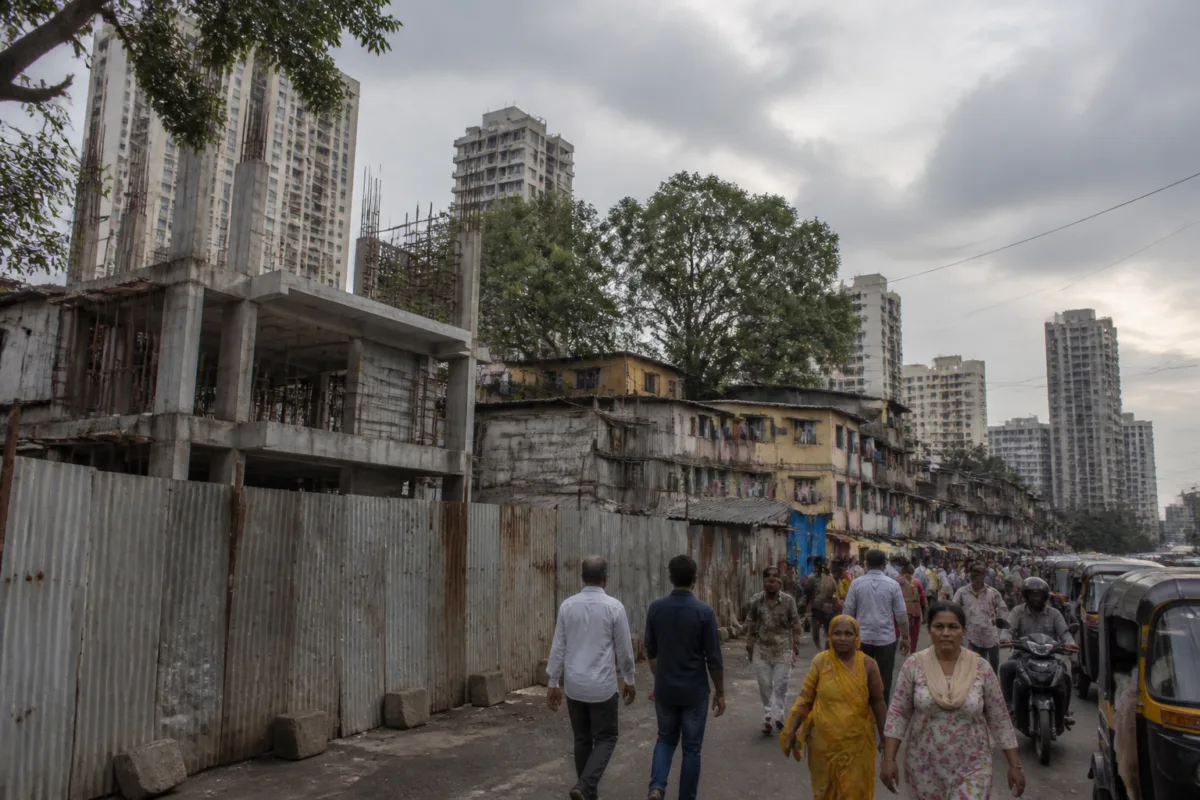
The Bombay High Court’s dismissal of petitions challenging decisions linked to the Jogeshwari SRA redevelopment project has opened the way for Mumbai’s Slum Rehabilitation Authority to invite fresh tenders and appoint a new developer. The decision affects a stalled project spread across about 50,000 square metres, involving 35 slum societies and the proposed rehabilitation of approximately 7,200 eligible slum residents.
The immediate legal outcome is clear: the recommendations of the Supreme Grievance Redressal Committee, or AGRC, dated 20 April have been upheld by a single bench of Justice Nizamuddin Jamadar. Those recommendations proposed withdrawing benefits extended to financial institutions connected with the project and allowing the SRA to search for a new developer. The petitions challenging the recommendations were filed by JC Flowers Asset Reconstruction Private Limited and Manomay Ventures Private Limited.
The significance of the ruling, however, lies beyond the question of which entity will undertake the next phase of the project. The case illustrates the central weakness of long-running slum redevelopment in Mumbai: a project can remain formally active for years while the people it is meant to house continue to wait without a completed rehabilitation scheme. In Jogeshwari, the project has reportedly remained stalled for 18 years. The court’s intervention therefore concerns both institutional authority and the consequences of prolonged non-delivery.
A legal decision shaped by prolonged delay
According to the report, the court took note of the fact that thousands of slum residents had been left without a clear resolution and that there were no visible signs of the rehabilitation scheme being completed even under the state government’s “amnesty scheme”. The court also held that decisions in a case where thousands of slum residents had effectively been left without a completed rehabilitation outcome fell within the jurisdiction of the AGRC.
That finding matters because it establishes the committee’s role in addressing a redevelopment project that has not delivered its stated purpose. The dispute was not presented merely as a disagreement over commercial rights or the continuation of an existing developer. It was linked to the failure to complete rehabilitation for a large group of residents. The institutional question before the court was whether the AGRC could preserve its recommendations and whether the SRA could proceed towards appointing another developer.
The ruling does not itself complete the rehabilitation project. It removes a legal obstacle to the SRA’s next administrative step. Fresh tendering and the appointment of a new developer remain separate stages. The supplied report does not specify the tender schedule, the eligibility conditions for prospective developers, the implementation timeline or the safeguards that will govern the transition from the earlier arrangement.
Why the 7,200-resident figure matters
The scale of the Jogeshwari project gives the ruling an importance beyond a single redevelopment dispute. About 7,200 eligible residents are expected to be rehabilitated across a site containing 35 slum societies. The number indicates that the project is not a small, isolated building exercise. It involves a large and complex group of households, multiple societies and a site of roughly 50,000 square metres.
Each additional year of delay in such a project has an administrative consequence and a human consequence. Administratively, records, eligibility decisions, financial arrangements and developer responsibilities remain unresolved for longer. For residents, the absence of completed rehabilitation means that the promise of permanent housing remains unfulfilled. The report states that thousands of people have been deprived of permanent homes because of the project’s prolonged delay.
The phrase “eligible residents” is also important. The rehabilitation entitlement is not described as applying automatically to every person living within the project area. It applies to those recognised as eligible under the applicable process. That means the eventual implementation of the court-enabled transition will depend not only on selecting a new developer, but also on maintaining clarity around the beneficiary list and the project’s existing administrative records. The supplied material does not establish whether those records are complete or disputed, so that remains an issue to be monitored rather than assumed.
The institutional chain behind the redevelopment
The case reveals a chain of responsibility involving the SRA, the AGRC, the state government’s amnesty scheme, financial institutions and private entities associated with the project. The SRA is the authority expected to invite new tenders and appoint a developer. The AGRC made recommendations concerning the withdrawal of benefits and the search for a replacement developer. The High Court then reviewed challenges to those recommendations and upheld them.
This sequence shows that stalled redevelopment is not resolved by a single announcement. A court ruling can clarify the authority to act, but the project still has to move through administrative and commercial stages. The SRA must now translate the permission to seek a new developer into an actual tender process. The next developer, once appointed, would have to take forward a project involving several societies and thousands of eligible residents. The available report does not provide details about the project’s financial structure, the previous developer’s construction progress or the specific benefits granted to the financial institutions.
The reference to withdrawing benefits extended to financial institutions is particularly significant because it indicates that the project’s difficulties were connected not only to construction but also to financial arrangements. Yet the exact nature of those benefits is not detailed in the supplied material. It would be inaccurate to infer the terms of the financial arrangement or assign responsibility for the delay without the full court order, AGRC recommendations or official SRA records.
What the ruling changes—and what it does not
The ruling changes the immediate legal position by leaving the AGRC recommendations intact. The SRA can now move towards a fresh tender and a new developer without the petitions continuing to block that route. For residents, this creates an administrative opening after years of stagnation.
It does not, on the evidence available, guarantee that construction will restart quickly or that rehabilitation will be completed within a defined period. No tender deadline, developer selection date or construction milestone is mentioned in the report. Nor does the report state whether the new process will involve revised project conditions, a different financial model or additional protections for residents during the transition.
That distinction is essential in evaluating redevelopment outcomes. A legal permission to appoint a new developer is an enabling decision, not a housing delivery milestone. The public value of the ruling will ultimately be measured by whether the SRA can convert the next tender into an implementable project and whether the 7,200 eligible residents see progress towards completed rehabilitation. At present, the supplied facts establish the first step but not the result.
The larger Mumbai redevelopment problem
Jogeshwari’s 18-year delay also raises a structural question about how Mumbai manages redevelopment projects that depend on the coordination of residents, authorities, developers and financiers. The project includes 35 societies, which means that implementation is likely to involve more than a single land parcel or a single resident body. Even without adding facts not contained in the report, the scale itself shows why institutional clarity matters: every delay affects a large group whose rehabilitation is tied to the same project framework.
The case further shows why the protection of resident interests cannot be treated as separate from financial and legal decisions. The AGRC recommendations were justified in the reported account by the absence of signs that the rehabilitation scheme would be completed and by the fact that thousands of residents had been left without a resolution. The court’s acceptance of the committee’s jurisdiction places the status of residents at the centre of the dispute.
At the same time, the ruling leaves several questions open. The report does not say when the fresh tender will be issued, what conditions will apply to a new developer, how the previous arrangements will be closed, or what mechanism will ensure continuity for eligible residents. It also does not provide the court’s detailed reasoning beyond the finding that the AGRC had authority to act in these circumstances.
The next phase will therefore be administrative rather than purely judicial. The SRA’s tender, the selection of a new developer and the publication of a clear implementation path will determine whether the ruling becomes a meaningful reset or simply another stage in a long-running process. For the residents of the 35 societies, the central measure remains unchanged: whether the promised rehabilitation homes are actually delivered.
The Bombay High Court decision confirms that the AGRC recommendations can stand and that the SRA may pursue a new developer for the Jogeshwari project. It does not establish a completion date. The next developments to watch are the SRA’s fresh tender, the appointment of a developer and the milestones set for rehabilitating the approximately 7,200 eligible residents.

