


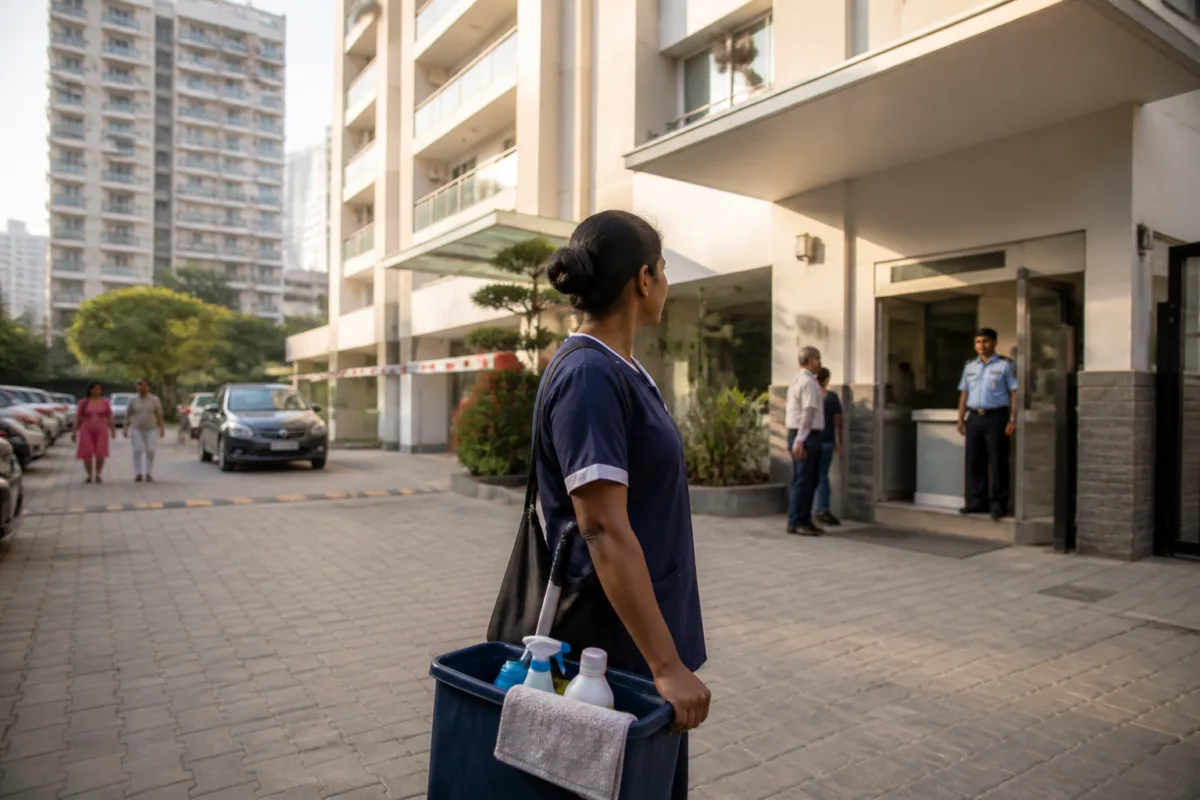
India’s instant househelp platforms are trying to turn domestic work into an on-demand urban utility. Their promise is simple: a household can book help with dishes, cleaning or laundry at short notice, often at prices close to or below what a traditional dedicated housekeeper might charge for a single visit. The harder question is whether this convenience can become a viable business without permanently subsidising every booking.
The figures reported by Economic Times show the tension clearly. Snabbit spent Rs 195 crore in FY26 against operating revenue of Rs 12.2 crore, while its net loss reached Rs 168 crore. Urban Company’s InstaHelp has also been prioritising expansion over near-term profitability. Its post-discount average order value fell to Rs 118 in the September quarter from Rs 134 in June as the company used lower introductory prices to attract users.
These numbers matter beyond the fortunes of individual startups. They show how a new urban service is being built: not through a conventional employer-household relationship, but through a platform that must recruit workers, locate them close to demand, manage short trips and persuade customers to book repeatedly. The model combines the cost pressures of a logistics network with the uncertain retention patterns of a consumer app.
The central challenge is that the service must be cheap enough to encourage trial and expensive enough to pay for the worker, the platform, travel time, technology, customer support and market expansion. At present, the gap between those two conditions is being financed by company capital and investor funding.
The price problem behind the convenience
Urban Company’s InstaHelp offers a useful illustration of the pricing problem. The company said in July that the service would need an average order value of around Rs 300 to break even. At that time, the average order value was Rs 138. Chief executive Abhiraj Singh Bhal said the business could take as long as five years to reach the break-even level.
That gap cannot be closed simply by increasing the number of bookings. Higher volumes can improve worker utilisation, but they do not automatically create a healthy business if each booking remains heavily discounted. The platform must eventually raise the revenue earned per order, reduce the cost of acquiring customers, or make each worker serve more households within a compact area.
Each route carries a risk. Higher prices could reduce demand among customers who are using instant househelp precisely because it is affordable. Lower discounts could make it harder to compete with a rival still willing to absorb losses. And if all major platforms attempt to build market share at the same time, the category could remain locked in a price war while presenting growth as proof of product-market fit.
This is particularly important because household help is not a uniform consumer category. Some bookings may be emergency substitutes when a regular worker is absent. Others may be occasional cleaning or laundry jobs. A smaller group of households may use the service frequently enough to create a stable routine. The financial model depends heavily on which of these behaviours becomes dominant after introductory offers end.
Density, not just scale, is the real test
The operational challenge is more demanding than a standard marketplace. A platform for domestic services cannot simply match a customer and a worker across a large city. Short-duration jobs become expensive when workers spend too much time travelling, waiting or moving between low-volume neighbourhoods.
The most attractive operating areas are therefore dense urban catchments, where many potential bookings are located close together. Density can reduce travel time, improve worker utilisation and allow a platform to offer quick service without maintaining an excessively large idle workforce. In lower-density areas, the same promise may require more workers and more repositioning for fewer orders.
Snabbit’s expansion illustrates both the opportunity and the cost. The company grew from around 500 daily jobs across eight micro-markets at the start of FY26 to a run rate of 35,000 jobs across more than 100 micro-markets by the end of the financial year. But its accounts also show the spending required to support that growth: expert service costs of Rs 63.1 crore, marketing expenses of Rs 48.7 crore and employee benefits of another Rs 46 crore.
The question is not whether the company can enter more neighbourhoods. It is whether each new micro-market becomes more efficient after launch. If recruitment, customer acquisition and service delivery remain expensive in every location, geographic expansion can increase the scale of losses as quickly as it increases bookings.
The sector’s reported numbers point to a similar imbalance. The three major platforms together handled 3.97 million orders in June, up 20% from May. However, their combined monthly cash burn also rose 14% to between $16 million and $17 million. More transactions are being completed, but the reported spending trajectory has not yet shown that volume is producing proportionately better economics.
The habit question
For instant househelp to become a durable urban service, customers must use it often enough to support a dedicated supply network. That is different from demonstrating that people will try the service when the need is urgent or when the price is unusually low.
The category is attempting to change how households organise domestic work. Traditional arrangements are usually built around a regular worker, a fixed schedule and a relationship that exists outside a digital platform. Instant services replace some of that predictability with flexibility. A household can book help when its regular arrangement fails, but the platform must persuade it that this flexibility is worth paying for repeatedly.
June’s order data suggests that demand is substantial. Snabbit narrowly overtook Urban Company’s InstaHelp in booking volumes, while Urban Company retained the lead in transaction value because of its higher average order value. The difference is significant: order counts show the reach of the service, but transaction value gives a clearer indication of the revenue available to support operations.
Pronto’s fundraising and reported operating figures provide another indication of investor confidence. The startup raised an additional $20 million and said its valuation doubled to $200 million within two months of an earlier funding round. It also reported that bookings rose from 3,000 to more than 26,000 a day since December and that burn per booking fell 55% while worker payouts were maintained.
Those figures suggest that operational improvement is possible. They do not, by themselves, establish whether customers remain active at normal prices or whether the reduction in burn can be sustained during rapid expansion. The decisive measure is likely to be repeat usage without comparable increases in discounts and acquisition spending.
Different companies, different financial runways
Urban Company has more room to fund a prolonged experiment because its established home-services businesses remain profitable. In its latest shareholder communication, the company said businesses outside InstaHelp generated Rs 119 crore in adjusted EBITDA during the first nine months of the financial year. It also reported Rs 1,901 crore in cash as of September 30 and approved a plan to raise Rs 2,500 crore through a qualified institutional placement.
Bhal has said InstaHelp losses will remain elevated for several quarters as the company prioritises scale. Urban Company has also said its core business can fund InstaHelp losses from Q3 FY28. That provides the platform with a longer runway, but it does not remove the need to demonstrate that the service can eventually pay for itself.
Snabbit faces a sharper financial test. Its FY26 net loss was almost 14 times its operating revenue. Founder Aayush Agarwal has argued that the annual accounts do not capture the company’s more recent progress, saying loss per job fell below Rs 200 in September from roughly Rs 1,500 at the start of FY26. This is a company-reported improvement, but it must hold as the network expands into additional markets.
The broader funding environment therefore has two possible effects. Capital can allow companies to build supply networks, improve technology and reach the density required for better utilisation. But it can also allow platforms to postpone the point at which customers pay the full cost of the service. If competitors continue subsidising bookings to protect market share, additional funding may prolong a price war rather than establish a profitable urban utility.
What the evidence establishes—and what remains open
The available evidence establishes that demand for instant domestic services is growing rapidly. It also shows that the sector is spending heavily to generate that demand and that the largest platforms have not yet demonstrated a stable relationship between booking growth and profitability.
The next stage will depend on three linked changes: whether average order values rise, whether workers can complete more jobs within dense local catchments, and whether customers continue booking after introductory discounts decline. These are not separate tests. Higher prices may reduce demand; higher density may require more local investment; and stronger repeat usage may depend on reliable service quality and worker availability.
The urban significance of the category lies in this intersection of convenience, labour and geography. Instant househelp is not merely an app feature. It is an attempt to organise a fragmented, highly localised form of domestic work through a citywide platform. Its success will depend less on the novelty of ten-minute booking than on whether neighbourhood-level operations can support fair worker payouts and sustainable customer pricing.
For now, the platforms have shown that households will try the service and that investors are willing to finance expansion. They have not yet shown that low-cost, rapid househelp can become consistently profitable at scale. That remains the sector’s central urban and financial test.

