


Swiggy Instamart’s widening gap with Blinkit is not only a contest between two delivery platforms. It is also a measure of how quickly each company has built the physical network needed to serve dense urban demand. Instamart’s quick-commerce business is growing, but its smaller dark-store footprint, weaker order value and continuing losses show that order growth alone does not guarantee a viable urban fulfilment model.
Instamart’s net order value rose 34.8 per cent year-on-year to ₹6,594 crore in the July-September quarter. Orders increased 29.3 per cent to 130 million, while monthly transacting users rose 23 per cent to 14.8 million. Sequential growth also accelerated, reaching 13.4 per cent from 2.5 per cent in the preceding quarter. These figures indicate that demand is expanding and that the service is reaching more consumers and generating more transactions.
The difficulty is that this growth has not yet translated into stronger operating economics. Instamart’s adjusted EBITDA loss widened to ₹895 crore from ₹849 crore a year earlier and ₹778 crore in the June quarter. Its contribution margin stood at minus 1 per cent of gross order value. The numbers point to a business that is increasing activity while still carrying a substantial cost burden for each unit of urban convenience it delivers.
Blinkit’s reported position illustrates the scale of that challenge. Eternal’s quick-commerce business recorded net order value of ₹20,940 crore, up 79.3 per cent year-on-year, and adjusted EBITDA of ₹184 crore. Blinkit’s order value was more than three times Instamart’s, while its network of 2,751 dark stores was over twice the size of Instamart’s 1,240 stores. Blinkit added 308 net stores during the quarter, compared with 69 added by Instamart.
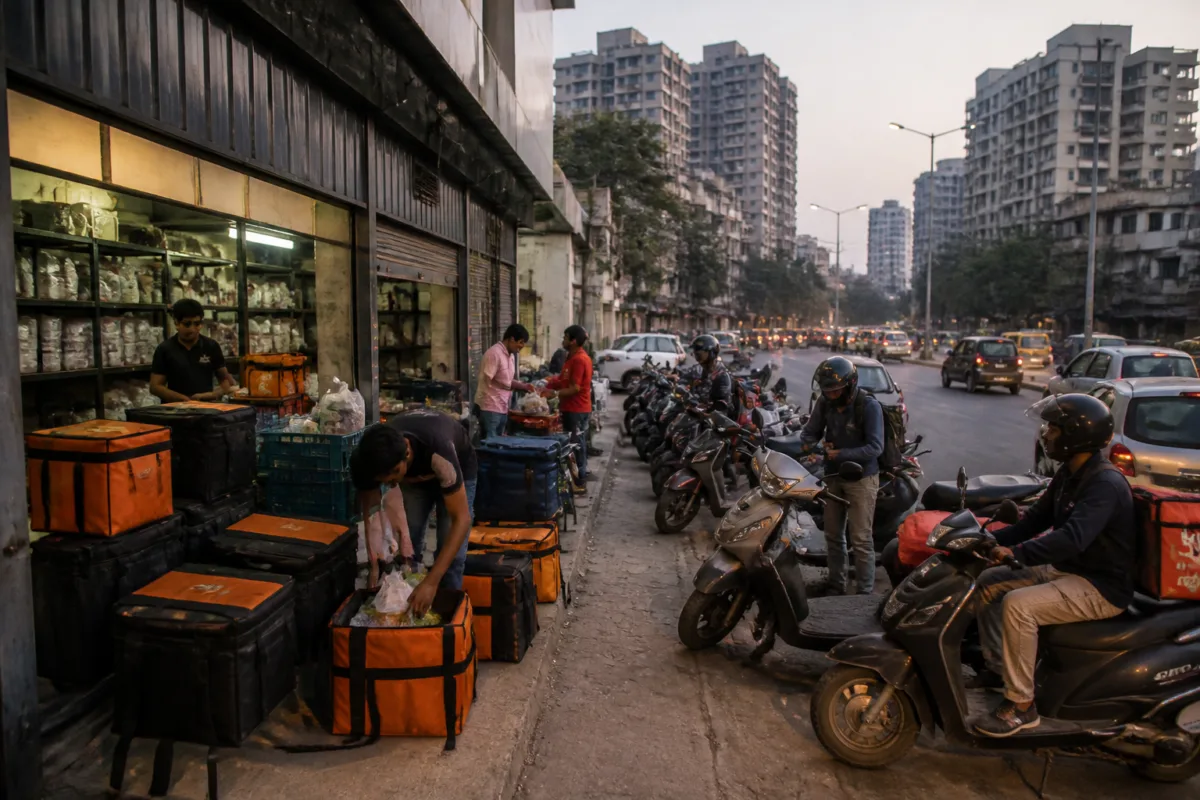
The comparison matters because a quick-commerce network is not simply a collection of retail outlets. Dark stores are local fulfilment points that determine how much inventory can be positioned close to customers, how far delivery workers must travel and how reliably an order can be assembled within a promised time. The supplied figures do not establish the precise productivity of each store, but they show that the two companies are operating with materially different network scales and expansion rates.
For Instamart, this creates a strategic choice between pursuing physical reach and improving the output of its existing network. Matching Blinkit store for store could require heavy investment and could further pressure losses. Holding back expansion could limit assortment, availability and delivery coverage in markets where the rival has already built a denser presence. The company’s reported focus on store productivity, product availability and service quality suggests that it is attempting to improve the economics of the network it already has while continuing to add locations.
That tension is central to the urban business model. A larger network can place goods closer to households, but it also creates fixed costs related to premises, staff, inventory and operations. The benefit of each additional store depends on whether it attracts enough orders and whether those orders generate sufficient contribution after fulfilment and delivery expenses. The report does not provide store-level revenue, rent, staffing or delivery-cost data, so it is not possible to determine from the supplied evidence which part of the cost structure accounts for most of Instamart’s deficit.
The reported margin figures nevertheless make the direction clear. Blinkit’s adjusted EBITDA margin improved for the sixth consecutive quarter to 0.9 per cent of net order value. Instamart, by contrast, remained at a negative contribution margin of 1 per cent of gross order value. These are not identical measures and should not be treated as a direct like-for-like profitability comparison. They do, however, show that Blinkit is reporting positive adjusted operating performance at the business level while Instamart is still attempting to move its order economics into positive territory.
Instamart is also betting that differentiation can reduce its dependence on a pure scale race. Swiggy’s Switch proposition brings together partnerships with around 400 brands, while private label No!ce and fresh-produce brand Nectr are intended to broaden the offer. According to the company, No!ce appears in one in eight baskets, and customers buying the brand show 15 percentage points higher retention. If sustained, higher retention could help increase repeat usage without requiring every improvement to come from adding stores, although the supplied report does not establish whether the private-label basket produces higher margins after all associated costs.
The planned transition to inventory ownership is another important change. Swiggy expects the transition to begin in mid-Q3 FY27 and take two to three quarters to complete. The company expects the model to add about 80 basis points to Instamart’s contribution margin once fully rolled out. This is a management expectation, not a realised result, and its effect will depend on execution, inventory turnover, procurement terms and the ability to maintain product availability without creating excess stock. None of those operating outcomes has yet been established in the supplied material.
Inventory ownership can alter the relationship between a platform and the goods it sells. Instead of primarily facilitating transactions between suppliers and customers, the business assumes more responsibility for what is stocked, how it is priced and how quickly it moves. That may give the operator greater control over assortment and availability, but it also places more working-capital and inventory risk on the business. The report identifies the expected margin benefit but does not provide the investment required or explain how the transition will affect cash flows.
The urban significance of this competition lies in the physical reorganisation of retail. Quick-commerce platforms rely on a distributed network rather than a small number of large shopping destinations. Their performance depends on the placement of stores within neighbourhoods, the availability of suitable premises, the flow of delivery workers and the ability to replenish stock frequently. As these networks expand, they become part of the operating layer of cities, even though the report does not provide location-level information on land use, rents, traffic or employment.
The data also exposes a difference between user growth and network economics. Instamart’s monthly transacting users increased 23 per cent, below its 29.3 per cent growth in orders, while net order value rose 34.8 per cent. This suggests that existing users are contributing a significant share of the increase in transactions and value, although the supplied figures do not provide order frequency, average order value or customer-level profitability. The company’s retention data for No!ce points to the importance of repeat behaviour, but it does not show whether retention gains are broad-based across the platform.
For the sector, the competitive benchmark is therefore moving beyond delivery speed. Store density, assortment, retention, inventory control and contribution margin are becoming equally important. Blinkit’s reported addition of 308 stores in the quarter gives it a clear expansion lead, while Instamart’s 69-store addition indicates a more measured pace alongside efforts to strengthen the existing proposition. The figures do not establish that one expansion strategy is universally superior; they show that the two businesses are making different trade-offs between reach, investment and profitability.
The immediate test for Instamart is whether its next phase of growth produces a different quality of revenue. Management expects sequential growth to continue in the following quarter alongside operating-margin improvement. The company also expects the inventory-owning model to begin in mid-Q3 FY27 and to be completed over two to three quarters. Those milestones will provide the next evidence on whether stronger assortment, private labels, retention and store productivity can narrow the gap without requiring an expansion cycle as large as Blinkit’s.
What the available evidence confirms is a substantial difference in scale and current economics. Instamart is not short of demand: its users, orders and net order value are all growing. But Blinkit’s larger network, faster store additions and positive adjusted EBITDA have made scale itself a competitive advantage. What remains uncertain is whether Instamart can convert its growth initiatives into sustained margin improvement, and whether its inventory transition will deliver the projected 80-basis-point contribution-margin benefit. The company’s next quarterly performance and the rollout of the new model will be the key developments to monitor.

