


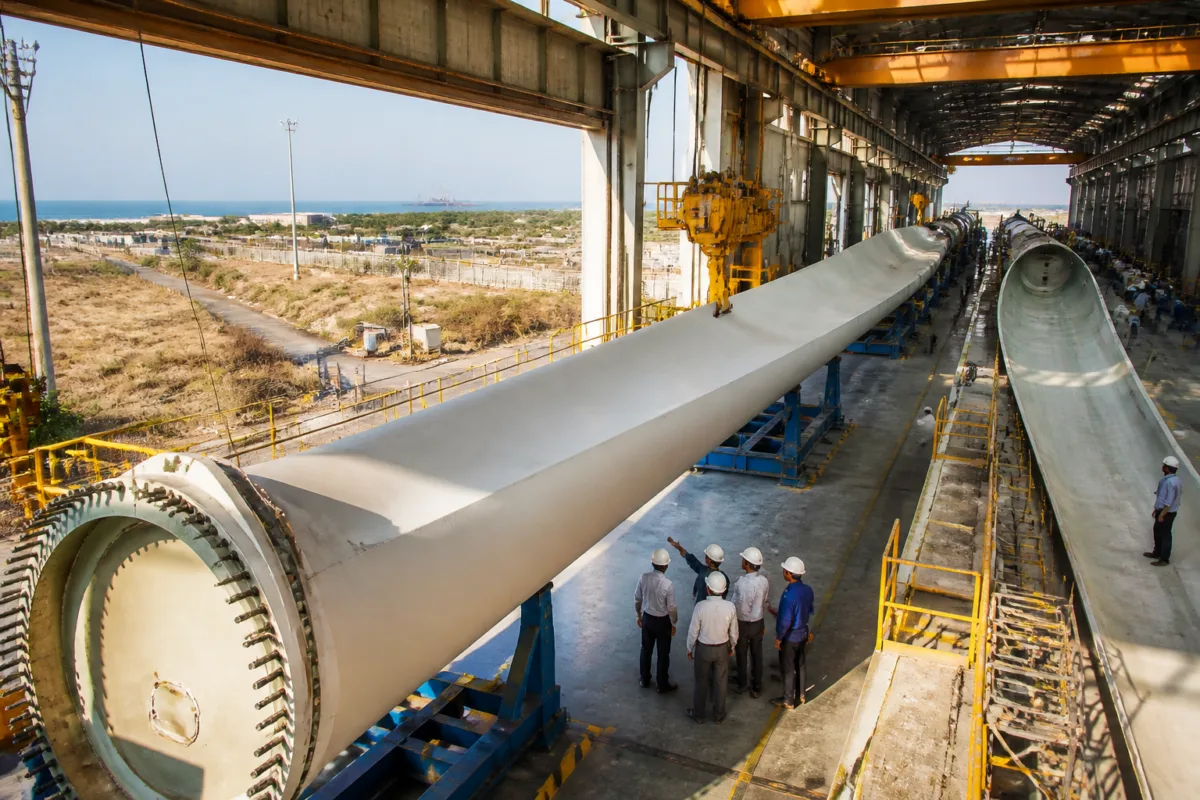
Adani Wind’s production of 91.2-metre onshore turbine blades at Mundra is more than a record-length manufacturing announcement. It shows how India’s wind equipment industry is trying to combine larger machines, domestic production and certification for locations where wind speeds may be low or moderate. The development also brings into focus a less visible part of renewable infrastructure: the industrial capacity required to manufacture, test and deploy increasingly large components.
Adani Wind, the wind manufacturing division of Adani New Industries Limited, said on Monday that it had begun producing the blades at its integrated facility in Mundra, Gujarat. The company, a wholly owned subsidiary of Adani Enterprises, said the blades were developed for its MWL185-5.0 MW wind turbine platform. The platform has received certification from WindGuard Certification GmbH, an independent German testing and certification body.
The certification followed prototype testing at the installation site in Mundra and confirms compliance with the internationally recognised IEC 61400 series of standards for wind turbine design, testing and manufacturing, according to the company. The certification is important because it moves the platform beyond development and testing towards serial production. In practical terms, the announcement links the size of the blade to the institutional process required before a turbine model can be manufactured at scale.
The MWL185-5.0 MW platform has a rotor diameter of 185 metres and a hub height of 140 metres. Its rotor sweeps nearly 26,600 square metres, an area the company compares with more than three and a half standard football pitches. These dimensions are not merely engineering specifications. They define the area through which the turbine can capture wind and the physical scale of the infrastructure that must be transported, assembled and operated at a project site.
Adani Wind said the platform is designed to capture wind at varying speeds, including low- and moderate-wind locations, and to improve energy generation and capacity utilisation. The supplied announcement does not provide operating results for the platform or compare its actual output with earlier models. What it establishes is the design intention: the turbine is being developed for a wider range of wind conditions rather than only for sites with stronger wind resources.
The 91.2-metre blades extend the range of products currently manufactured at Mundra. The facility produces blades measuring 78.6 metres and 80.5 metres, the company said. The progression in blade length reflects the growing physical scale of the company’s product portfolio, although the announcement does not establish whether the longer blades will lower project costs, increase annual generation in specific locations or reduce the number of turbines required for a project.
That distinction matters for understanding the industrial story. A longer blade can be part of a strategy to extract more energy from a turbine platform, but the benefits depend on site conditions, project design, transport logistics, installation capability and grid availability. The company has described the platform’s intended performance range, but the supplied material contains no independent operating data or project-level cost assessment. The record-length claim therefore establishes manufacturing capability, not a demonstrated outcome across wind farms.
The platform was developed in partnership with German technology company W2E, or Wind to Energy. This arrangement places the Mundra facility within a wider technology and certification chain. The product is being manufactured in India, while its development involved a German technology partner and certification by a German body. The supplied facts do not specify the division of intellectual property, the share of locally sourced components or the extent of technology transfer. They do, however, show that domestic manufacturing capability is being built alongside international engineering and compliance relationships.
Adani Wind said three of its turbine platforms are listed under the Ministry of New and Renewable Energy’s Approved List of Models and Manufacturers for wind, or ALMM-Wind. The listing provides an institutional link between the company’s equipment portfolio and the approval framework for models and manufacturers. The announcement does not set out the eligibility conditions or procurement consequences associated with the listing, but it confirms that the company’s product strategy is being developed within a government-recognised equipment framework.
The company also said its MWL 160-5.2 MW platform had crossed 2 GW in installations at Khavda in Gujarat. This is the most concrete installation figure in the announcement and offers a measure of deployment experience within the company’s portfolio. It relates to the MWL 160-5.2 MW platform, however, not the newly certified MWL185-5.0 MW model. The two should not be treated as interchangeable evidence: one represents reported installations, while the other has reached certification and is being prepared for serial production.
The company’s cumulative orders from independent power producers outside the Adani Group have crossed 1 GW following recent orders. This indicates that the business is seeking demand beyond its parent group, but the supplied material does not identify the buyers, projects, locations, order values or delivery schedules. The figure is therefore a measure of reported external order volume, not a complete picture of the company’s market share or future installations.
Adani Wind currently has manufacturing capacity of 2.25 GW and plans to expand it further. Its portfolio covers wind turbine platforms ranging from 3.x MW to 5.x MW. Together, these figures describe a manufacturer attempting to operate across multiple platform sizes while expanding production capacity. They also underline the difference between nominal manufacturing capacity and installed renewable capacity: the former refers to what the factory can produce, while the latter depends on orders, project approvals, site development, logistics, transmission and commissioning.
Mundra’s role in this announcement is consequently central. The facility is not being presented only as a plant producing one component. It is described as an integrated manufacturing facility making blades of different lengths, while prototype testing for the new platform also took place at the site. That combination brings product development, testing and manufacturing into the same industrial location, although the announcement does not specify the full range of components produced there or the number of jobs and suppliers connected to the facility.
The larger urban and infrastructure question is how renewable generation becomes deployable infrastructure. A turbine blade is visible as a large industrial object, but its public value depends on the chain around it: a certified model, a suitable wind site, transport routes capable of moving oversized equipment, installation systems, a connected grid and an owner able to place the equipment into operation. The supplied announcement provides evidence on the first part of that chain and partial evidence on manufacturing and orders. It does not provide information on transmission capacity, land requirements, local approvals or the operational performance of the new platform.
The announcement therefore supports a measured conclusion. Adani Wind has commenced production of 91.2-metre blades for a certified 5 MW platform, expanded the product range at Mundra and reported 2.25 GW of manufacturing capacity, more than 1 GW in orders from independent power producers and 2 GW of installations for another platform at Khavda. What remains unestablished is how the new model will perform in commercial projects, where it will be deployed and how quickly the expanded manufacturing capability will translate into commissioned generation. Those are the next facts that will determine whether the manufacturing milestone becomes a broader infrastructure outcome.

