


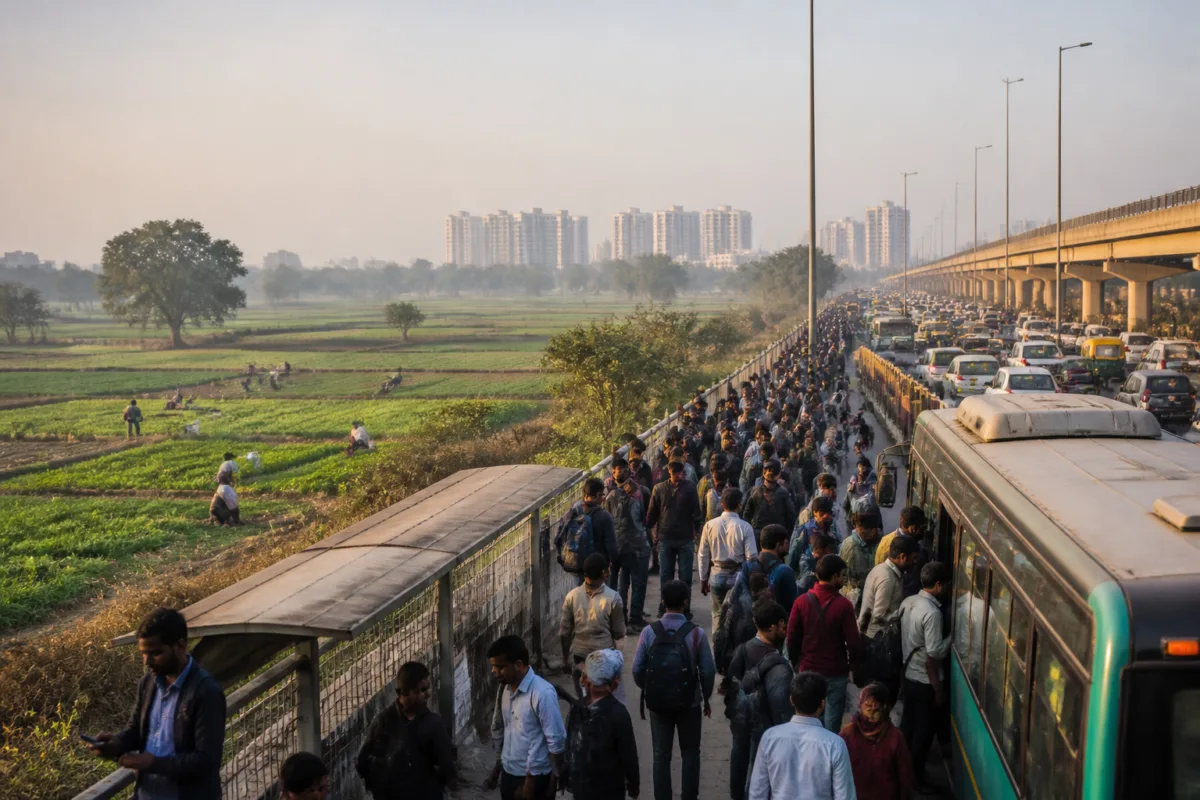
India’s unemployment rate fell to 5.1 per cent in July-September 2026 from 5.4 per cent in the previous quarter, but the improvement was driven primarily by rural India. Urban unemployment moved in the opposite direction, rising slightly to 6.8 per cent from 6.7 per cent. The contrast makes the latest Periodic Labour Force Survey more than a headline decline: it shows a labour market improving unevenly across the country.
The data, released by the Ministry of Statistics and Programme Implementation, indicates that the national unemployment rate does not tell a uniform story. Rural unemployment fell from 4.8 per cent in April-June to 4.3 per cent in July-September. In cities, however, the rate increased marginally. This divergence is important because urban employment is closely tied to the availability of regular, salaried and non-agricultural work, while the rural labour market recorded a strong increase in agriculture-linked employment during the quarter.
The survey also recorded a rise in the proportion of people aged 15 years and above who were either working or seeking work. At the national level, this share increased to 55.5 per cent from 54.6 per cent. The improvement was sharper in rural areas, where the proportion rose from 56.9 per cent to 58.1 per cent. In urban areas, the figures supplied in the report moved from 50.2 per cent to 50.4 per cent, even as the ministry’s reported comparison described the urban change as marginal.
This distinction between unemployment and labour-force participation matters. A lower unemployment rate can reflect more people finding work, but it can also be shaped by changes in the number of people actively seeking employment. The latest figures show that more people were working or looking for jobs overall, while the increase was concentrated more strongly in rural India. The data therefore points to a broader expansion of labour-market participation, but not to an equally distributed improvement in employment conditions.
The employment-to-population picture also improved. The proportion of people who were actually employed increased to 52.7 per cent from 51.7 per cent. Rural employment participation rose to 55.6 per cent from 54.2 per cent, while the urban figure remained nearly unchanged at 46.9 per cent. The gap between these two figures underlines the different employment structures facing rural and urban workers.
Rural employment increased alongside a significant shift towards agriculture. The share of rural workers engaged in agriculture rose to 56.7 per cent from 52.9 per cent in the previous quarter. The share of self-employed workers in rural areas also increased, reaching 62.7 per cent from 61.4 per cent. Taken together, these figures show that the rural improvement was associated not only with a lower unemployment rate, but also with a greater concentration of workers in agriculture and self-employment.
That composition is central to understanding the headline decline. The survey does not present the fall in unemployment as a single, uniform transition into formal or salaried work. Instead, the available figures show an increase in rural agricultural employment and self-employment, alongside a relatively stable urban employment rate and a slight rise in urban unemployment. The national result is therefore being shaped by different kinds of work in different parts of the country.
Urban India presents a separate pattern. The share of city workers holding regular salaried jobs rose slightly to 49.6 per cent from 49.3 per cent. That increase is modest, and it occurred alongside urban unemployment rising to 6.8 per cent. The combination suggests that the urban labour market experienced limited movement in regular salaried employment during the quarter, even as the overall urban unemployment rate edged upwards.
The figures also reveal a significant gender dimension. The proportion of women aged 15 years and above who were working or seeking work increased to 34.7 per cent from 33.2 per cent. The share of women who were employed rose to 32.8 per cent from 31.3 per cent. These are improvements in both participation and employment, but the figures also show that women’s measured engagement with the labour market remains well below the corresponding overall participation levels reported for the population.
The survey estimated that approximately 57.9 crore people aged 15 years and above were employed in India on average during July-September 2026. This included 40.5 crore men and 17.4 crore women. The gender split places the increase in women’s participation in the context of a much larger male employment base, while also making the rise in women’s employment a notable part of the quarter’s movement.
For cities, the most important signal is not the national fall alone but the limited improvement in urban employment indicators. Urban unemployment rose from 6.7 per cent to 6.8 per cent, and the proportion of people who were actually employed remained at 46.9 per cent. The regular salaried workforce increased only marginally. In contrast, rural areas recorded declines in unemployment and increases in both labour-force participation and employment participation.
This rural-urban divergence also highlights the limits of using a single national indicator to assess the health of India’s labour market. A national unemployment rate of 5.1 per cent can coexist with different realities: a rural labour market absorbing more people into agriculture and self-employment, and an urban labour market where unemployment has increased slightly and employment participation has barely changed.
The Periodic Labour Force Survey is consequently relevant to more than labour statistics. It provides a window into how households connect to the wider economy and how the structure of work differs between villages and cities. In the latest quarter, the rural data is marked by higher agricultural engagement and self-employment, while the urban data is marked by a small increase in regular salaried work but no improvement in the overall share of people employed.
The figures also place women’s employment within this uneven transition. Women’s participation and employment both improved during the quarter, but the report does not establish from the supplied data whether this increase was concentrated in rural or urban areas, or what types of work accounted for it. That limitation is important: the headline improvement can be established, but its sectoral and geographic distribution requires more detailed information than is provided here.
What the latest survey confirms is a split labour-market movement. Rural India drove the fall in unemployment, supported by higher participation, greater employment participation, increased agricultural work and more self-employment. Urban India did not share the same improvement: unemployment rose marginally, employment participation remained unchanged at 46.9 per cent, and regular salaried employment recorded only a slight increase.
The next question for readers and policymakers is therefore not simply whether unemployment has fallen nationally. It is whether the improvement is translating into more stable and productive work across both rural and urban economies. The supplied figures establish the divergence clearly, while further survey detail would be needed to assess the quality, durability and location of the new employment recorded in the quarter.

