


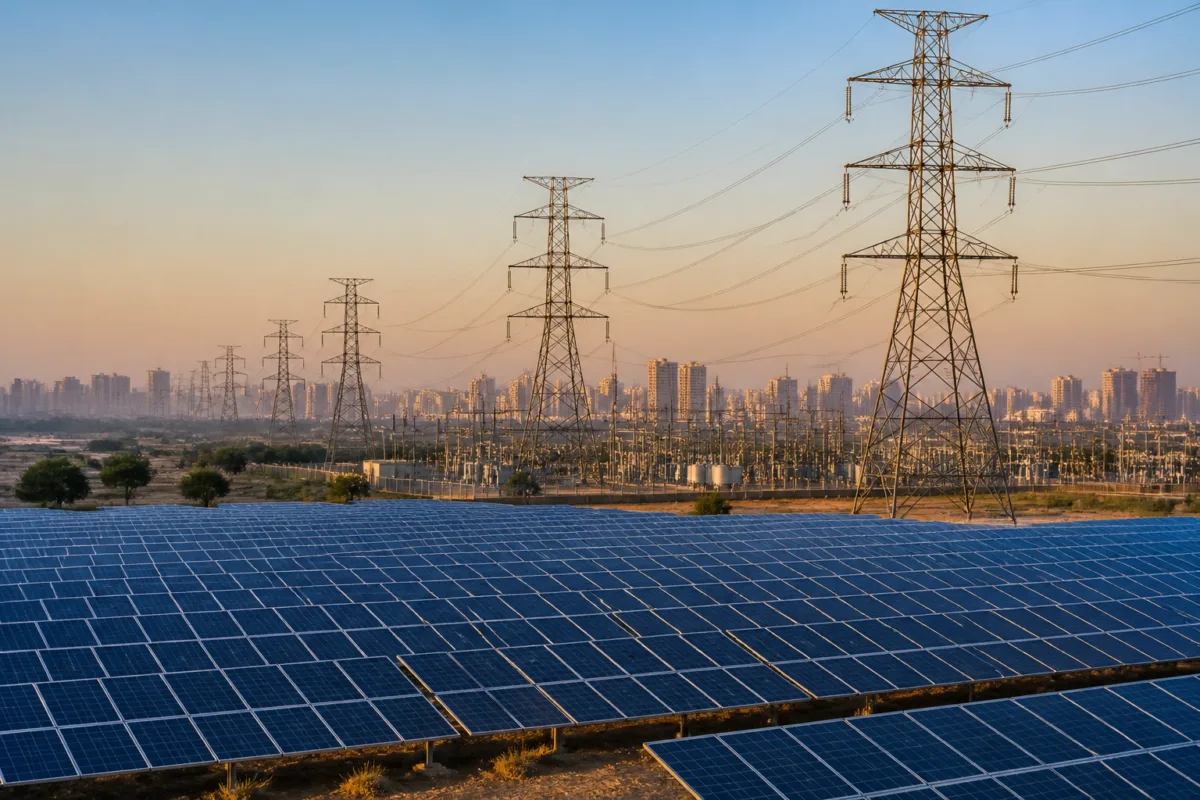
India’s renewable energy policy is increasingly being treated as an investment framework rather than a collection of climate measures. A new analysis by Zero Carbon Analytics describes the country as a “role model” for emerging economies because its policies address several risks that can deter private capital: land and transmission access, construction, market access, payment delays and long-term visibility for developers.
That assessment comes as India prepares to mobilise around $220 billion between 2027 and 2030 for renewable-energy capacity, manufacturing, transmission infrastructure and storage. The scale of the proposed investment makes the policy question an urban and infrastructure question as much as an energy one. Renewable power must ultimately be connected to cities, industries and consumers through networks that can transmit, balance and pay for electricity reliably.
India is targeting 500 GW of installed non-fossil fuel capacity by 2030. The Zero Carbon Analytics report, titled Emerging market financing for renewables, argues that this target, combined with an annual bidding trajectory of 50 GW of renewable-energy capacity through financial year 2028, gives developers and investors a clearer pipeline of opportunity.
The significance of that pipeline is institutional. Large-scale renewable projects are not built only through generation contracts. They require land, evacuation infrastructure, financing, access to power markets and confidence that electricity buyers will pay on time. The report’s argument is that India has increasingly tried to address these risks together.
What India’s renewable energy policy is solving
The report describes India’s approach as “a renewables powerhouse built on enabling policies”. Its assessment is based on measures that operate at different stages of a project’s life cycle. Some reduce the difficulty of developing a project, others improve the market available to generators, while others attempt to strengthen the financial position of electricity buyers.
Among the development-side measures cited is the Ultra Mega Renewable Energy Power Parks scheme. The scheme provides developers access to land and transmission infrastructure, reducing two of the early uncertainties that can delay renewable projects. For investors, the importance of such arrangements is not limited to administrative convenience. Delays in land assembly or grid connectivity can increase financing costs and postpone revenue generation.
The report also points to capital and interest subsidies for renewable-energy projects. These measures can reduce the upfront cost of development, although the supplied material does not quantify their combined effect or identify how much investment has been mobilised through each instrument.
Offshore wind has received a separate policy push through viability-gap funding. The support is intended to help develop India’s first offshore wind farms. Offshore projects require higher initial investment and more complex infrastructure than many onshore developments, making the design of public support important to whether private capital enters the sector.
The framework also includes a demand-side component. Renewable consumption obligations require distribution companies and large industrial and commercial consumers to source a specified proportion of electricity from renewable sources. The Zero Carbon Analytics assessment says these obligations have helped create an expanding market for green power.
That market is also supported by access to day-ahead and intra-day power exchanges. Such access gives generators additional avenues to sell electricity instead of depending on a single contracting arrangement. It connects renewable policy to the operation of the wider power market, where the timing and flexibility of electricity supply matter as much as installed capacity.
The payment problem behind the investment story
The most revealing part of the assessment concerns payment delays by distribution companies. Renewable-energy developers may have long-term contracts, but their cash flows remain exposed if electricity buyers do not pay generators on time. The report says outstanding dues of distribution companies stood at Rs 1.4 lakh crore in 2022 and declined to Rs 4,109 crore in February 2026 after measures introduced by the government in 2022.
The figures, as reported by the Times of India from the Zero Carbon Analytics analysis, indicate a substantial reduction in reported dues. They also show why the financial health of distribution companies is central to renewable-energy expansion. If payment risk is high, developers may demand higher returns, lenders may price projects more cautiously, and new capacity may become harder to finance.
The supplied material does not establish whether the reduction in dues is uniform across all distribution companies or states, nor does it explain how much of the decline reflects structural improvement, settlement mechanisms or changes in the classification of outstanding payments. Those distinctions matter when assessing whether the payment problem has been permanently reduced or temporarily contained.
Still, the direction of the figures supports the report’s broader argument: investor confidence depends not only on targets and auctions, but also on the daily financial functioning of the electricity system.
From capacity targets to physical infrastructure
India’s 500 GW non-fossil fuel target is a capacity objective, but capacity alone does not guarantee usable electricity. Renewable projects need transmission links to connect generation zones with demand centres. They also require storage and other balancing arrangements because electricity production from solar and wind varies according to weather and time of day.
The investment requirement of around $220 billion between 2027 and 2030 reflects this wider system. According to the reported assessment, the funds are expected to support renewable generation, manufacturing, transmission infrastructure and energy storage. That combination is significant because it shifts the policy conversation from adding projects to building an integrated energy supply chain.
For cities, the implications are direct. Urban areas concentrate households, commercial activity, data centres, public infrastructure and industrial demand. Yet the land and natural conditions required for renewable generation are often located elsewhere. The relationship between renewable-energy sites and cities therefore depends on transmission planning, grid reliability and the ability of distribution companies to procure and deliver power.
The same logic applies to manufacturing. The industry executive quoted in the report said that further investment focus is required in India’s solar supply chain. Manufacturing capacity can support domestic deployment and reduce exposure to external supply disruptions, but the supplied material does not provide a breakdown of current production capacity, import dependence or the investment needed across individual components.
The policy advantage—and its limits
The report identifies the government’s decision to allow up to 100% foreign direct investment in the electricity sector as another measure that can improve access to capital. For a sector requiring large and sustained investment, the ability to draw foreign capital may broaden the pool of financing available to developers and infrastructure providers.
However, openness to investment is only one part of the risk equation. A project can be legally open to foreign capital and still face delays in land access, transmission availability, construction, offtake or payment. The report’s emphasis on a holistic approach is therefore important: it presents policy credibility as the combined effect of several administrative and financial systems rather than a single incentive.
This is also why the annual bidding trajectory matters. A stated pipeline of 50 GW of renewable-energy capacity through financial year 2028 gives developers a clearer view of future procurement opportunities. But the final value of that visibility will depend on whether bids translate into projects, whether projects receive timely grid connections and whether contracted power can be absorbed by financially capable buyers.
The evidence available in the reported analysis does not provide project-level completion rates, transmission bottleneck data or a state-by-state comparison of implementation. It therefore supports a conclusion about policy architecture, not a complete verdict on delivery performance.
An emerging-market model under pressure to deliver
Zero Carbon Analytics estimates that capital expenditure on solar and onshore wind projects across emerging and developing economies could reach $356 billion by 2040 if current trends continue. India’s experience is being presented within that larger financing challenge. The country’s policy measures are relevant not simply because they support domestic renewable deployment, but because they show how governments can attempt to reduce risks that prevent private capital from entering infrastructure sectors.
The claim that India is a role model should therefore be understood as an assessment of policy design and investment conditions, not as proof that every implementation problem has been resolved. Renewable expansion still requires coordination between central ministries, state authorities, distribution companies, regulators, developers, lenders and grid operators. Each institution controls a different part of the project chain.
The reported figures show both progress and unfinished work. India has secured $64 billion in private investment between June 2024 and June 2026, including $6.2 billion in foreign direct investment, according to MNRE secretary Santosh Sarangi. At the same time, the country is seeking around $220 billion in the following three-year period for a broader set of energy-system investments.
That gap is not necessarily a contradiction: the future requirement includes multiple infrastructure categories and represents an investment mobilisation goal, while the earlier figure records investment already secured. But it does underline the scale-up expected from the policy framework.
The larger urban question is whether renewable-energy policy can move from project attraction to system reliability. Investors need predictable rules, but cities and industries need electricity that is available when required, transmitted across long distances and purchased through financially sustainable institutions. Renewable capacity, storage, manufacturing, transmission and distribution reform are therefore connected parts of the same built environment.
The evidence supplied by the report confirms that India has built a policy architecture aimed at reducing several investment risks simultaneously. It does not establish that the architecture has eliminated delays, regional disparities or grid constraints. The next developments to watch are whether the planned investment materialises, whether solar supply-chain capacity expands, whether offshore wind support produces projects and whether reduced distribution-company dues remain durable as renewable capacity grows.

