


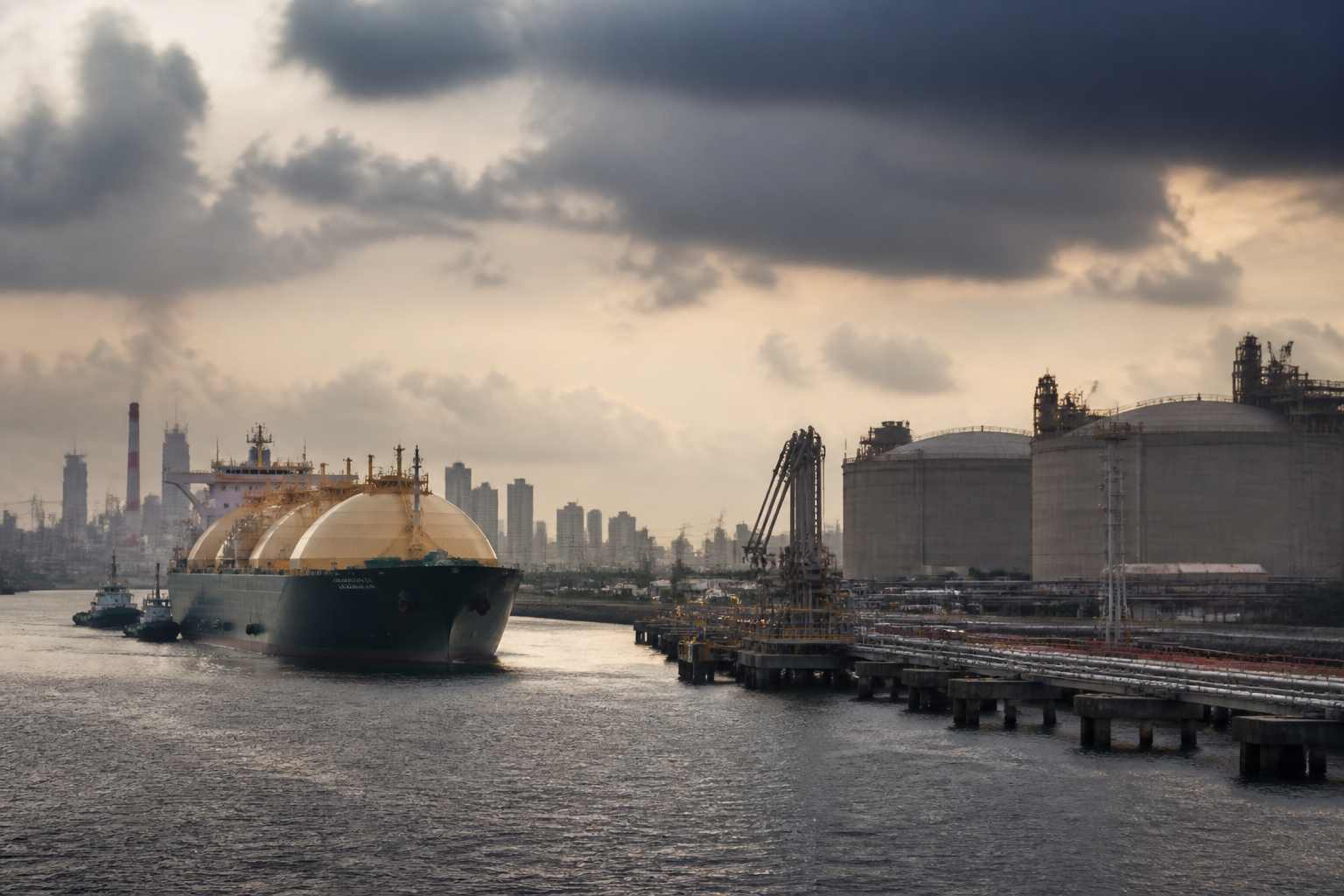
India and four other major emerging Asian economies have spent $7.4 billion on spot liquefied natural gas after disruptions to shipments through the Strait of Hormuz, more than double the cost of comparable supplies purchased under long-term contracts a year earlier. The immediate price shock is exposing a wider weakness in the region’s energy model: imported LNG can appear reliable until a geopolitical disruption turns procurement into a competition for expensive replacement cargoes.
The finding, reported by the Economic Times citing a Bloomberg News analysis of purchase tenders, covers India, Pakistan, Bangladesh, Thailand and Vietnam. Together, these countries spent about $7.4 billion on spot LNG during the period after the US-Iran war began, compared with approximately $3.1 billion for a similar volume under long-term contracts during the same period last year.
That difference is not simply an accounting effect. It shows how a disruption in a strategically important shipping route can quickly move through energy markets and into national power systems, industrial users and household economies. For countries that rely on imported gas for electricity generation and industrial activity, higher LNG prices create pressure on the cost and reliability of energy supply at the same time.
The Strait of Hormuz has become the immediate point of vulnerability. Qatar, which accounted for about a fifth of global LNG shipments before the conflict, has seen most of its LNG shipments through the strait stop since fighting began in late February. Buyers that had expected contracted cargoes therefore had to seek replacement supplies in the spot market, where prices respond more sharply to sudden demand and limited availability.
This is the important distinction between long-term contracting and spot procurement. Long-term contracts can offer buyers greater predictability over volumes and prices, although their terms may vary. Spot purchases provide flexibility when supply is lost, but that flexibility becomes expensive when many buyers are looking for cargoes at the same time. The five Asian economies have paid for that exposure in a market disrupted by events outside their control.
For India, the episode comes after another period in which global gas markets were unsettled by the Russia-Ukraine war. The latest disruption adds to the concern that geopolitical shocks are no longer isolated events for LNG buyers. The Economic Times report cited Sam Reynolds, research lead for LNG and gas in Asia at the Institute for Energy Economics and Financial Analysis, describing one geopolitical conflict as a negative event and a second as a pattern that Asian countries are recognising.
The urban implications are significant because gas is not used only by energy traders or large producers. Imported LNG supports power generation and industrial operations, including activities that underpin cities, manufacturing zones and commercial economies. When gas becomes more expensive, the pressure can appear through higher generation costs, changes in industrial fuel choices and greater stress on electricity systems that have limited short-term alternatives.
The report also shows why substitution is difficult. Moving rapidly from LNG to another power source can place pressure on electricity supplies. Gas has often been valued for its ability to support power generation when demand changes, even though its fuel cost can be vulnerable to international prices. A sudden switch therefore involves more than identifying a cheaper fuel; it requires available generation capacity, transmission infrastructure, fuel logistics and a system capable of absorbing the change.
That constraint is helping preserve LNG demand despite the price shock. Fabian Kor, executive vice president for Asia at SEFE Marketing & Trading, said at a conference in Singapore that if prices remain at such levels, LNG would have difficulty competing with alternative fuels. The statement captures the commercial challenge now facing gas-fired generation: its position depends on remaining affordable relative to other sources, not only on its operational flexibility.
The alternatives being considered by Asian buyers are varied. Countries are examining solar and wind power, coal, nuclear energy, domestic gas production and pipeline supplies. The choices differ because national energy systems have different infrastructure, resource availability and policy priorities. There is no single regional response to the LNG shock.
Pakistan, previously viewed as a high-growth LNG market, is likely to increase its reliance on solar and hydropower because of the impact of the Hormuz disruption, according to the report, which cited BloombergNEF analyst Akshay Modi. Bangladesh has spent more than $2 billion replacing lost Qatari LNG supplies and is offering incentives for rooftop solar installations. In Thailand, a newly released long-term energy plan sets a target of sourcing at least 65% of electricity from renewable energy by 2050.
For Vietnam and the Philippines, the response could move in the opposite direction. Modi said the two countries may turn towards coal as LNG becomes more expensive. The report also cited the International Energy Agency’s expectation that global coal consumption will reach a record this year, with higher gas prices adding to demand. This creates a difficult trade-off: reducing exposure to imported LNG may increase dependence on a fuel with higher emissions and its own supply-chain risks.
The numbers on planned gas-fired power capacity indicate that the problem predates the current disruption. Around 47 proposed gas-fired power plants, representing $52 billion in investment, have been cancelled, withdrawn or made little progress over the past five years in countries including the Philippines, Thailand and Vietnam. The figure, cited from the Institute for Energy Economics and Financial Analysis, suggests that developers and policymakers have already been reassessing the financial viability of gas projects before the latest price shock.
For cities and industrial regions, this matters because power planning is also land-use and infrastructure planning. A gas-fired plant requires fuel import facilities, storage, transmission connections and a predictable procurement model. If projects are delayed or abandoned, the consequences extend beyond the generating unit. Port infrastructure, grid planning, industrial investment and the reliability assumptions built into urban expansion plans can also be affected.
The crisis is simultaneously changing how buyers think about procurement. Around 80% of buyers surveyed by McKinsey expect to change their procurement strategies, with greater geographical diversification becoming a priority over the next few years. Diversification could benefit LNG projects with direct access to Asian markets, including developments in Papua New Guinea, while producers in the United States and Canada may also gain from demand for alternative supplies.
However, supplier diversification does not remove the underlying exposure to imported energy. It reduces dependence on one route or producer, but buyers remain exposed to shipping costs, global competition, foreign exchange movements and future geopolitical disruptions. The present episode therefore raises a broader question about whether security should be measured only by the number of suppliers or also by the share of energy that can be produced domestically or from sources with lower marginal fuel costs.
The LNG industry’s own demand outlook remains positive over the longer term. Shell expects global LNG demand to rise 65% by 2050, driven largely by South and Southeast Asia. That projection reflects the region’s expected energy needs, but the current disruption shows that demand growth and commercial viability are not the same thing. Countries may need more energy while becoming less willing to accept unlimited exposure to volatile imported gas prices.
India’s position sits within this wider Asian transition. The reported spot-gas bill does not establish that the country is abandoning LNG, nor does it show that any particular alternative will replace imported gas quickly. It does demonstrate the financial cost of securing replacement fuel when contracted supplies are disrupted. The evidence also indicates that Asian buyers are reassessing both their fuel mix and the institutional arrangements through which they procure energy.
The next phase will depend on how long the disruption continues, whether LNG prices remain elevated and how quickly alternative power capacity can be developed. Those developments will determine whether the present shift is a temporary procurement response or a deeper change in Asian energy planning. For urban economies, the key issue is clear: energy security is no longer only about securing enough fuel, but also about limiting the infrastructure and economic damage when imported fuel becomes suddenly expensive or unavailable.
