


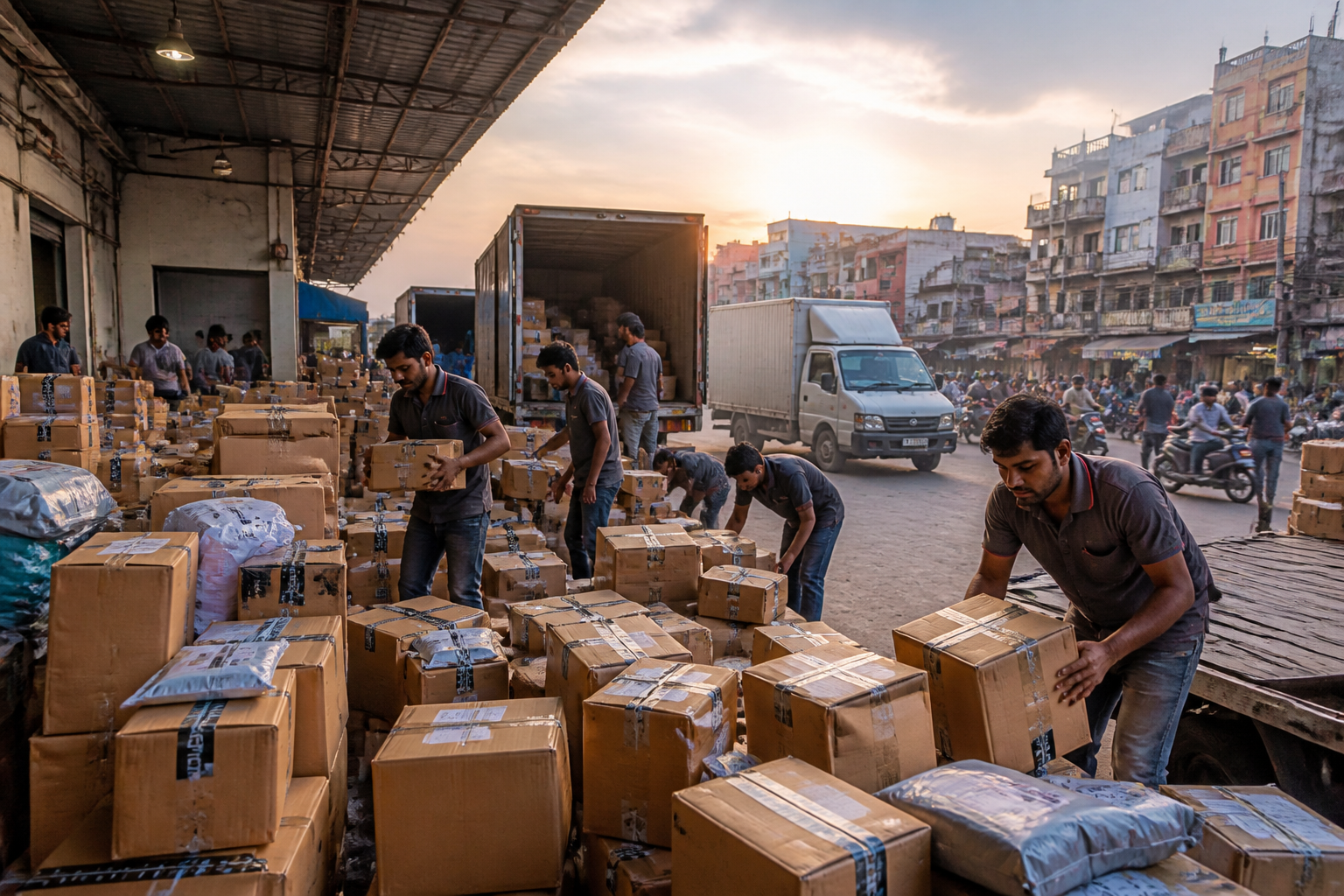
India’s festive e-commerce boom is no longer being driven mainly by metropolitan shoppers. Flipkart’s opening-hour figures for its Big Billion Days sale show how demand, fulfilment and digital participation are spreading across tier-II, tier-III and smaller towns, creating a new geography for retail infrastructure and online commerce.
Flipkart recorded 6.3 million concurrent users in a minute during the opening hour of the 13th edition of its sale. The company said nearly one in two visits came from tier-III towns and beyond, while non-metro customers accounted for about 60 per cent of demand. New customers grew 34 per cent, and the platform recorded more than six times as many Indians shopping in the opening hour as during a regular hour.
These numbers matter because they place smaller cities at the centre of India’s digital consumption story. The strongest growth was not confined to the largest urban markets. Sardulgarh in Punjab, Panskura in West Bengal, and Sheikhpura and Kishanganj in Bihar were among the fastest-growing markets cited by Flipkart. The evidence points to a retail network in which demand is becoming geographically broader even as the largest platforms continue to concentrate technological and logistical capacity.
The shift is visible in what people are buying. Premium and flagship smartphones recorded strong demand, with one in four customers choosing product exchange and one in three opting for no-cost EMI. Large-appliance sales grew 30 per cent year-on-year in the first hour, while tablet sales increased 73 per cent. Beauty sales rose 42 per cent, led by men’s grooming and self-care products. At peak demand, Flipkart sold more than 1,600 men’s perfume units per minute.
This pattern complicates the older assumption that online shopping in smaller towns is primarily about low-cost essentials. The reported demand included premium electronics, wearables, grooming products, air fryers, laptops and external hard drives. Gen Z customers drove a 48 per cent increase in beauty and a 42 per cent rise in watches, while sneakers, perfumes, skincare, creatine and jeans were among the most-searched products across fashion and personal care.
The expansion of this market is also linked to how consumers access digital platforms. Flipkart said 64 per cent of voice-search users came from tier-II-plus markets, with lifestyle and makeup among the most-searched categories. This suggests that the urban digital divide is not simply a question of whether consumers are online. It is increasingly shaped by how platforms make discovery, payments, product comparisons and fulfilment work for users outside the biggest cities.
The logistics layer is becoming equally important. Flipkart Minutes, the company’s ultra-fast delivery service, recorded order volumes 3.5 times higher than on regular days, while new customers grew 11 times during the first hour. During Early Access, an iPhone 17 was delivered to a customer in New Delhi in 3.4 minutes. The New Delhi example is a metro case, but the broader sale figures show that smaller-city demand is expanding at the same time as rapid delivery becomes a more visible part of the competitive model.
That model has an urban infrastructure requirement. Fast delivery depends on inventory positioning, local fulfilment capacity, transport links, delivery workers, digital payments and reliable address systems. The supplied figures do not establish how these systems are distributed across tier-II and tier-III markets, or whether rapid delivery outside metropolitan areas is being supported by dedicated facilities or existing retail and logistics networks. They do, however, show that customer demand is expanding faster than the traditional metro-centred picture of online commerce suggests.
The seller data provides another view of the change. During Early Access, 51 per cent of transacting sellers recorded twice the sales of regular days. Sellers in tier-II-plus India, including MSMEs and small businesses, grew 2.9 times, with Bhiwandi, Panipat, Tirupur and Hisar leading the growth. These locations have different economic profiles, but their appearance in the same growth narrative illustrates how the e-commerce system connects manufacturing, wholesale, warehousing and retail markets across urban India.
This connection is significant for the built environment because online retail does not operate as a purely digital service. It requires physical places where products are made, stored, sorted, exchanged and delivered. Bhiwandi’s logistics role, Panipat’s manufacturing base, Tirupur’s textile economy and Hisar’s small-business activity are brought into the same consumer network through platform infrastructure. The source does not provide employment, warehouse or land-use figures, so the scale of the physical transformation cannot be quantified here. But the sales data makes clear that smaller businesses are participating in a wider distribution system.
The wider market is also growing. Datum Intelligence projected that online festive sales could rise by as much as 29 per cent this year, reaching up to ₹1.55 trillion from ₹1.20 trillion in 2025. Quick commerce was expected to account for about 16 per cent of festive sales, up from 12 per cent last year. Those projections place rapid delivery within a broader shift in purchasing behaviour, rather than treating it as a separate metropolitan convenience.
The competition between platforms is reinforcing this expansion. Amazon said its Great Indian Festival 2026 had its biggest-ever opening, with customers ordering more than twice as many products year-on-year. It said customers from every pin code in India had placed orders across smartphones, consumer electronics, fashion, beauty, home, kitchen and everyday essentials. Amazon also reported that, in more than 120 cities served by Amazon Now, one out of every two products was delivered in minutes.
Amazon’s reported figures also show how affordability and payment mechanisms remain part of the market’s expansion. One in two customers shopped using EMI, while one in three units bought was rewarded with cashback. Premium Android smartphone sales grew 70 per cent year-on-year, MacBook Neo sales were 65 times higher than on a regular day, and premium wearables sold at 80 times the regular-day rate. These figures indicate that festive demand combines financial offers with access to higher-value products, rather than being limited to discount-led purchases of basic goods.
The institutional and policy landscape behind this growth is not detailed in the supplied material. There are no figures on public infrastructure spending, delivery-worker conditions, warehouse approvals, municipal services or the regulatory treatment of quick commerce. Those omissions are important because the platforms’ consumer-facing performance does not by itself explain how cities and towns absorb the additional movement of goods, packaging, vehicles and workers during peak periods.
What the available evidence does establish is a change in the location of demand. The first hour of a major sale is no longer a simple contest for metro consumers. It is a national event in which tier-III towns, small businesses, voice-search users, premium-product buyers and rapid-delivery customers participate simultaneously. The distinction between “urban” and “non-urban” commerce is therefore becoming less useful than a closer examination of the networks linking cities, towns and production centres.
The central urban question is whether India’s physical and institutional systems are keeping pace with this distributed demand. The reported growth in smaller markets, seller participation and quick commerce shows where the market is moving. It does not yet show how evenly fulfilment capacity is distributed, how delivery networks affect local streets, or whether smaller cities are gaining durable commercial infrastructure or simply experiencing seasonal spikes.
For now, the evidence confirms that festive e-commerce is broadening India’s retail map. Flipkart’s figures, alongside Amazon’s reported opening-day performance and the Datum Intelligence projection, point to a market that is simultaneously more geographically dispersed, more dependent on digital finance and more demanding of local logistics. The next developments to monitor are whether this demand persists beyond sale periods and how platforms, sellers and cities build the physical systems needed to support it.
