


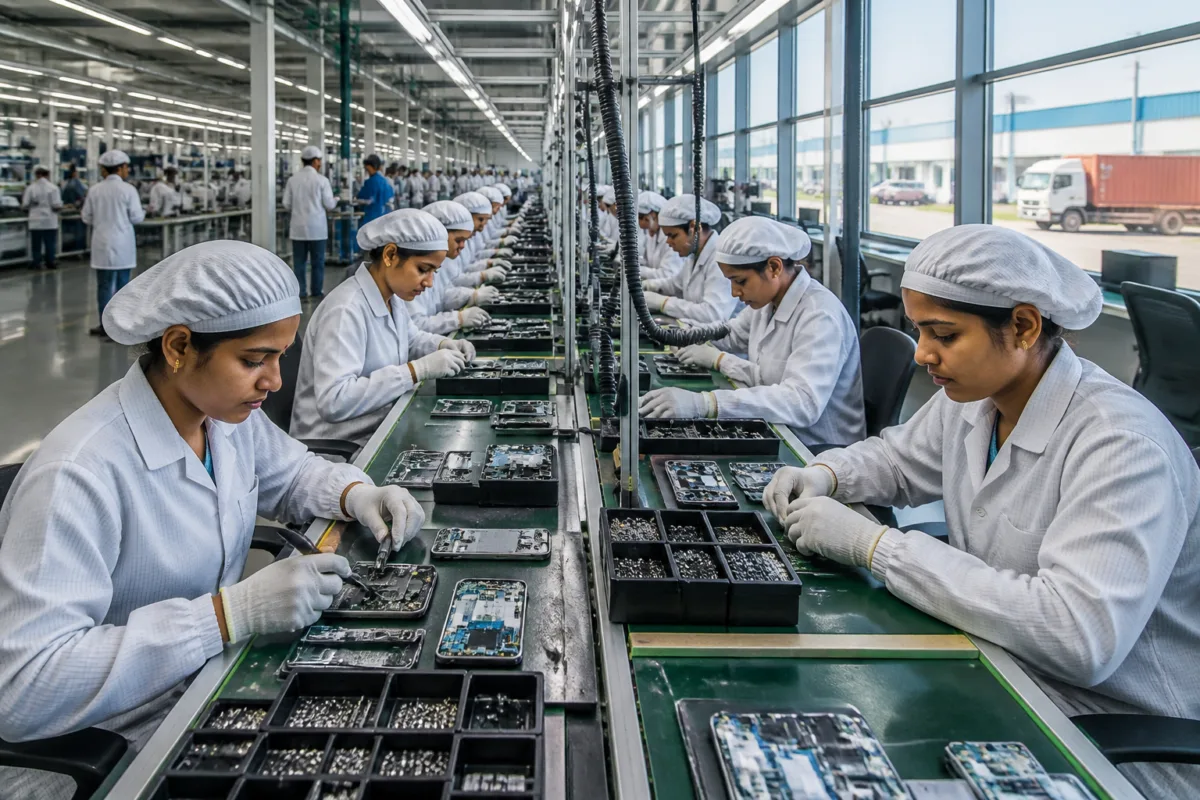
India’s mobile manufacturing story has moved beyond the question of whether phones are being made in the country. The more consequential question is how much of the value embedded in those phones is being created domestically. Government figures cited by Union Electronics and IT Minister Ashwini Vaishnaw show a sharp rise in production, exports, tax collection and employment under the Production Linked Incentive scheme. But the continued dependence on imported memory chips, processors, displays, camera components and batteries shows why factory output alone cannot establish that India has become a deep electronics manufacturing hub.
That distinction matters because the PLI scheme was designed to do more than increase the number of phones assembled on Indian soil. Its stated purpose is to make India more attractive for investment, expand production, generate jobs and build an export-oriented manufacturing base. The early evidence indicates that it has succeeded in changing the scale and geography of mobile production. The unresolved question is whether the next phase will create a wider ecosystem of component suppliers, design capabilities, engineering services and semiconductor-related skills.
### From import dependence to large-scale production
The change in India’s mobile market is substantial. According to government figures cited in the source report, around 75% of the country’s mobile phone demand was met through imports in 2014-15. By 2024-25, the import share had fallen to approximately 0.02%. Over the same period, domestic mobile phone production rose from about ₹18,000 crore to nearly ₹5.5 lakh crore.
The wider electronics sector expanded as well. Total electronics production increased from roughly ₹1.9 lakh crore in 2014-15 to ₹11.3 lakh crore in 2024-25, according to the figures reported by Aaj Tak Business. These numbers point to a transformation in manufacturing capacity and indicate that India is no longer relying primarily on imported finished phones to meet domestic demand.
The scale of the shift also changes the role of cities and industrial regions in the electronics economy. Large factories require land, power, water, logistics, worker housing, transport links and local services. The effect of a manufacturing policy is therefore not confined to the factory gate. Where production clusters expand, surrounding urban systems must absorb new workers, supplier networks and freight movement. The source material does not establish the precise local distribution of these effects, but the employment figures indicate that the manufacturing push has a sizeable labour-market dimension.
### What the PLI numbers actually show
The official figures cited in the report show rapid growth under the large-scale electronics manufacturing PLI scheme. Information provided in Parliament in July 2025 recorded ₹12,390 crore of investment, ₹8.44 lakh crore of production and ₹4.65 lakh crore of exports up to June 2025. Government figures for March 2026 put cumulative investment at ₹20,587 crore, production at ₹11.61 lakh crore and exports at ₹6.43 lakh crore.
These are cumulative figures for the scheme’s reported achievements, not annual results. That distinction is important when assessing performance. The numbers demonstrate that production and exports have expanded considerably, but they do not by themselves reveal the amount of domestic value added in each phone, the profitability of the supported firms, or how much activity would have occurred without the incentives.
Vaishnaw’s recent defence of the mobile manufacturing programme adds another set of figures. In a post on X dated 27 October, he said the government had provided ₹19,000 crore in incentives for mobile manufacturing. He compared that with ₹25,000 crore in direct tax collection and ₹3 lakh crore in GST collection, and said 12 lakh people were employed in mobile manufacturing within a broader electronics manufacturing workforce of 25 lakh.
Those figures make the government’s case that the scheme has generated benefits beyond factory output. Employment, tax collection and exports are relevant measures of industrial impact. However, tax collections cannot be treated as the net economic return on public support without a fuller accounting of the incentive cost, additional economic activity, imported inputs and the distribution of employment. The reported figures establish scale; they do not settle the question of overall policy efficiency.
### The iPhone effect and the supply-chain question
Apple’s expansion in India is the most visible symbol of the country’s manufacturing shift. The source report cites a recent Bloomberg report saying that roughly one in every four iPhones made globally is now produced in India. If sustained, that would place Indian factories within a global production network rather than limiting them to the domestic market.
Apple’s move is also linked to the wider China Plus One strategy, under which companies diversify production across more than one country to reduce dependence on a single manufacturing base. For India, participation in that strategy can bring investment, jobs, export opportunities and exposure to global production standards. It can also create demand for logistics, industrial services and component suppliers.
But a global production role is not automatically the same as domestic technological depth. The source report notes concerns over India’s reliance on imports for high-value parts including memory chips, processors, displays, camera lenses and batteries. If these components are manufactured elsewhere and merely incorporated into phones in India, a significant portion of the product’s value continues to accrue outside the country.
This is the central distinction between assembly capacity and a full manufacturing ecosystem. Assembly can still generate wages, local services, factory operations and some domestic sourcing. It can also provide a platform from which suppliers and engineers develop capabilities. But the economic gains are different when a country designs components, manufactures them, owns the relevant intellectual property and supplies equipment and engineering services.
### Why semiconductors are a harder step
The next stage of the electronics strategy is more demanding because semiconductor manufacturing requires specialised machinery, materials, technical expertise and dependable supply chains. Chips are essential to mobile phones, computers, vehicles and other electronic products, but establishing a chip industry involves more than constructing a plant.
The source material refers to arguments by Bloomberg columnist Andy Mukherjee that India should not focus only on expensive chip factories, but should also invest in engineering, design and other industries capable of generating employment. Supporters of domestic semiconductor capacity, meanwhile, argue that dependence on foreign technology and supply chains creates long-term vulnerability.
Both positions point to the same institutional challenge: manufacturing policy must connect factories to skills, research, design, equipment, local suppliers and technical services. A chip plant without a supporting ecosystem would not deliver the same industrial benefits as a broader electronics cluster. Conversely, design and engineering capabilities without sufficient production capacity could leave India dependent on overseas manufacturing for commercial scale.
The evidence supplied in the report does not establish how much progress has been made in each of these areas. It does show that the policy debate is moving from the first question—whether India can attract large factories—to the more difficult question of what capabilities those factories are building around them.
### From Make in India to Made in India
The PLI scheme represents the policy logic of Make in India: attract firms, lower the economic barriers to domestic production and create a large manufacturing base. The reported rise in output, exports and employment suggests that this approach has produced visible results in mobile phones.
Made in India, however, implies a deeper domestic contribution. It requires a greater share of components, design, engineering, technology and supply-chain activity to be located in India. That transition cannot be measured only by the value of finished phones leaving factories. It requires information on local sourcing, component production, domestic research and development, worker skills and the durability of supplier networks.
This is also where the urban and regional consequences become significant. Electronics manufacturing depends on industrial land, reliable utilities, freight connectivity and a workforce that can access employment at scale. If manufacturing clusters expand without corresponding housing, transport and civic services, the gains can be accompanied by pressure on local urban infrastructure. The supplied material does not provide city-level evidence on these outcomes, but the size of the reported workforce makes the connection impossible to ignore.
India’s mobile manufacturing programme has therefore achieved a meaningful first step: it has reduced dependence on imported finished phones and created a large export-oriented production base. The figures cited by the government also indicate substantial employment and tax activity. What remains unresolved is the composition of that growth—how much is assembly, how much is component manufacturing, and how much domestic design and technology capability is being created.
The next assessment of the PLI strategy will need to look beyond production and export totals. The decisive indicators will be the growth of Indian component suppliers, the depth of local engineering and design, the development of semiconductor-related capabilities, the quality and location of jobs, and the infrastructure supporting manufacturing clusters. India has demonstrated that it can make phones at scale. The larger test is whether it can increasingly make the technologies, components and industrial systems that make those phones valuable.

