


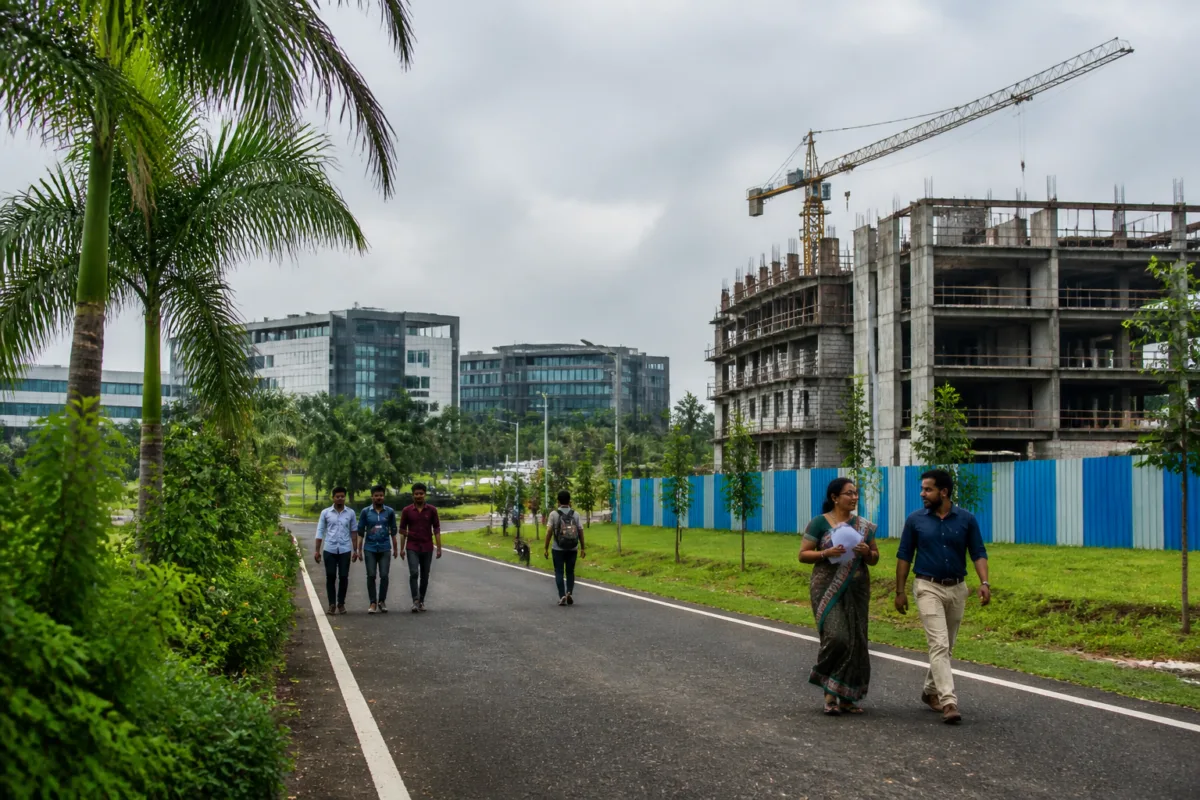
The approval of 14.06 acres at Infopark Phase 2 for a permanent IIM Kozhikode campus is more than a land-allotment decision. It places a major residential education institution inside one of Kochi’s established technology districts and creates a new test for how employment zones can evolve into wider knowledge and urban ecosystems. The campus is planned to accommodate around 1,000 students, along with faculty members, researchers and corporate executives, but its development still depends on a legally significant change in the status of the land.
A government order dated November 15 approved the lease of the site by the state IT department. The land is currently classified as part of a Special Economic Zone and is undergoing denotification to obtain non-SEZ status. The approval is therefore conditional rather than an immediate transfer of fully available land. The order says the government has sanctioned the proposal subject to completion of the denotification process, making the land-status conversion the first institutional step before construction can proceed.
This distinction matters because the proposal is not simply for another academic building. IIM Kozhikode has described the Infopark facility as a technology-enabled residential education and knowledge hub. The proposed infrastructure includes classrooms, residential quarters, auditoriums, conference centres, a library, research facilities, sports complexes and recreational open spaces. In planning terms, the proposal combines an educational campus, student housing, research functions and facilities for corporate engagement on one site.
The arrangement also gives Infopark a role beyond that of a conventional commercial technology park. The land will remain subject to conditions in the government order. Infopark’s chief executive officer has been directed to ensure that it is neither transferred nor sold. The lease must be registered within the legally prescribed timeframe and must include provisions to address any future change in the contracting entity. These conditions indicate that the state is treating the site as a controlled public asset, even while making it available for a new institutional use.
The proposed campus will add a second IIM Kozhikode presence in Kochi. The institute already operates an urban satellite campus near the Cusat Metro station. That facility was developed by Kochi Metro Rail Ltd as part of its non-fare revenue initiative and occupies about 40,000 square feet. It hosts the four-year Bachelor of Management Studies programme and executive postgraduate programmes, while also providing smart classrooms, a digital library, collaborative discussion spaces and hybrid-learning infrastructure.
The contrast between the two locations is central to understanding the institution’s expansion. The existing facility is an urban satellite campus built around access, shared infrastructure and public transport. The proposed Infopark campus is planned as a full-fledged residential institution with its own academic, accommodation and recreational facilities. Together, the two sites point to a differentiated campus model: one embedded in the metropolitan transport network and another designed as a larger, self-contained academic hub within a technology district.
That difference also raises an important land-use question. The government order does not establish whether the Infopark site will be connected to public transport through new services, pedestrian infrastructure or other mobility arrangements. The supplied information confirms the transit access of the existing satellite campus, but it does not provide a mobility plan for the proposed residential campus. As the site is developed, the relationship between the campus, Infopark’s existing workforce and surrounding transport systems will become an important implementation issue.
The campus proposal is also significant because it links higher education with the operational geography of the technology sector. IIM Kozhikode says the facility will accommodate students, faculty, researchers and corporate executives. Its planned conference centres, research facilities and corporate-oriented functions suggest that the campus is intended to support interaction between academic programmes and the surrounding business environment. The available information does not quantify the expected employment, investment or local economic impact, so those outcomes cannot yet be treated as established. What is clear is that the institution is planning a multi-user campus rather than a limited teaching centre.
The decision illustrates how institutional expansion can depend on administrative sequencing. The first stage is not construction but denotification. The second involves execution and registration of the lease. The third will be the physical development of the campus, which IIM Kozhikode’s director said it aims to open within three years. Each stage involves a different responsibility: the state must complete the land-status process, Infopark must comply with the lease conditions, and the institute must develop the proposed facilities.
This sequencing also limits what can be concluded from the approval. The government order establishes permission subject to a condition; it does not establish that construction has begun or that the campus will be operational within a fixed statutory deadline. The three-year opening target is an institutional objective stated by IIM Kozhikode director Prof Debashis Chatterjee. It is therefore a declared timeline, not yet evidence of completed project milestones.
The financial structure is similarly only partly visible in the available information. Prof Chatterjee said the institute was acquiring the land at a subsidised price and thanked the chief minister and industries minister for expediting cabinet approval. The supplied material does not specify the lease value, subsidy amount, construction budget, funding sources or cost-sharing arrangements. Those details will determine how the project is financed and how much of its planned infrastructure can be delivered, but they are not established in the government order as reported.
The land-use conditions nevertheless provide an institutional safeguard. Preventing transfer or sale reduces the possibility that the site will be diverted from its stated purpose. The requirement to register the lease within the prescribed period creates a formal compliance milestone. The provision for amendments if the contracting entity changes addresses a governance risk that can arise when public or institutional projects are reorganised. These clauses do not guarantee timely delivery, but they define some of the administrative controls attached to the allotment.
For Kochi, the proposal adds to an existing pattern in which educational infrastructure is being positioned within the metropolitan urban system rather than entirely outside it. The current IIM-K satellite campus near Cusat Metro station demonstrates one model, with Kochi Metro Rail Ltd using a station-linked facility to support education and generate non-fare revenue. The Infopark proposal represents another model, placing a residential campus within a technology-oriented district. The available evidence does not show whether the two campuses will share programmes, facilities or transport planning, so the functional relationship between them remains to be clarified.
The numerical scale of the proposal is modest compared with a conventional city district but substantial for an institutional campus. The site covers 14.06 acres and is intended to serve about 1,000 students, in addition to faculty, researchers and corporate executives. The proposed programme includes academic buildings, housing, research and event spaces, sports facilities and open areas. Its urban footprint will therefore be shaped not only by student capacity but also by the mix of residential, academic and corporate uses on the land.
The key question is whether the campus will operate as an isolated enclave or as part of Infopark’s wider urban ecosystem. The government order and institutional statement establish the intended use, but they do not yet provide details about site planning, access, construction phases, water and power demand, waste management, parking, public transport integration or public access to facilities. These are not minor design details for a residential knowledge hub; they will determine how the campus interacts with the technology park and the surrounding city.
The project therefore deserves to be followed through its next formal milestones rather than judged solely by the approval announcement. The immediate issue is completion of the SEZ denotification process. This must be followed by timely lease registration and the preparation of the campus for development. After that, the three-year opening target will need to be assessed against actual construction and institutional delivery milestones.
The approval confirms a new permanent IIM Kozhikode campus for Kochi and establishes the broad scale and proposed functions of the project. It also reveals the administrative conditions attached to using Infopark land for education. What remains uncertain is how the land conversion will be completed, how the project will be funded and delivered, and how the residential campus will connect with Kochi’s transport and technology infrastructure. Those details will determine whether the proposal becomes simply a new campus or a more integrated knowledge district within the city.

