


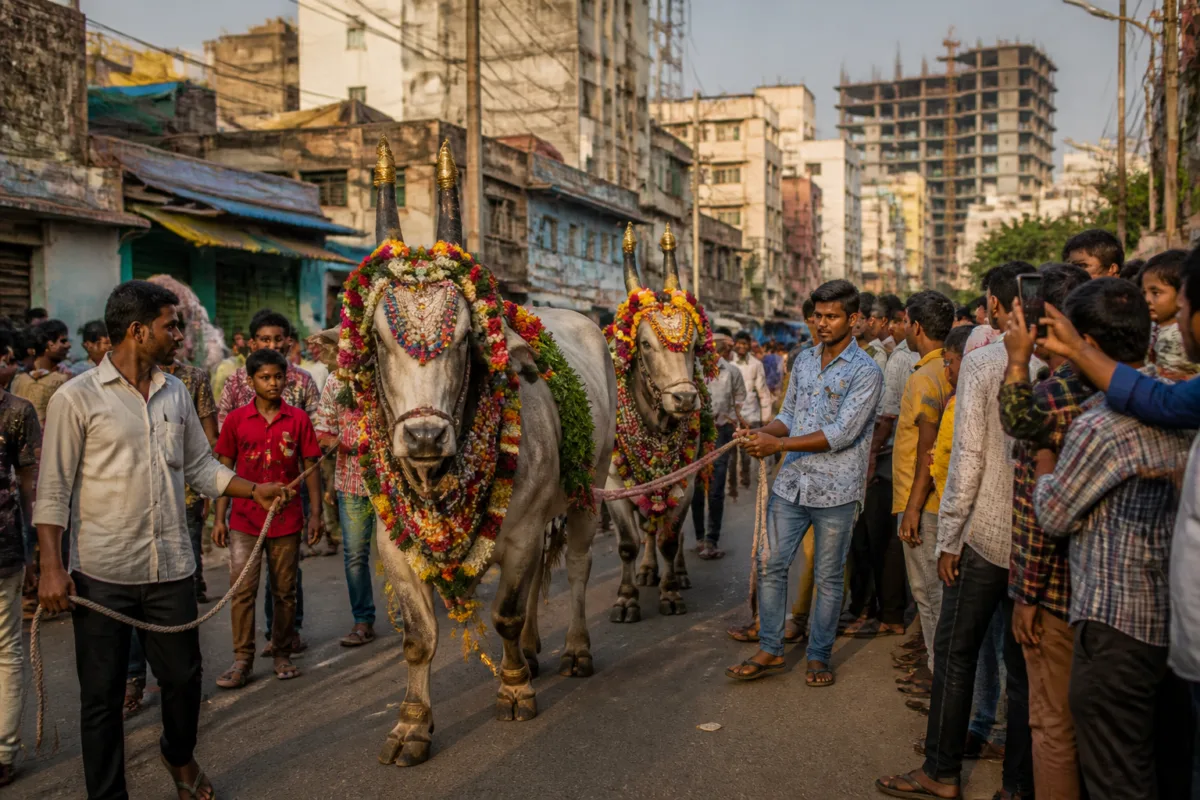
Hyderabad’s Sadar Utsav is being kept alive by a generation growing up in neighbourhoods where the dairies that once anchored community life are steadily disappearing. The celebrations across areas including Bolaram, Khairatabad and Gunfoundry were not only religious and cultural gatherings; they also revealed how urbanisation is changing the spaces, livelihoods and institutions through which a community remains connected.
The festival, also known as Dunnapothula Panduga, celebrates the cattle-rearing heritage of the Yadav community and its mythological association with Lord Krishna lifting Govardhan Hill. At Risala Bazaar in Bolaram, nearly 100 bulls were brought for the celebrations. Khairatabad hosted processions featuring decorated bulls, brass bands, banners and billboards naming organisers, while younger members revived the festival at Gunfoundry after a gap of nearly two decades.
Taken together, these events show a cultural practice adapting to a city that no longer offers the same physical or economic setting in which it developed. The festival continues, but the local dairy economy that gave it everyday relevance has weakened in some neighbourhoods. Ankit Yadav, who spoke about the revival at Gunfoundry, said the celebrations had been discontinued because urbanisation led to the disappearance of several dairies in the locality. “Many large dairies were replaced by high-rise buildings. The younger generation has now revived the Sadar Utsav in our area,” he said.
That account places the festival within a familiar pattern of urban change: land uses associated with older livelihoods give way to denser construction, while the social practices linked to those livelihoods are left to find new forms. The source does not establish how many dairies have disappeared across Hyderabad or quantify the scale of redevelopment. It does, however, provide a specific neighbourhood-level account of the change and identifies high-rise construction as the replacement for dairies in Gunfoundry.
The contrast between the festival’s history and the city’s physical transformation is particularly visible at Risala Bazaar. Organisers said the Sadar Utsav there is among the oldest in Hyderabad, with a history spanning nearly seven decades. Families from Hakeempet, Turkapally, Shamirpet, Lothkunta, Keesara, Bhudevi Nagar and surrounding areas participated. The event therefore operates across a network of neighbourhoods rather than within a single settlement, bringing together families whose connections extend beyond the immediate locality.
Organisers also said that the surrounding areas had around 60 dairies, and that participants brought bulls from their own farms rather than sourcing them from outside. This detail matters because it connects the public spectacle to an existing, if changing, production system. The bulls displayed during the festival were not presented simply as ceremonial objects; they were linked to farms and dairies that remain part of the community’s economic and social life.
At the same time, the source indicates that the relationship between cattle-rearing and the city is being mediated through new communication tools. Lamba Chandrakanth Yadav, Sharan Yadav, Kiran Yadav and Satyam Yadav said younger members had taken charge of the community association and introduced WhatsApp groups. These groups are used to share information about cattle rearing and emerging diseases, while older members contribute their experience in dealing with cattle illnesses.
This is more than a change in communication style. It shows how a community organisation is attempting to preserve practical knowledge while its traditional physical setting changes. Information that may once have travelled through direct contact among dairy-owning families can now be circulated across a wider network. The organisers also said periodic health camps are conducted, suggesting that the association performs functions related to animal care as well as cultural celebration.
The association’s role extends beyond cattle-related matters. According to the organisers, it provides financial assistance to families after a death and supports members seeking higher education. Those activities indicate that the organisation functions as a social support network, not merely as an event committee. The annual festival provides visibility to that network, while the less visible assistance offered during illness, bereavement or education reflects how community institutions can fill practical gaps in urban life.
The revival at Gunfoundry adds an intergenerational dimension. The festival had been discontinued there for nearly two decades, but younger community members brought it back with a procession of decorated bulls. The account suggests that the revival was not driven by an unchanged urban setting. It was a response to a changed one, in which the older relationship between dairies, neighbourhood identity and public celebration had weakened.
This distinction is important. Reviving a festival does not restore the land uses or livelihoods that once sustained it. A procession can recreate public visibility, but it cannot by itself bring back dairies replaced by high-rise buildings. The evidence supplied in the report does not show whether the revived celebration has resulted in new dairy activity, whether the participating farms are inside Hyderabad or in surrounding areas, or how residents and local authorities manage the presence of large animals during processions. Those remain questions beyond what the current account establishes.
The celebrations also show how public space is being used to negotiate continuity. At Khairatabad, decorated bulls moved through processions accompanied by brass bands, banners and organiser billboards. Such events temporarily turn streets and neighbourhood spaces into places of collective display. They make visible a community’s history at a time when the built environment is changing around it.
Yet the report does not describe the administrative arrangements behind the processions, including permissions, traffic management, animal welfare measures or sanitation provisions. Those details would be necessary to understand how traditional public events are accommodated within a dense and rapidly changing city. Their absence does not undermine the account of the celebrations, but it limits what can be concluded about the governance of these gatherings.
What the reported events do establish is a layered transition. Older members continue to transmit knowledge about cattle diseases and rearing. Younger members are using WhatsApp to coordinate communication and are reviving celebrations that had stopped. Families remain connected across Hyderabad and surrounding areas. At the same time, dairies have disappeared from at least some localities as high-rise buildings replaced them. Tradition is therefore not being preserved in a fixed environment; it is being reorganised around a different urban geography.
That geography has implications for how cities understand cultural infrastructure. Urban infrastructure is often associated with roads, public transport, water systems and buildings. But neighbourhood institutions, shared rituals and social support networks also depend on space and continuity. When a land use disappears, the impact may extend beyond employment or property value. It can alter how knowledge is transferred, where people meet and how communities represent themselves in public.
The Sadar Utsav account does not offer a citywide assessment of these changes, and it should not be read as proof that all Hyderabad communities are experiencing urbanisation in the same way. Its value lies in the concrete connection it draws between redevelopment and cultural interruption in Gunfoundry, and in the way it records adaptation elsewhere through social media, health camps and renewed participation by younger members.
For planners and municipal institutions, the episode raises a question about whether urban growth is being understood only through replacement of land uses or also through the social systems attached to them. The source does not identify any formal planning response to the loss of dairies or the revival of the festival. It shows instead that the community itself is carrying much of the work of adaptation through associations, family networks and digital communication.
The evidence confirms that Sadar Utsav remains an active public tradition in parts of Hyderabad and that its organisers are linking cultural activity with cattle-health information and welfare support. It also confirms that urbanisation has displaced dairies in at least one locality, contributing to a break in the festival’s continuity. What remains unclear is the wider scale of that transition, the future of cattle-rearing within the metropolitan area and the institutional arrangements that allow such processions to occupy increasingly dense urban neighbourhoods. Those are the developments that deserve closer attention as Hyderabad continues to grow.

