


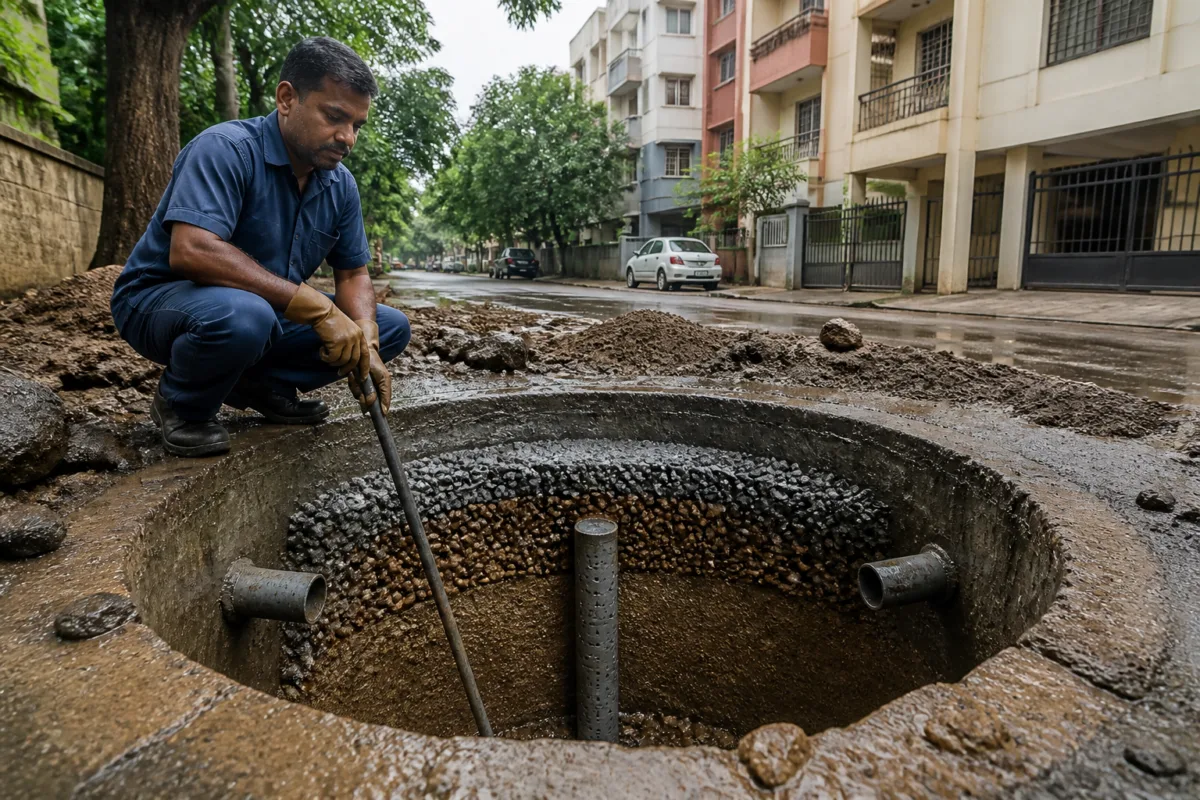
The Indian Green Building Council has urged the Hyderabad Metropolitan Water Supply and Sewerage Board to restore blocked rainwater-harvesting pits across the erstwhile GHMC area, linking poor maintenance of the structures to Hyderabad’s declining groundwater table.
The appeal was made at a roundtable meeting in Hyderabad on Friday, where IGBC national chairman C. Shekhar Reddy called for the water board to engage an empanelled agency to revive the defunct pits. He also proposed collaboration between HMWSSB and IGBC to secure a silver rating for the systems, with the stated objective of improving their efficiency and supporting groundwater recharge.
Rainwater-harvesting pits are intended to capture and allow rainwater to percolate into the ground, but IGBC said many installations across the former GHMC limits had become blocked because of inadequate maintenance. The organisation’s proposal places responsibility for restoration with the water utility while also suggesting a role for an empanelled agency in inspecting and improving the installations.
Reddy also urged the Telangana government to offer property-tax incentives to people who build rainwater-harvesting pits. He cited Rajasthan as an example of a state that provides such incentives. The proposal would connect rainwater management on private properties with municipal taxation, although the report did not specify the size, eligibility conditions or implementation mechanism for any proposed incentive in Telangana.
The meeting also discussed the use of updated technology in sewage treatment plants. Reddy asked the water board to adopt the latest technology in STPs, alongside measures to revive rainwater-harvesting infrastructure. The report did not provide details of a specific technology, investment requirement or implementation schedule.
IGBC presented figures from its certified green-building portfolio to illustrate the potential for water savings. It said 1,283 residential and commercial projects in Telangana, covering 164 million square feet of certified built-up area, were registered with the organisation. Of these, 541 projects had been certified and were saving 6.56 billion litres of water annually, according to the council.
Applying the water-saving intensity of that certified portfolio to Hyderabad’s building stock, IGBC estimated potential annual savings of between 16.98 billion and 18.62 billion litres. The estimate covered a residential portfolio of 296 million square feet and an office portfolio ranging from 129.1 million to 170 million square feet.
The broader Telangana figures cited at the meeting showed that the residential sector had 471.5 million square feet of registered built-up area, of which 35.54 million square feet was certified. Commercial properties accounted for 282.7 million square feet of registered area, with 91.88 million square feet certified.
IGBC also asked residential welfare associations to register with the council and adopt net-zero and green-building concepts. It proposed recognising people who plant saplings as “Green Volunteers” through IGBC Awards. IGBC executive director M Anand also addressed the meeting.
The immediate proposals place the condition and maintenance of existing rainwater-harvesting pits at the centre of Hyderabad’s groundwater response. The report did not state whether HMWSSB has accepted the request, identified the number of blocked pits or announced a timetable for restoration.

