


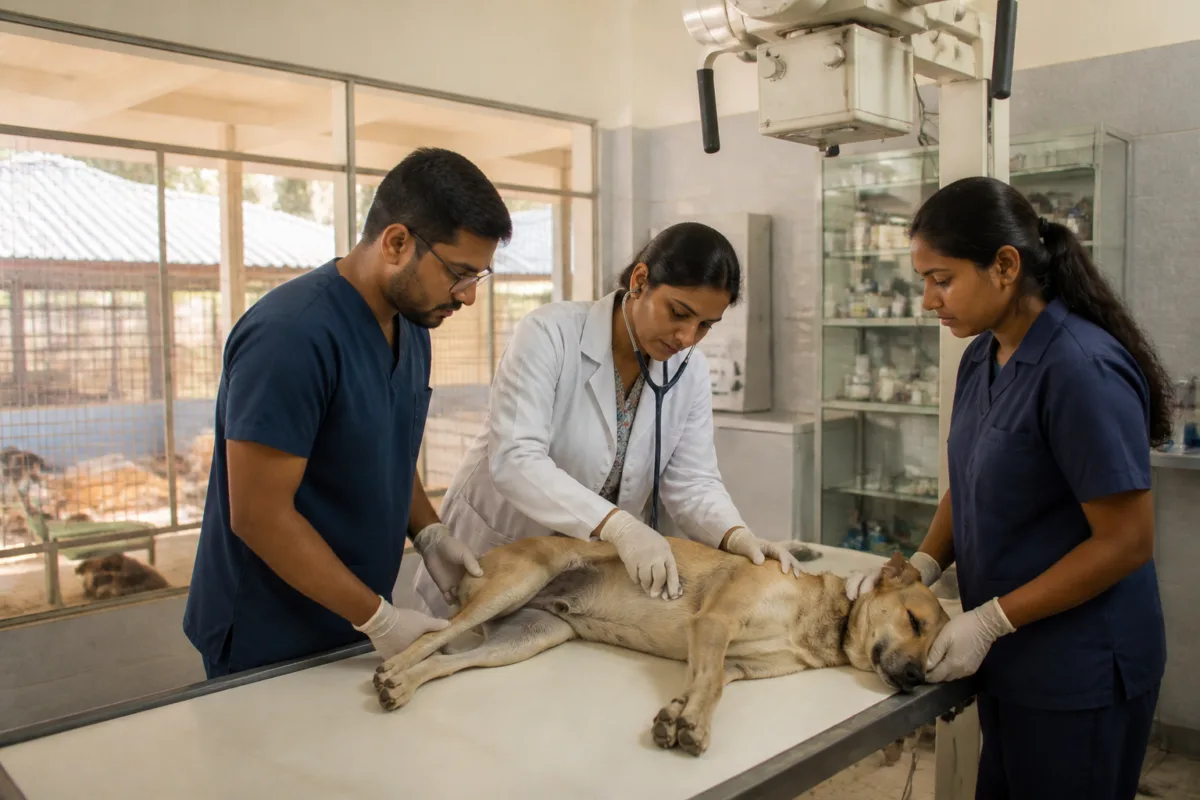
Stray animals needing emergency surgery or prolonged medical care will be able to access free treatment at a new multi-speciality animal hospital and shelter in Hyderabad’s Begum Bazaar from November 30, according to the Greater Hyderabad Society for Prevention of Cruelty to Animals (GHSPCA).
Located near Muslim Jung Bridge, the facility will operate round the clock throughout the year. GHSPCA says it can accommodate more than 100 animals and 150 birds, with separate shelters for different species. It will also include isolation wards for cases requiring quarantine and an in-house pharmacy.
The ₹3 crore project is intended to address the limits of existing rescue services in handling major trauma, orthopaedic injuries and cases requiring extended medical supervision. GHSPCA’s 2026 impact report also identifies the need for separate accommodation for wildlife cases that require quarantine.
The hospital will have an operating theatre for sterilisation procedures and major surgeries, a recovery room for post-operative monitoring, a mobile X-ray unit and laboratory services. A consultation room will allow pet owners from the community to seek care, although the facility’s free treatment programme is intended for stray animals.
Four veterinarians and eight paraveterinary personnel will provide medical care. Nine additional employees will manage administrative and support functions. GHSPCA coordinator Soudharm Bhandari said the organisation would rely on donations to operate the facility and described it as the first multi-speciality facility in South India to offer free treatment to strays, a claim not independently assessed in the report.
The organisation estimates monthly expenditure at ₹19 lakh. Medicines and rehabilitation are projected to cost ₹8 lakh a month, salaries ₹5 lakh, and administration and maintenance ₹6 lakh. This amounts to an estimated annual operating expenditure of ₹2.28 crore, compared with GHSPCA’s reported current annual expenditure of ₹30 lakh.
Of the capital cost, ₹1.8 crore has been allocated to construction and ₹1.2 crore to medical equipment. The facility’s operating model will therefore depend on sustaining donations at a scale substantially higher than the organisation’s existing annual expenditure.
GHSPCA, which was established in 2008, reports having rescued, rehabilitated and released more than 61,000 animals and birds. Its records include more than 33,655 mammals, over 21,400 birds and more than 6,272 reptiles. The organisation introduced a 24-hour animal ambulance service in 2019 and currently reports more than 50 emergency rescues each month.
The hospital adds a permanent treatment and shelter component to that rescue network. Its capacity, isolation wards and surgical facilities could reduce the need to manage serious cases through short-term rescue arrangements, while the donation-dependent model leaves long-term operating finances as a central operational challenge. GHSPCA says its work currently extends across 12 states with more than 100 active volunteers.

