


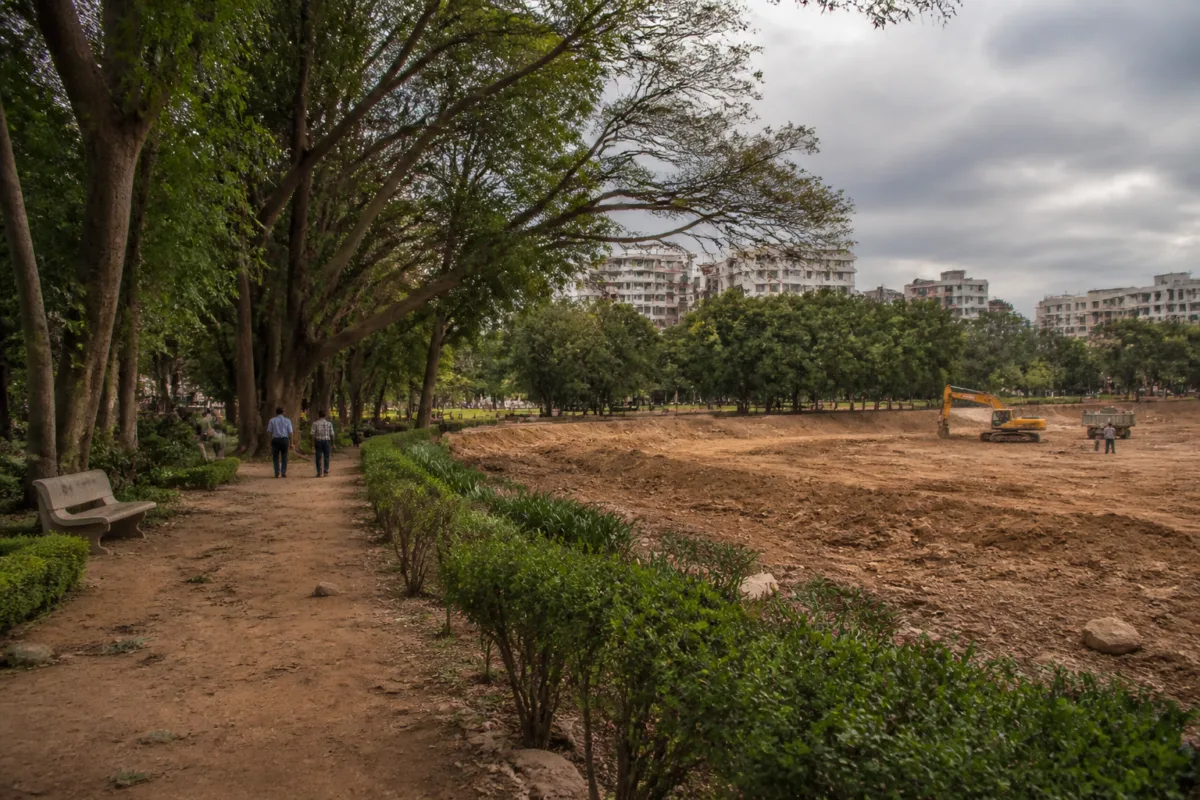
The expansion of a lake inside Hyderabad’s Krishna Kanth Park has turned a public green space into a test of how the city balances water infrastructure with ecological protection. A Rs 7.5-crore project is planned to enlarge the lake from three acres to 12 acres, while more than 200 trees inside the Yousufguda park are being removed or relocated.
According to Telangana Today, 30 trees have already been cut and the remaining 170 are to be translocated near Sunnam Cheruvu, where the Hyderabad Disaster Response and Asset Protection Agency (HYDRAA) is developing a new site. The GHMC Urban Biodiversity wing, or GHMC-UBD, told the publication that it had obtained permission from the Tree Protection Committee and enumerated the trees before work began.
The immediate dispute is therefore not simply about whether a lake should be expanded. It is about what happens when an existing urban ecosystem is treated as available land for a new public amenity, and whether the replacement measures can compensate for the environmental functions of mature trees and established foliage.
Krishna Kanth Park is described as one of Hyderabad’s largest and most popular parks. It is located in the city’s heart and is used by thousands of daily walkers, according to the report. The park’s dense vegetation had provided a green refuge within a heavily built-up area. The lake project now proposes to replace part of that landscape with a larger water body, upgraded walking paths, an open-air gym and boating facilities.
The project was launched by HYDRAA in October as a rejuvenation and expansion plan. The change in scale is substantial: the proposed lake would be four times the existing size, increasing from three acres to 12 acres. The source material does not provide a detailed project design, construction schedule, environmental assessment, water-quality plan or explanation of how the expanded lake will be maintained. Those omissions are important because the project’s public value will depend not only on the size of the water body but also on its long-term ecological and operational performance.
Urban lake projects often bring together several objectives that do not automatically reinforce one another. A larger lake can create a visible public amenity and may be intended to improve the appearance or recreational use of a park. Walking paths and an open-air gym can increase public access. Boating can add a new activity. But each of these interventions also changes the space’s physical functioning, including the amount of soil, shade and vegetation available within the park.
In this case, the reported tree removal makes that trade-off visible. The GHMC-UBD’s position, as cited by Telangana Today, is that the trees were enumerated and that permission was secured from the Tree Protection Committee. The reported plan is to relocate 170 trees near Sunnam Cheruvu. The source does not state the species, age, size or survival prospects of the trees, nor does it describe the conditions at the relocation site. Without those details, it is not possible to establish whether the relocation will preserve the ecological value that the trees currently provide at Krishna Kanth Park.
That distinction matters because tree relocation is not equivalent to retaining an established canopy in place. A mature park landscape consists of more than a count of individual trees. It includes shade patterns, undergrowth, soil conditions and the relationship between vegetation, paths and public use. The report records that much of the foliage has already been cleared and that the park now appears barren and dusty to walkers and environmental activists. This provides a ground-level indication of how the project is being experienced before the proposed lake and new amenities are complete.
The competing descriptions of the site reveal a familiar planning tension. For the project authorities, the park is a location for lake rejuvenation and expansion. For regular users and environmentalists, it is already a functioning urban ecosystem whose green cover has social and environmental value. Both perspectives concern public interest, but they measure that interest differently: one through the proposed infrastructure and amenities, the other through the existing landscape and daily experience.
The institutional structure also deserves attention. HYDRAA is identified as the agency that launched the Rs 7.5-crore plan, while GHMC-UBD is responsible for the tree-related work and the Tree Protection Committee is the authority cited for permission. This means the project involves separate responsibilities for the proposed lake intervention, urban biodiversity management and tree protection. The source does not identify the full approval chain or explain how the agencies assessed the cumulative effect of clearing vegetation for the lake expansion.
That administrative division can make accountability difficult for residents to follow. A park user may see one construction site, but the decisions behind it may involve a project agency, a municipal biodiversity wing and a tree-protection mechanism. The public record described in the report establishes that permission was obtained and trees were enumerated. It does not establish what alternatives were considered, how the final lake footprint was selected or what measurable conditions will determine whether the relocated trees survive.
The numbers supplied in the report show the scale of the intervention clearly. The lake is planned to expand by nine acres, from three acres to 12 acres. Of more than 200 trees identified inside the park, 30 have been cut and 170 are proposed for relocation. The project cost is Rs 7.5 crore. These figures describe a major physical reconfiguration of a public park, rather than a limited repair or maintenance exercise.
At the same time, the available evidence does not establish whether the expanded lake will improve water storage, address flooding, restore water quality or serve another defined urban-water function. The project is described as lake rejuvenation and expansion, but the supplied report does not state the lake’s current condition, its catchment, the source of water entering it or the expected operational benefits. Those facts are necessary to evaluate whether the ecological cost is proportionate to a clearly defined public need.
The same limitation applies to the proposed amenities. Upgraded walking paths, an open-air gym and boating facilities may broaden the park’s recreational use, but the article does not provide projected visitor numbers, maintenance arrangements, boating safety provisions or details of how these facilities will interact with the lake’s ecological management. Without such information, the project can be assessed only as a significant change in land use and public-space design, not as a completed success or failure.
For Hyderabad, the larger question is whether urban lake rejuvenation is being planned as an ecological intervention or primarily as a redevelopment opportunity around water. The distinction is consequential. If the objective is ecological restoration, the condition of the surrounding tree canopy, soil and habitat should be central to the project. If the objective is recreation, the city must still account for what is lost when an established green landscape is cleared to create new facilities.
The concerns raised by walkers and environmental activists do not by themselves prove that the project is unlawful or that the expanded lake will fail. The reported permission from the Tree Protection Committee is a material fact, as is the proposed relocation of 170 trees. But the public information supplied so far does not answer whether the replacement site can sustain the trees, how survival will be monitored or how the original park ecology will be protected during and after construction.
The evidence currently confirms a large lake expansion, extensive tree intervention and visible loss of foliage at Krishna Kanth Park. It also confirms that the project has been framed by authorities as rejuvenation and by affected users as an ecological loss. The next significant questions are whether HYDRAA and GHMC will publish the project design, tree inventory, relocation and survival plan, and the environmental and operational objectives for the enlarged lake. Until those details are available, the project’s promised public amenities can be described, but its ecological balance remains unestablished.

